

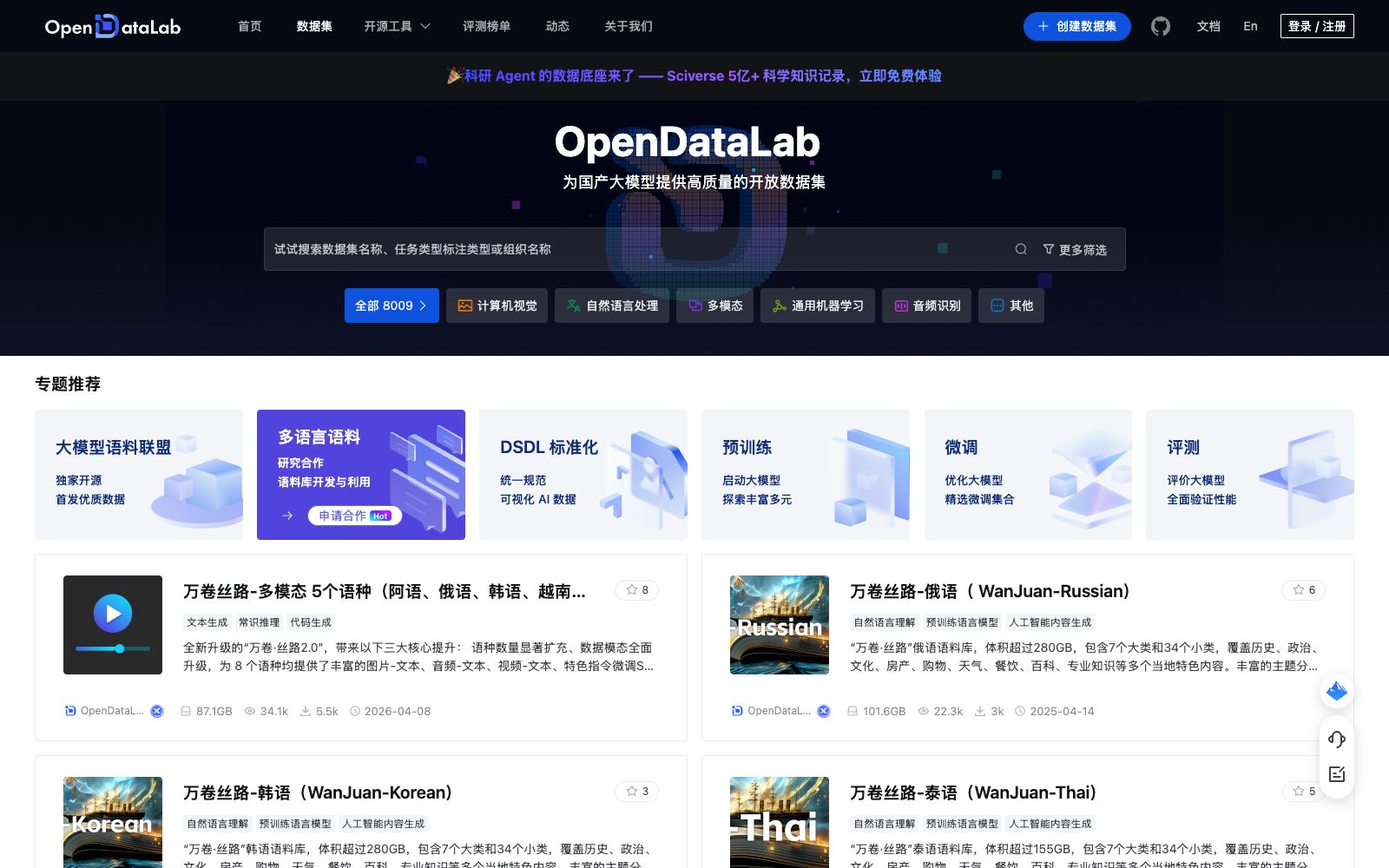

OpenDataLab
The open data platform launched by the Shanghai Artificial Intelligence Laboratory is officially said to provide high-quality open-source datasets for domestic large models, support dataset retrieval and download, and be equipped with data annotation and governance tools as well as open-source community capabilities.
Updated: 2026-10-30
What is OpenDataLab?
OpenDataLab is officially positioned as "providing high-quality open datasets for domestic large models" and is launched by the Shanghai AI Laboratory. It addresses the most resource-intensive link in model training: where datasets come from, their quality, and how to annotate and govern them. The platform integrates dataset retrieval, download and supporting tools, organizes content around the open-source community, and provides researchers with reusable data foundations.
Who is it for?
- Large model training teams: Looking for Chinese datasets that can be directly used or secondarily processed.
- Universities and research groups: Use public datasets to conduct reproducible comparative experiments.
- Project teams that need to perform data annotation: Refer to its annotation toolchain to build their own annotation workflows.
- Data engineering practitioners: Understand the methods of dataset governance and quality control. The official states that the goal is to provide researchers with a reusable data foundation.
- Dataset Contributors: Publish the sorted datasets on the platform to get usage feedback. The official states that the platform addresses the most resource-intensive part of model training: where datasets come from, their quality, and how to annotate and govern them.
Key features
6Open Datasets
The official statement indicates that it provides high-quality open datasets for domestic large models, covering multiple modalities and task types.
Dataset Retrieval
The official provides dataset access and retrieval capabilities, making it easy to find available data by task and modality.
Data Annotation Tools
The platform is equipped with a supporting annotation toolchain for processing raw data into trainable datasets.
Data Governance
Provide supporting capabilities around data quality verification and post-structural processing to improve data availability.
Open-source Community
The official organizes data contributions and exchanges in the form of an open-source community to expand the coverage of datasets. The official states that the platform integrates dataset retrieval, download and supporting tools, and organizes content around the open-source community.
Multimodal Coverage
The dataset types cover common modalities such as text and images, meeting the needs of different training tasks. The official states that the platform is launched by the Shanghai AI Laboratory and positioned to provide high-quality open datasets for domestic large models.
How to use OpenDataLab
- Before downloading, confirm the license agreement of each dataset one by one, as the commercial use and redistribution conditions of different datasets vary greatly.
- Pay attention to the collection time and domain distribution of the dataset, and conduct sampling checks before training to avoid domain shift.
- For datasets involving personal information or copyrighted content, confirm their compliant sources and use them cautiously for commercial model training.
- When building your own annotation process, start with a small-batch trial annotation, and unify the annotation specifications before scaling up.
- Establish version and source records for the dataset to ensure the reproducibility of experimental conclusions.
- In addition, such infrastructure- and community-oriented tools often reveal their value only after being used for a period of time: spending a little more time familiarizing yourself with their data structures and interface conventions in the early stage will significantly reduce the cost of integrating them into your own workflows later on.
Traffic & popularity
Data month Sep 2026
OpenDataLab receives about 29.6K visits per month and ranks #963,312 worldwide.
Monthly visits
12 monthsTraffic sources
- Search43.6%
- Direct34.7%
- Referrals17.6%
- AI assistants1.9%
- Social1.6%
- Other0.6%
Top countries
- China53.0%
- United States10.2%
- Hong Kong, China5.9%
- Taiwan, China4.1%
- South Korea2.7%
Estimated from third-party traffic data.
Similar tools
 RoboflowA computer vision platform for developers and enterprises, covering data management, annotation, training to cloud and edge deployment. The official claims that over 1 million engineers are using it, and it is equipped with open-source libraries such as Inference and supervision.
 Biaobei TechnologyBabel Technology is an AI data infrastructure service provider. Centering on scenarios such as speech, vision, text and large models, it offers end-to-end services from data collection and annotation to dataset delivery, and possesses speech model capabilities such as ASR, TTS and voice cloning.
 Lightning AIAn AI cloud platform built by the original team of PyTorch Lightning. The official website provides on-demand GPUs, clusters and coding agents, covering the entire process from dataset construction to training and inference, targeting teams that develop dedicated models independently.
 MercorA human resource data platform for the AI field, its official website states that it has built a network of professionals such as doctors, lawyers, and engineers, providing data annotation, model evaluation datasets, human evaluation and agent training services for cutting-edge laboratories and enterprises.
 Hugging FaceThe world's leading open-source AI community, hosting over 2 million models, datasets and Spaces applications, providing inference services, cloud computing power and team enterprise editions, supporting the entire process of model selection, trial, fine-tuning and deployment.
 PaperspaceThe cloud GPU platform under DigitalOcean offers GPU computing power and hosts such as H100, covering the entire process from model development, training to deployment, and also provides cloud desktops and rendering workflows.