

Open Notebook
An open-source, privately deployable AI research note-taking tool positioned as "Taking Control of Research Privately". It offers AI note-taking, podcast generation, and privacy control, and is regarded as a self-hosted alternative to NotebookLM.
Updated: 2026-10-26
What is Open Notebook?
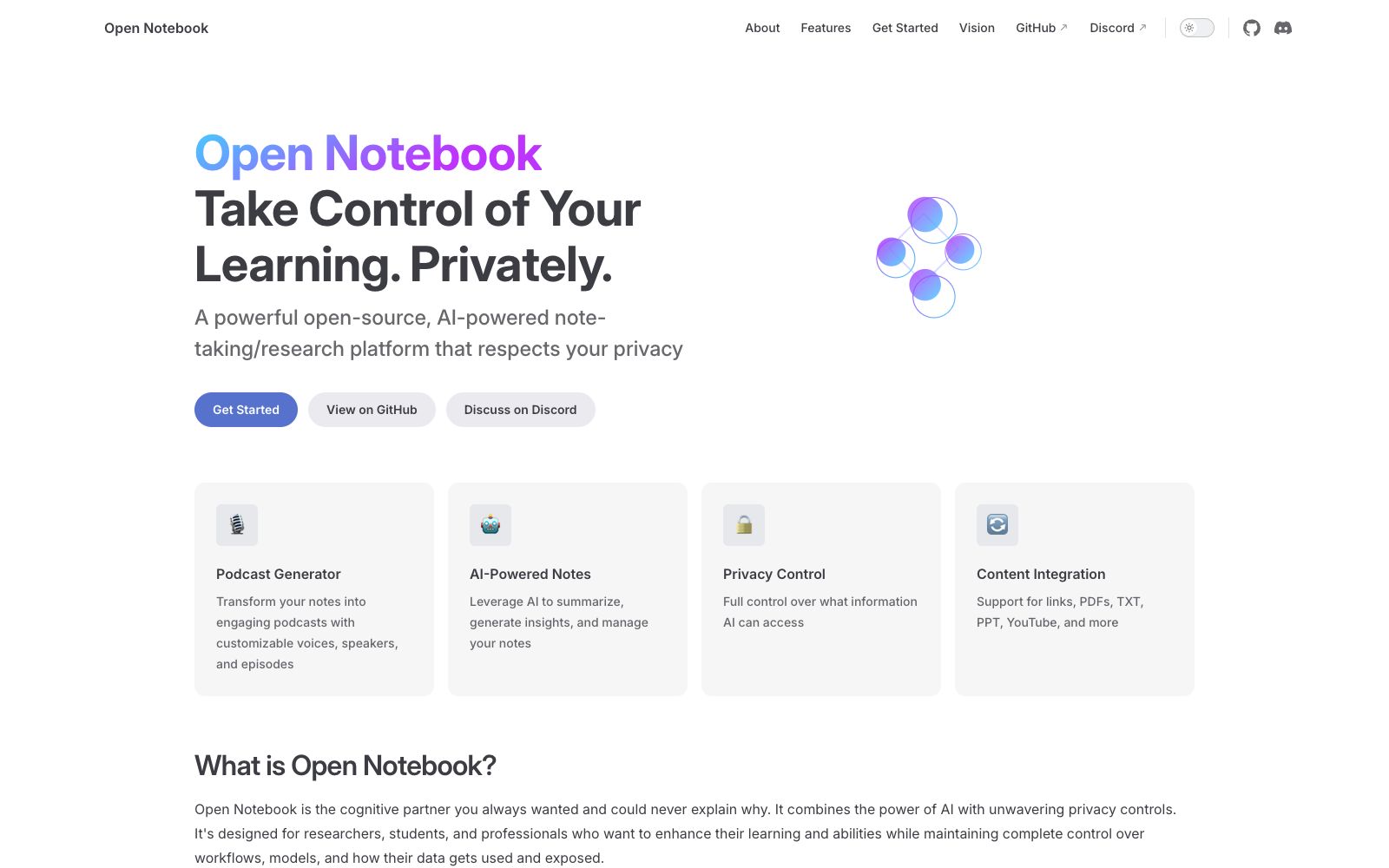
Open Notebook is an open-source research note-taking tool officially positioned as "Take Control of Your Research, Privately," and is often regarded as a self-hostable alternative to NotebookLM. The official homepage guides visitors with "What is Open Notebook" and "Is it for me?" with a tone more like a community project for early users than a mature commercial product. It describes its target users as "learning enthusiasts" and "independent thinkers" — those with too much learning backlog and wanting an AI study companion, those who value privacy and hope to do things their own way, who place "working in your own way" and "controlling data" ahead of features. In addition to AI note-taking capabilities, it offers a podcast generator — converting notes into podcasts with customizable timbres, speakers, and episodes, making it easy to digest research content by listening. For those who are tired of handing over research data to cloud-based products, "controlling your own data" is reason enough to choose it; the project also explicitly welcomes community contributions, and its roadmap is shaped by users together.
Who is it for?
- Researchers and technical users who value data privacy and want to build their own research note-taking systems; research groups within research institutions that require on-premises deployment and cannot transfer data to the cloud; learners who have accumulated too much learning material and want AI assistance to organize it; as well as people who prefer converting content into podcasts and digesting it by listening during fragmented time like commutes. It also includes privacy-sensitive users who wish to use the tool completely offline without relying on external model APIs — as long as the local hardware can support it, research materials can be kept within the user's own environment.
Key features
5AI Notes
Note-taking and knowledge organization for research scenarios, centralizing materials from multiple sources in one place.
Podcast Generator
Officially, it can convert notes into podcasts, with customizable timbres, speakers, and episode numbers.
Privacy Control
The official emphasizes that you retain full control over your data and supports private deployment, which is its core selling point differentiating it from cloud-based products.
Content Integration
Integrate materials from different sources into the same research space and reduce frequent switching.
Open Source & Community
The code is open source, allowing you to deploy it on your own, participate in testing, contribute code, and share research results.
How to use Open Notebook
- Before deployment, first check the deployment instructions and resource requirements in the repository and conduct a small-scale trial.
- organize and standardize the note structure (with clear titles and chapters) – the podcast generation and retrieval effects will be significantly better.
- Separate public materials from sensitive data, and using relatively complete chapters for podcast generation will yield better results.
- Participating in the community (reporting bugs, submitting feature requests, sharing research usage) is the most direct way to understand the project roadmap.
- First run a minimal instance in a container to verify feasibility, then decide how much machine resources to invest.
Things to know
Traffic & popularity
Data month Sep 2026
Open Notebook receives about 46.0K visits per month and ranks #974,461 worldwide.
Monthly visits
12 monthsTraffic sources
- Search57.9%
- Direct29.0%
- Referrals10.6%
- Social1.3%
- AI assistants0.6%
- Other0.6%
Top countries
- United States11.2%
- India6.1%
- Italy3.3%
- Canada3.1%
- United Kingdom3.0%
Estimated from third-party traffic data.
Similar tools
 MemAn AI Agent-centric note-taking workspace allows you to effortlessly take notes, record meetings, jot down ideas and conduct research, while automatically organizing them into lasting memories. The AI Agent understands task objectives and takes timely initiative to advance progress, making it ideal for those juggling multiple projects simultaneously.
 Refact.aiOpen-source self-hostable AI coding agent that covers end-to-end task execution, in-IDE dialogue and real-time completion. Officially claims to support more than 25 programming languages and local deployment.
 geneiAn AI tool for research and writing, which uses self-developed algorithms to automatically summarize literature, analyze research and locate key information, helps produce blogs, articles and reports faster, and offers a 14-day free trial.
 SurfThe AI smart notebook produced by Deta integrates web pages, videos and PDFs into the same stream of thinking. It can automatically generate personal notes and code-free interactive charts. Data is stored locally, and the core code is open source.
 PandaWikiPandaWiki is a knowledge base construction system launched by Changting Baizhiyun. With the help of large models, it provides AI creation, AI question answering and AI search. It can quickly build product documents, FAQs and blogs, and supports open source and multi-model access.
 CraftA cross-device note-taking and document productivity app that integrates documents, tasks, calendars, and whiteboards. The official version states that the basic version is available for free and supports MCP and API connections, making it suitable for individuals and teams to record ideas.