

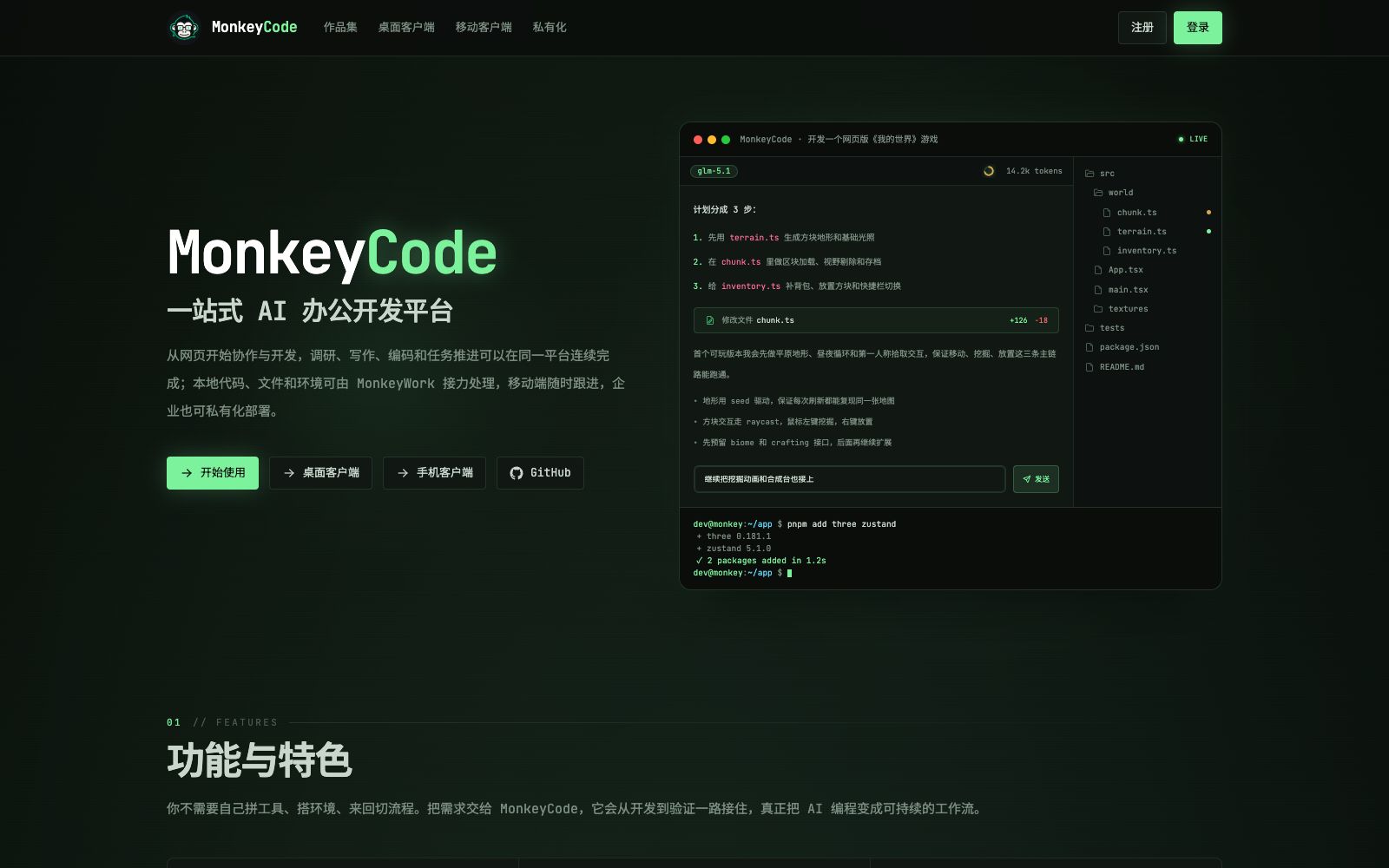
MonkeyCode
Online AI programming platform, officially available for free use with unlimited quota. It comes with a cloud development environment and terminal, file management, and port preview, and links projects, requirements, and Git Review in the same workflow.
Updated: 2026-10-26
What is MonkeyCode?
MonkeyCode is an online AI programming platform launched by Changan Technology (Beijing Changan Technology Co., Ltd.). The copyright ownership is indicated in the footer of its official website, and a "Changan Baizhi Cloud Login" entry is provided during login. It positions itself not as a plug-in but as a platform, with the official statement being "Not an AI programming tool, but a revolution to traditional R&D models". Its core propositions focus on three points: free use with unlimited quota, built-in cloud development environment, support for mainstream large models, and retention of open-source and private deployment directions.
Who is it for?
- Developers who want to validate their ideas without setting up a local environment: Create tasks directly and run them in the cloud environment.
- R&D teams that need to integrate AI coding back into the PR collaboration workflow: Use automated Review bots to monitor merge requests.
- Teams with data boundary or privatization requirements: The official retains the direction of open-source repositories and offline deployment, and provides host binding for team spaces.
- R&D managers who want to centrally manage multiple projects: Use the project-requirement-task hierarchy to accumulate process materials.
Key features
6Online Task Execution
The official states that you can start by entering requirements, with "no need to first prepare an environment, install tools, or connect to a local engineering machine on your own computer". Coding, terminal operations, file modification, and Git collaboration are all integrated into a single online workspace.
Cloud Development Environment
Tasks run in the development environment provided by the platform. The official lists terminal, file management, code preview and port preview functions. Access to ports is only allowed after whitelisting IPs are configured.
Project and Requirement Management
It provides a three-level structure of projects, requirements, and tasks. As described by the official, users first "initiate design tasks" to generate technical solutions, then "start development tasks" to produce code, and tasks can be associated with repositories and branches.
Code Review
You can create a review bot, configure the Webhook address and Secret Token in the repository. The official instructions state that "when a new Pull Request or Merge Request is submitted, MonkeyCode will automatically start the Review task".
MCP and Model Access
You can manage MCP servers and their tool capabilities, as well as bind your own large models (fill in the model API address, API Token, context length, etc.). The official note states that built-in models can only be used on the built-in host machine.
Notifications & Collaboration
Message notifications support DingTalk, Lark, WeChat Work bots and Webhooks, and task notifications can also be received via the WeChat Official Account; there is also a Developer Plaza for publishing articles or sharing executed tasks.
How to use MonkeyCode
- For first-time use, create a project first and bind the Git repository and identity credentials, then create requirements and follow the workflow from "design task to development task", which is easier for review than starting a conversation directly.
- The official note states that "tasks will be automatically recycled if there is no conversation for three consecutive days".
- for long tasks, it is recommended to first save the key outputs to the repository or download them locally.
- In terms of quotas, the official provides membership tiers and daily Token quotas (Basic, Professional, and Flagship are approximately 10M, 100M, and 300M Tokens per day respectively).
- If you run out of tokens, you can enable "continue usage with points consumption".
- the rules for check-in and invitation rewards shall prevail based on the in-site page.
- For the built-in model, you need to fill in the API address and Token.
- The official reminder states that if the model list cannot be pulled, you should manually fill in the model name according to the service provider's documentation.
- Automatic Review will be written to the warehouse Webhook.
- before integration, verify the permission scope in a test warehouse.
- Git identity credentials involve commit permissions, and it is recommended to use tokens with the least privileges.
Traffic & popularity
Data month Sep 2026
MonkeyCode receives about 563.6K visits per month and ranks #77,768 worldwide.
Monthly visits
12 monthsTraffic sources
- Direct54.4%
- Referrals24.1%
- Search17.6%
- Social3.1%
- AI assistants0.8%
Top countries
- China82.6%
- India5.0%
- Taiwan, China4.4%
- Hong Kong, China1.7%
- Brazil1.4%
Estimated from third-party traffic data.
Similar tools
 CodeGPTCodeGPT is an AI programming agent embedded in mainstream development environments. It supports integrating multiple models with its own API Key. It first reads the code, provides modifiable solutions, and then takes action, making it suitable for teams that value data controllability.
 MacroscopeAn AI code review tool for R&D teams that checks the correctness, security, testing and regression risks of each change before merging, automatically generates PR descriptions and summarizes multi-repository changes, and also includes a cloud-based coding Agent.
 Project IDXProject IDX was once Google's web-based full-stack development workspace. Officially, it was said to have built-in Gemini and cloud emulator previews. Currently, it is being integrated into Firebase Studio, and the workspace will continue.
 Maiya AIA one-stop AI collaborative development platform for product and R&D teams, officially covering four stages: requirement prototyping, professional documentation, code development, and testing and delivery. It offers AI prototyping, AI documentation writing, AI code writing, and AI automated testing.
 boatThe official website states that Boat is a persistent Linux cloud sandbox for AI agents, offering SSH, Docker, virtual desktops, snapshot forking, and external agent calls. It charges by the second and does not count downtime, making it suitable for batch execution of coding, testing, and browser tasks.
 OpenHandsOpenHands is an open-source cloud-based coding intelligent agent platform. It is model-agnostic, can automatically turn engineering requests into deployable changes, and integrates with Slack, GitHub, and Jira to handle reviews, triage, and security scanning.