


OpenComputer
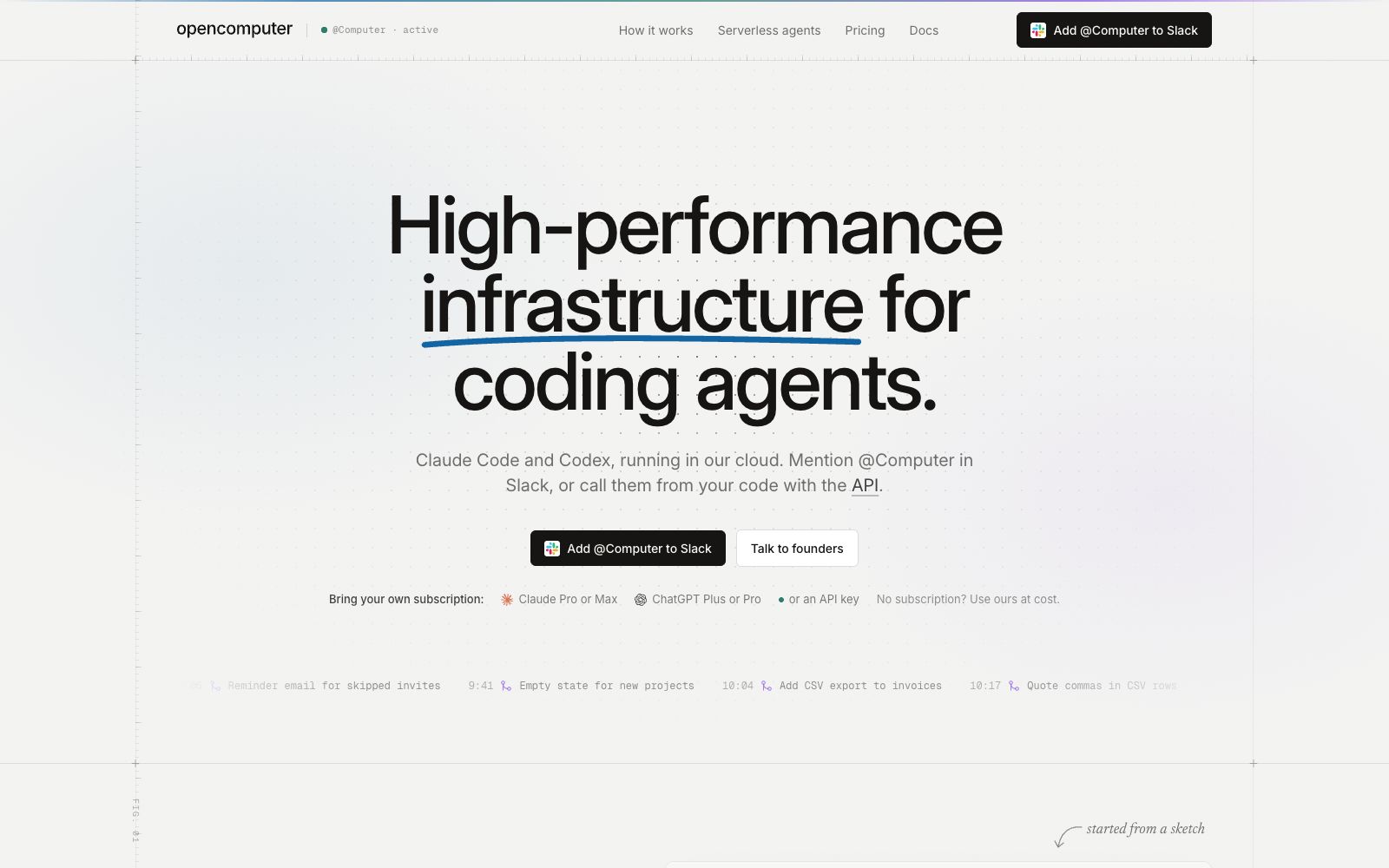
OpenComputer is a high-performance infrastructure for coding agents as described on the official website: the agents run on its cloud and can be mentioned in chat tools or called via APIs; the official website states that responses are returned in a streaming manner, the reading, writing and execution processes are visible, and interface changes come with screenshots and previews.
Updated: 2026-10-27
What is OpenComputer?
The positioning of the official website homepage of OpenComputer is a high-performance infrastructure for coding agents. It places common coding agents in its own cloud, and users can directly mention the robot in team chats or call it from code through APIs; the official website states that users can bring their own subscriptions and API keys, or use the models provided by the platform at cost when there is no subscription. The focus of the page is not on the chat itself, but on the visible process of the agents performing engineering tasks: reading files, executing commands, splitting tasks, submitting changes and running checks.
Who is it for?
- Engineering teams that already use chat tools in daily collaboration and want to directly attach coding tasks to channels.
- Product teams that want multiple members to observe, ask questions about, and take over the output of the intelligent agents at the same time.
- Development teams that need to provide warm-start repositories, dependencies, and build caches for the intelligent agents.
- Developers who want to deploy their own built agents as schedulable and HTTP-callable services.
Key features
6Initiate engineering tasks within chat
The official website states that you can assign tasks by mentioning the robot in a channel, and replies will stream out as they are generated, showing every file it opens and every command it runs.
Cautious Strategy for Codebases
The official description states that it only makes small changes required by the task, follows the existing patterns, naming conventions and dependencies of the repository, does not proactively introduce new dependencies, and hands over the work to humans for review and merging upon completion.
Self-Check and Preview
The official website states that it checks its own diffs and also checks whether human diffs will be damaged by input; interface changes come with screenshots and preview links.
Multi-person Collaboration
The official description states that everyone in the same thread can view the work process and continue to provide directions, and the conventions explained by one person will be applied to the requests of others afterwards.
Priced by working minutes
The official website states that timing starts from when the robot receives the message until the reply is sent, including reading code, running commands, building and testing; waiting for human review is not charged.
Build Your Own Agent
The official website states that you can write an agent using TypeScript functions and deploy it with a single command, then call it from the product according to a plan or via HTTP, and the key will not enter the runtime.
How to use OpenComputer
- First test on low-risk branches, observe task splitting, file reading, diff scope and check results, then integrate into daily workflows.
- Clarify the repository conventions so that the agent follows existing patterns and dependencies, reducing one-time large changes or additional library introductions.
- Keep high-risk changes under manual review, and focus on verifying whether the self-checked diff and input corruption testing mentioned on the official website cover real edge cases.
- Pricing is calculated cumulatively by working minutes, with concurrent threads timed separately.
- first estimate the team's daily task volume, then select a package or top up the quota.
- When using the API form, place the API key in the position recommended by the platform and confirm whether the fact that the key does not enter the runtime as stated on the official website meets your own security boundary.
Traffic & popularity
Data month Sep 2026
OpenComputer receives about 1.6K visits per month and ranks #10,026,636 worldwide.
Monthly visits
10 monthsTraffic sources
- Direct41.4%
- Social35.8%
- Search13.6%
- Referrals7.5%
- AI assistants0.9%
- Other0.7%
Top countries
- United States91.7%
- Turkey8.3%
Estimated from third-party traffic data.
In these collections
Similar tools
 T3 CodeT3 Code is an open-source control plane for coding agents that schedules multiple mainstream coding agents in a single interface. According to its official website, it comes with built-in subscriptions, enabling one-click commit, push and PR creation, and is available on both desktop and mobile platforms.
 QodoAn AI platform for code review provides cross-repository context and more than 15 agent workflows, covers IDE, PR and security scenarios, and transforms team specifications into executable governance rules.
 AmpCoding agents and development environments for cutting-edge models run each task in an isolated runtime environment. The agents can continue working even after you close your laptop, and they support three usage methods: desktop, web, and command line.
 BitoThe model routing and code context layer for coding agents, officially stated that existing tools can be connected by changing just one Base URL, routing each request to a more suitable model, and the official announced task cost reduction of about half in customer A/B tests.
 TraycerA specification-first workspace for agent-oriented coding, it brings agents, memory, conversations and products into the same space. Officially, it supports built-in subscriptions, multi-model context sharing and team collaboration, and is available as desktop apps for macOS and Windows.
 MonkeyCodeOnline AI programming platform, officially available for free use with unlimited quota. It comes with a cloud development environment and terminal, file management, and port preview, and links projects, requirements, and Git Review in the same workflow.