


Manifest
Open-source LLM router and gateway that uses a single OpenAI-compatible endpoint to access subscription-based, pay-as-you-go, local models and custom providers, automatically fixes erroneous requests, and switches to backup models in case of failures.
Updated: 2026-10-26
What is Manifest?
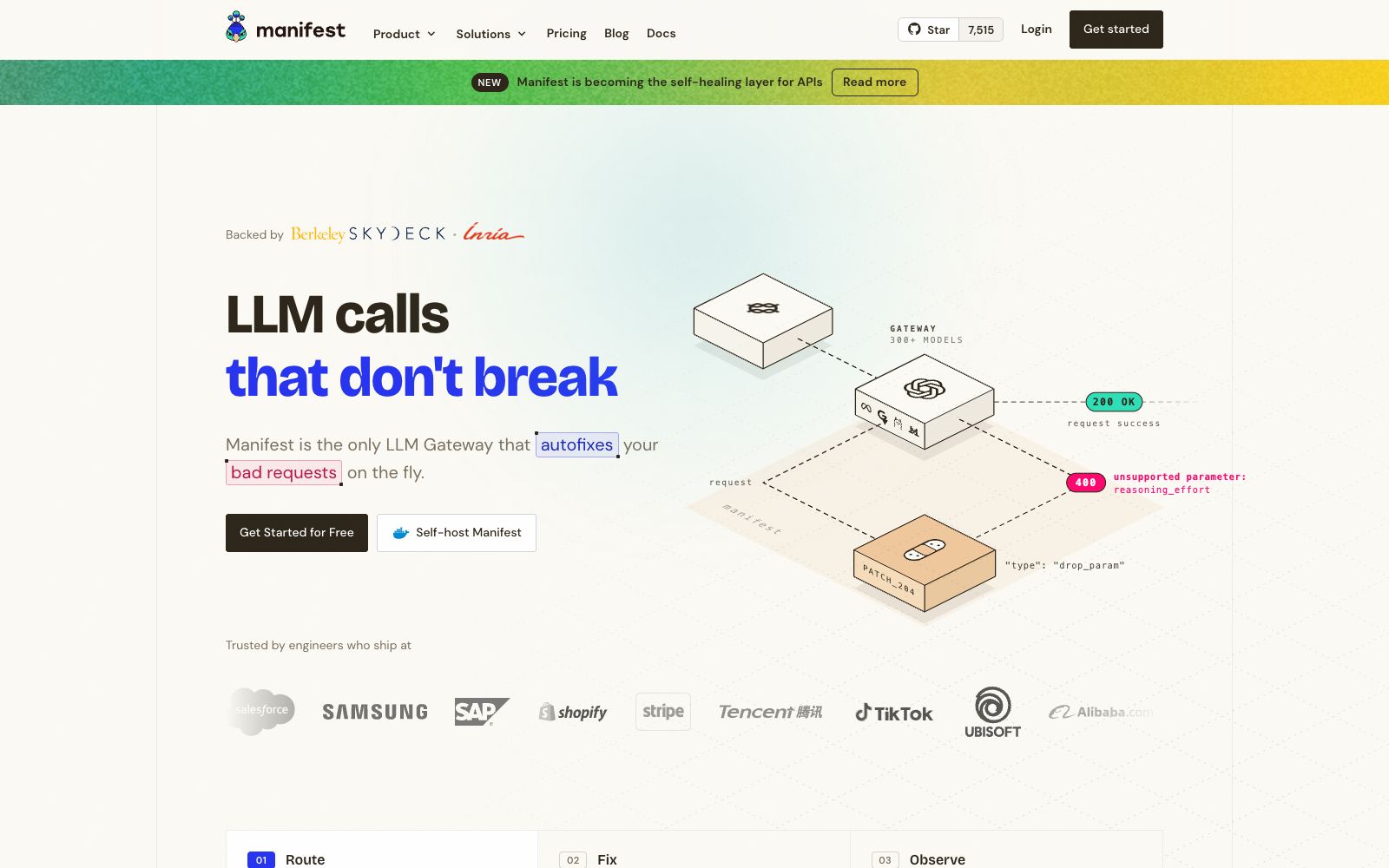
Manifest's entry point is a frequently overlooked number: about 5% of LLM API calls in production environments fail, and most of these failures could have been avoided. It claims to be "the only LLM Gateway that autofixes your bad requests on the fly" and has a straightforward goal—"LLM calls that don't break." With a single OpenAI-compatible endpoint, users can access subscription-based, pay-as-you-go, on-premises models and custom providers. The official statement says it can connect AI agents to any provider with various frameworks in just a few seconds, and supports free migration to self-hosting at any time after starting for free. Designed for AI builders, startup teams, and platform users, it is fully open for collaboration on GitHub.
Who is it for?
- Engineering teams that integrate with multiple model vendors at the same time and are troubled by occasional failure rates and opaque billing; developers who need to flexibly switch between local models and cloud models; and teams building AI products, platforms and vendor services (the official categories of AI builders, Teams & startups, Platforms & providers). For budget-sensitive scenarios, you can first use the free tier to run real traffic, accumulate cost data, and then decide the investment method.
Key features
5Single-endpoint Routing
One OpenAI-compatible entry point connects to all models and providers; no code changes are needed when switching providers. The official outlines the usage process in three steps: Route → Fix → Observe.
Model Fallback (Fallback)
Automatically switches to a backup model when the main provider is unavailable or throws an error, reducing service outages. The official slogan is "Fallback when providers are down".
Autofix
Corrects malformed requests on the spot. This is its core capability that differentiates it from other gateways, eliminating a large number of avoidable failures.
Comprehensive Logging and Cost Visualization
Tracks every request body, token, and dollar, giving you a clear overview of costs and usage.
Self-hosting & BYOK
Can be self-deployed, supports Bring your own key, local models and custom providers; fully open source (Built in the open) and remains OpenAI-compatible.
How to use Manifest
- First, go through the process of requesting the key technical path to establish a log and cost baseline with it.
- then enable rollback and auto-repair strategies, and gradually expand the access scope.
- Before going live, complete supplier key rotation and fault drills, and treat the gateway as production infrastructure.
- small teams can start with the free tier to verify the effect before deciding whether to self-host.
- personal projects can also use it as a unified model access layer and keep an eye on the bills while using it.
Things to know
Traffic & popularity
Data month Sep 2026
Manifest receives about 31.2K visits per month and ranks #925,397 worldwide.
Monthly visits
12 monthsTraffic sources
- Direct52.9%
- Search19.9%
- Referrals16.0%
- Social6.4%
- AI assistants4.8%
Top countries
- United States25.0%
- India8.7%
- Bangladesh5.4%
- Germany5.4%
- Turkey4.6%
Estimated from third-party traffic data.
Similar tools
 Helicone AIHelicone is an open-source LLM observability and AI gateway platform: request logs, monitoring alerts, policy routing, multi-dimensional segmentation and HQL analysis, access with one line of base_url modification, used by the fastest-growing AI companies.
 TrustedRouterAn AI routing gateway compatible with OpenAI; changing just one base_url allows access to hundreds of models. It can filter routes based on zero data retention and end-to-end encryption levels. The gateway's source code and deployment configuration are public with build proofs. When no route meets privacy requirements, requests fail directly instead of degrading. Billing is based on vendor costs.
 KiloOpen-source AI coding agent, covering VS Code, JetBrains, CLI and cloud, supporting access to more than 500 models and zero markup for self-provided keys, and using local models can protect code privacy.
 MLflowMLflow is the largest open-source AI engineering platform, covering Agents, LLMs and traditional models: it integrates link monitoring, system evaluation, prompt optimization, AI gateways and model deployment into one solution, making AI iteration ten times faster.
 OpenRouterAn aggregation gateway that unifies various models into a single interface, with text, images, videos, and audio sharing a single channel, charged by token, and the interface compatible with mainstream writing methods. Suitable for teams that want to switch between multiple models for price comparison.
 Hermes AgentNous Research's open-source and self-hostable AI agent, officially available for free under the MIT license, supports persistent memory, automatic skill generation, multi-platform access, and isolated sandboxes. It can be downloaded for desktop or terminal installation.