


Genmo
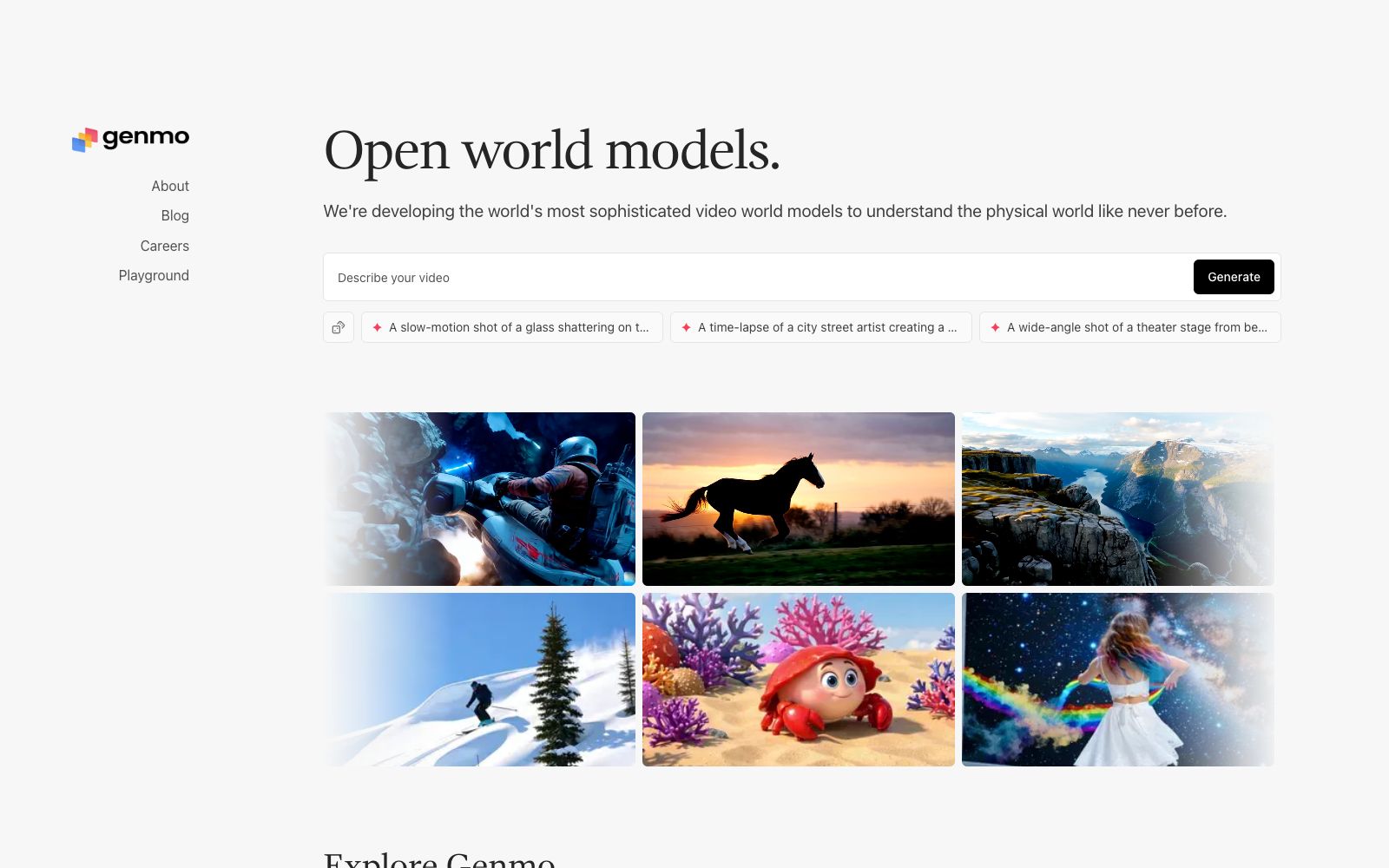
Genmo is a research-driven open-source video generation lab. With the Mochi text-to-video model and open-world models, it enables users to create high-quality videos locally or in the playground.
Updated: 2026-10-26
What is Genmo?
Genmo is a research-driven open-source video generation lab focused on building open and cutting-edge video and world models, rather than just closed-source text-to-video products. It uses the Mochi text-to-video model to turn concepts into dynamic visuals and explores open world models that can understand the physical world. Officially, it is committed to unleashing the "right brain" of AGI and pushing generative media toward controllability and auditability. Unlike most closed-source text-to-video products, Genmo opens up its models and weights, allowing users to not only use them but also modify them, rather than just calling a black-box interface.
Who is it for?
- Developers and researchers who want to deploy locally and freely customize video models, retaining full control.
- Teams that require a controllable and auditable generation process and are unwilling to be bound by closed-source services, with more stable compliance.
- Content creators who conduct creative experiments and explore visual inspiration through random prompts, and conduct low-cost trial and error.
- Researchers who are interested in the future of open models and generative media, and who want to keep up with cutting-edge directions.
Key features
5Open-world models
Developing video world models that understand the physical world as if they had never existed before, going beyond the narrative of simple text-to-video generation and moving toward more general spatial intelligence.
Mochi Open-Source Model
A cutting-edge open text-to-video generation model that transforms textual concepts into visual narratives with storylines, accessible to the community for independent verification of its effects.
Local Execution
Run and customize Mochi via open-source repositories or ComfyUI, adjust the experience as needed, keep data on your local machine, and ensure greater privacy and compliance control.
Interactive playground
Directly test model features and capabilities in the online playground, get started without a local environment, and lower the threshold for first-time experience.
Open Collaboration
The models are open-sourced on GitHub and Hugging Face, allowing the community to contribute and customize them. Iteration is driven by the collective, and capabilities grow alongside the ecosystem.
How to use Genmo
- 1First try generating content with random or self-written prompts in the playground to feel the capability boundaries and styles of Mochi.
- 2When you need more control, pull the open-source repository and run it locally, fine-tune the model according to the scenario, and protect sensitive materials.
- 3Integrate your existing workflow with ComfyUI, embed generation into your production pipeline, and reduce manual steps.
- 4Follow the research blog to keep track of world model progress, as the model's focus has shifted from Mochi to a more general direction.
- 5Before commercial use, confirm the open-source license and compliance requirements, and do not treat it as a free closed-source service by default.
Traffic & popularity
Data month Sep 2026
Genmo receives about 281.4K visits per month and ranks #119,443 worldwide.
Monthly visits
12 monthsTraffic sources
- Direct51.9%
- Search34.3%
- Referrals6.8%
- Social3.3%
- Mail1.7%
- Other2.0%
Top countries
- United States19.7%
- India19.7%
- Russia9.6%
- Bangladesh7.4%
- Pakistan6.8%
Estimated from third-party traffic data.
Similar tools
 MarbleA single prompt generates a high-fidelity, continuously browsable 3D world that can be downloaded and exported, and you can also stitch multiple worlds together in Studio to create videos; unlike 3D design tools, it provides ready-to-use spaces rather than deliverable models.
 Tencent Hunyuan AI VideoTencent Hunyuan has launched a text-to-video capability. Officially, its open-source video models rank among the top in terms of parameter scale and performance. It supports text-to-video generation, native shot cutting and continuous actions, and also provides voice-driven digital human images and automatic dubbing capabilities.
 VivixAn AI team focused on real-time interactive multimodal models officially states that Vivix-A1 powers full-body real-time avatars and Vivix-W1 generates real-time evolving worlds, providing APIs, Playground and technical reports.
 Fireworks AIA training and inference platform for open-source models, the official website states that it can transform open models into exclusive intelligence, supports calling the latest models with a single line of code, and provides multiple paths from guided training to reinforcement learning.
 HedraHedra is officially positioned as an institution engaged in the research and development of visual reasoning models and infrastructure. Meanwhile, it provides creators with a visual workbench that enables planning, generation, and editing across video, image, and audio models on the same canvas.
 Flaq AIFlaq AI is an API platform that aggregates multiple models. With one API key, you can call image, video, music, 3D, and language models. The official rate is claimed to be lower than that of each official API. It is suitable for developers who do not want to connect to suppliers one by one.