


Factory
An enterprise R&D iteration platform centered on automated intelligent agents, in which an intelligent agent named Droid automatically completes the entire process of development, testing and deployment, and is equipped with mechanisms for usage analysis, task orchestration and implementation of coding standards. The official stated that it has served many large-scale institutions.
Updated: 2026-10-26
What is Factory?
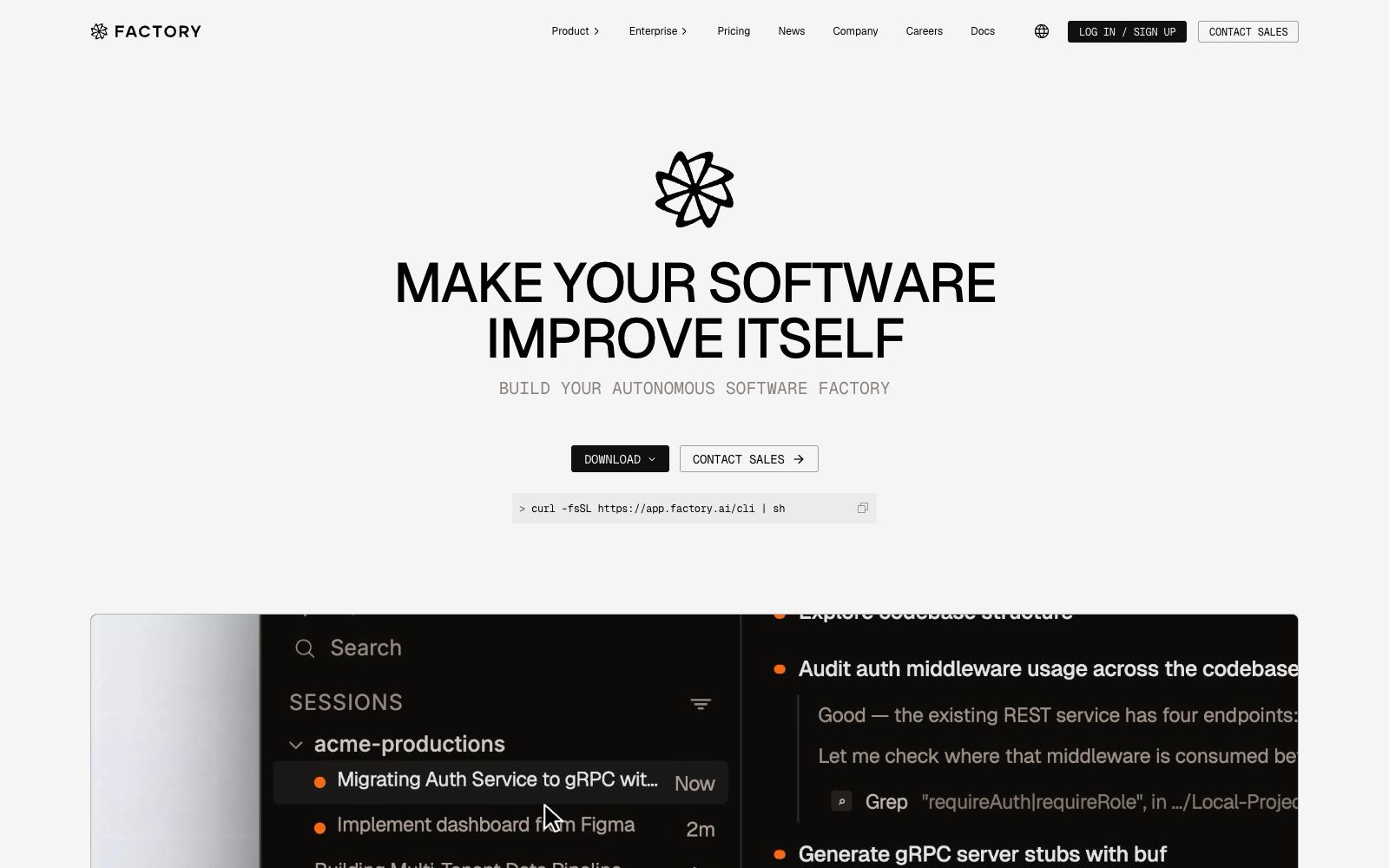
Factory is an enterprise software development platform focusing on "agent-native". Its official website slogan is "MAKE YOUR SOFTWARE IMPROVE ITSELF", aiming to make software get better and better on its own. Its core role is called Droid, which the official says can automate coding, testing and deployment. Ultimately, the company intends to convert the context of the company and code base into verified production code, with the goal of building a sustainable software factory.
Who is it for?
- Medium and large-scale R&D organizations that are fragmented by multiple tools and wish to unify measurement standards and observability.
- Enterprise IT that has clear compliance requirements and needs to have full control over the operating environment of agents.
- Managers who need to justify the return on investment (ROI) of AI to their superiors and translate engineering efficiency into business figures.
- Teams that already make extensive use of coding agents but lack unified governance and quota control.
Key features
7Control
The official website emphasizes sovereignty and model neutrality, allowing you to decide where the system runs, how it learns, and which models to use on your own.
Governance
The official statement says that governed self-improving systems can be deployed, continuously converting enterprise signals into verified production code.
Value
Link the adoption and effectiveness on the engineering side to business metrics such as growth, profitability, and risk.
Droid
Plans, codes and verifies tasks in accordance with predefined goals and strategies, while the team sets the objectives and policies.
Analytics
Tracks adoption rates and consumption by developers and teams, providing real-time usage metrics and exportable reports.
Droid Computers
The official website states that this is hardware dedicated to running local agents, equipped with independent computing power and maintaining continuously available status.
Mission Control, Automations, Model Routing, Code Review, AutoWiki
Modules listed on the official website, covering orchestration, automated routing and knowledge accumulation.
How to use Factory
- 1Before launching, first agree on "which changes can be automatically merged", clarify the boundaries of permissions and reviews before opening up access.
- 2The analytics module is ideal for aligning metrics with the middle platform; first check if report export is possible before discussing acceptance criteria.
- 3The official mention allows you to bring your own model selection. First confirm the list of models you are allowed to call to avoid discovering problems after selection.
- 4The official website displays logos of many large enterprise customers, and when selecting the solution, you can ask them to provide reference cases of implementation in the same industry as proof.
- 5Dedicated local hardware is an additional investment; first estimate the number of online users and the volume of tasks before deciding whether to adopt it.
- 6Product modules and package benefits may be adjusted; recheck the official website's enterprise edition page before officially signing the contract.
Traffic & popularity
Data month Sep 2026
Factory receives about 80.5K visits per month and ranks #525,648 worldwide.
Monthly visits
12 monthsTraffic sources
- Direct57.2%
- Search25.7%
- Referrals7.4%
- Social6.3%
- AI assistants1.5%
- Other1.9%
Top countries
- United States36.2%
- India15.7%
- China8.4%
- United Kingdom6.3%
- Russia4.4%
Estimated from third-party traffic data.
Similar tools
 Tencent Cloud ADPTencent Cloud's enterprise-level intelligent agent development platform provides LLM+RAG, Workflow and Multi-agent development engines, supporting integration of construction, distribution, management and operation.
 PencilPencil is a marketing-oriented AI operating system that aggregates leading models from OpenAI, Google, Adobe and other companies, implements enterprise-level governance, and transforms production savings into media growth.
 Forge CodeA team-oriented software factory, officially stated that once configured, it can trigger tasks by defects, Slack discussions or alerts, automatically complete building, testing, deployment and continuous monitoring, and recover from checkpoints after a crash.
 Jeeva AIJeeva AI is an enterprise-level digital employee platform that hosts autonomous digital employees for customer service, IT, revenue, security, finance and other functions through a shared runtime. It supports deployment described in natural language and has built-in permission approval and audit functions, making it suitable for enterprises that need large-scale automation.
 ConductorThe combined tool for running coding agents in a cloud isolated sandbox runs multiple tasks in parallel in independent micro-VMs. It can reuse your existing subscriptions and keys to drive mainstream command-line coding assistants and supports web and mobile terminals.
 Vertex AIAn AI development platform under Google Cloud, now named Gemini Platform on its official website, provides model invocation, training fine-tuning and agent deployment capabilities, targeting technical teams that need to integrate AI into production systems.