


easybits
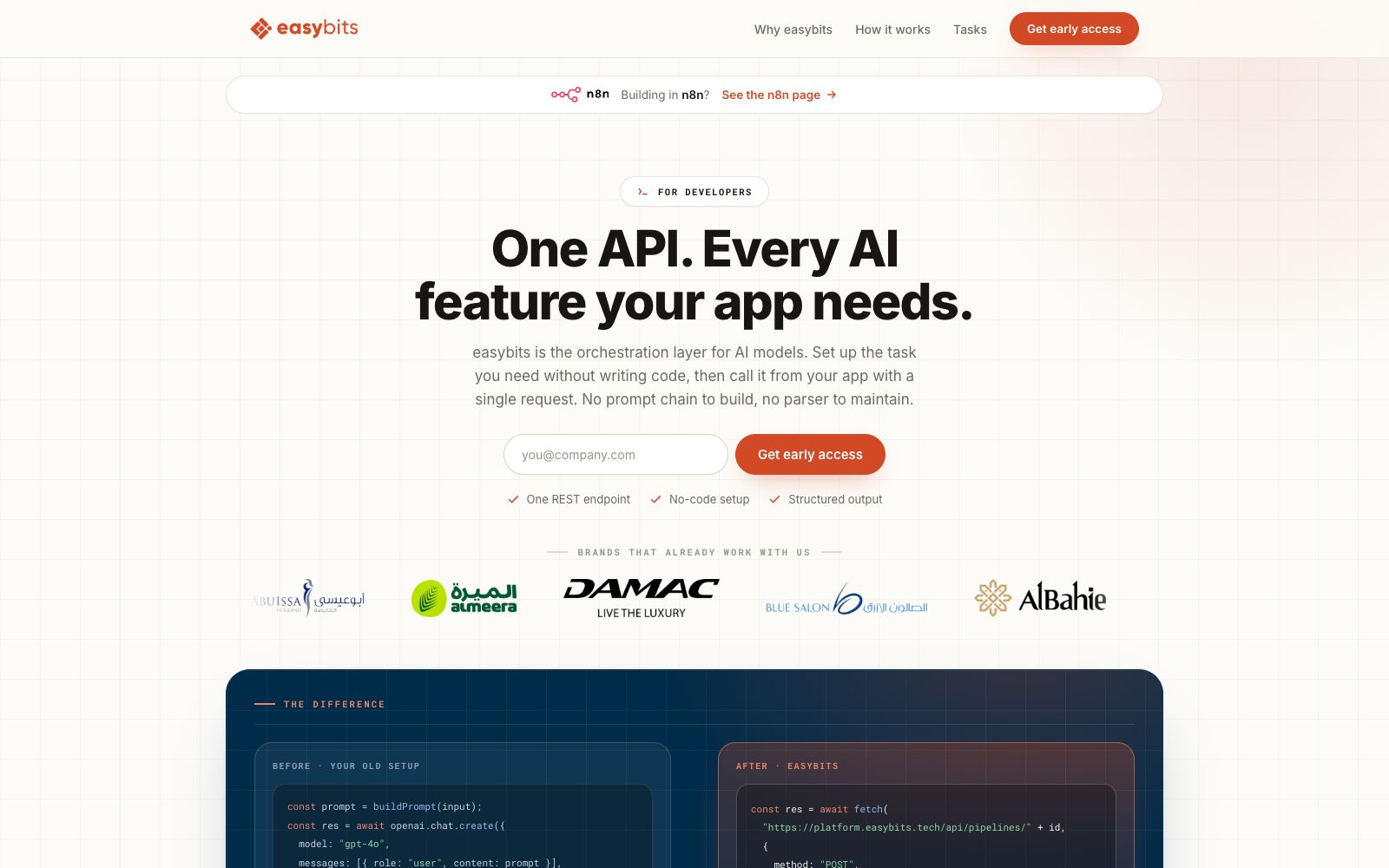
According to its official website, easybits positions itself as an AI orchestration layer within applications: first, configure tasks such as classification, extraction, and summarization on the platform, and then the application sends a request to call them; prompts, models, and output structures are maintained on the platform, and the results are directly mapped to program types.
Updated: 2026-10-27
What is easybits?
The first positioning sentence on the easybits official website is "the AI orchestration layer for your app": it targets developers, not general chat users. The official website uses code comparisons before and after to illustrate the differences: the traditional approach requires maintaining prompts, model calls, JSON parsing, model selection and versions within the application; easybits, on the other hand, places these configurations on the platform, and the application only sends requests to one REST address. The official website also states that the platform is in an invite-only early access phase, and it will first onboard a group of developers and maintain direct communication with the team.
Who is it for?
- Engineers who repeatedly implement small AI functions such as classification, extraction, summarization, and transcription in their products.
- Small teams that do not want to perform model evaluation, prompt versioning, and parsing fallbacks for each feature.
- Builders who piece together workflows using low-code or automation tools and want to integrate AI capabilities through a single API node.
- Application developers who need to directly write outputs into databases, forms or internal systems.
Key features
6Task-based Configuration
The process outlined on the official website involves selecting a task, choosing a model, configuring labels, guidelines, structure and output fields, and then calling from the application; no code writing is required during the configuration process.
One REST Call
The official website states that each task is a single POST request. After submitting text or files, it returns structured results, and it can be integrated with any programming language and framework.
Built-in Task Templates
The official website lists ten common tasks for getting started, including contextual Q&A, text classification, structured extraction, audio transcription, summarization, speech synthesis, text generation, translation, image captioning, and sensitive information redaction.
Structured Output
The official website states that results are returned in the structure you define, which can be directly mapped to types in your program and eliminates the need to handle parsing failures in business code.
Model Replacement
The official website states that each task comes with a default model, and there are two recommended alternatives available; when a model is retired or a better option becomes available, the platform will handle the replacement, ensuring the integration continues to function without disruption and the output schema remains unchanged.
No Deployment Required for Configuration Changes
The official website states that modifying prompts or switching models on the platform takes effect immediately, without requiring the app to undergo a new release.
How to use easybits
- 1Start with a task with clear boundaries, such as classification with fixed tags or extraction with stable fields, verify the output structure before expanding.
- 2Clearly define tags, fields, and business rules on the platform; the reliability of structured output mainly depends on the completeness of these definitions.
- 3Keep input samples and acceptance samples for each task, and use them for regression testing when replacing the default model.
- 4When dealing with privacy or sensitive information, first evaluate the masking tasks listed on the official website and the platform's privacy policy, then decide what data can be transmitted.
- 5Currently in invite-only early access, confirm the available scope, billing and support channels before integration to avoid anchoring your core workflow on unavailable services.
Traffic & popularity
Data month Sep 2026
easybits receives about 1.1K visits per month and ranks #16,446,898 worldwide.
Monthly visits
12 monthsTraffic sources
- Direct57.1%
- Mail31.5%
- Social8.6%
- Search2.9%
Top countries
- Germany100.0%
Estimated from third-party traffic data.
In these collections
Similar tools
 PerfectParserPerfectParser is a document extraction software positioned on its official website: describe the fields to be extracted in natural language, batch process files, scanned documents and images, and output table or interface data, which is suitable for replacing manual data entry.
 MindcaseMindcase is a web data API service for AI agents. Its official website states that it offers 84 APIs that can extract structured data from sources such as LinkedIn, Google Maps, and Amazon. It supports access via Prompt, the console, and MCP, and charges based on records.