


Mindcase
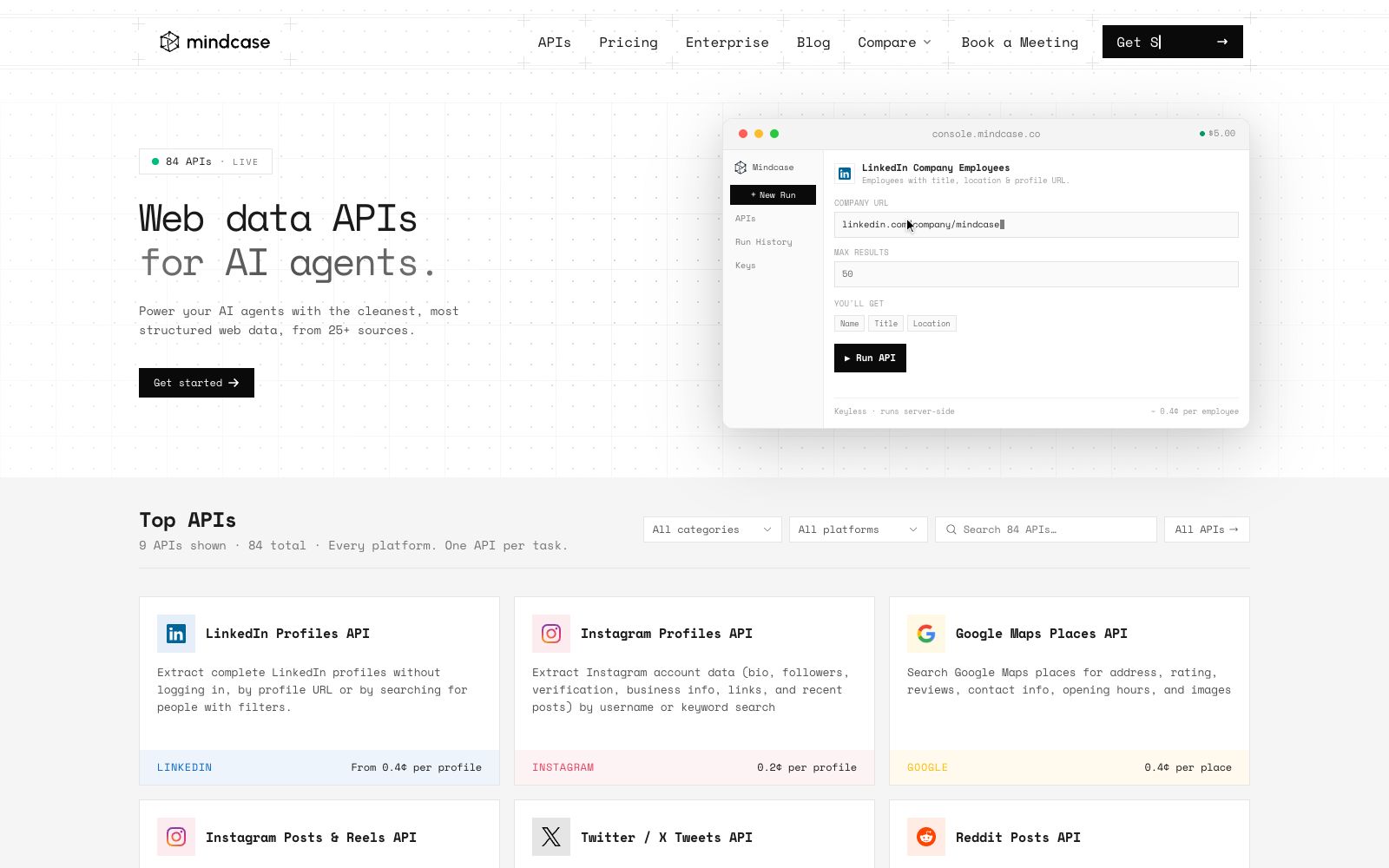
Mindcase is a web data API service for AI agents. Its official website states that it offers 84 APIs that can extract structured data from sources such as LinkedIn, Google Maps, and Amazon. It supports access via Prompt, the console, and MCP, and charges based on records.
Updated: 2026-10-27
What is Mindcase?
Mindcase's official website positions itself as a "web data API for AI agents". Its focus is to enable agents to access structured web data through APIs, Prompts or MCPs, rather than having teams maintain crawling infrastructure by themselves. The official website states that the product covers more than 25 sources and provides 84 APIs.
Who is it for?
- Development teams that need to provide external data such as LinkedIn, Amazon, maps, social media, etc. to AI agents.
- Data engineering teams that do not want to maintain crawling servers, proxies and anti-crawling infrastructure.
- Automation developers who need to call a single API per task in the agent workflow instead of building general-purpose crawlers.
- Independent agent developers who need to quickly verify market, company, location, or content data.
Key features
6Multi-source Data APIs
The official website lists APIs such as LinkedIn Profiles, Google Maps Places, Amazon Products, Instagram Profiles, Twitter/X Tweets, and Reddit Posts, with each API corresponding to a specific type of data task.
Structured Output
The official website states that it can return fields by record, such as the name, position, and location of company employees, or the rating, reviews, business hours, and contact information of map locations.
Agent Integration
The official website showcases three entry points: running in the console, copying the Prompt to the agent, and connecting to MCP. It also states that the API documentation is a one-page guide for AI agents to read.
Pay-per-record pricing
The official website states that users pay by record using their wallet credit, with no subscription plans or seat limits, and the credit never expires; the page also provides examples of per-record prices for different APIs.
Server-side Execution
The official website states that for Demo scenarios, no API key is required; it runs on the server side. You can set the maximum number of results and view the number of records, costs, and time consumption.
Custom Data Sources
The official website states that for requirements without existing APIs, its team can build and run custom data sources, complex pipelines, or managed tasks.
How to use Mindcase
- 1First verify the fields, prices and return quality with a small result set in the console before integrating with the production agent.
- 2Clarify the source, maximum number of results, and target fields for each task to prevent agents from repeatedly calling different APIs for similar tasks.
- 3Before handing the API documentation to the agent, check the input conditions and output fields to ensure that the data validation rules on the application side can accept the results.
- 4Set up result sampling and cost monitoring for long-term tasks, especially processes that require continuous crawling of map, product, or social media data.
- 5If the existing APIs do not cover the target website, first test the custom building service provided by the official website with a small-scale requirement, and then expand the process.
Traffic & popularity
Data month Sep 2026
Mindcase receives about 37.5K visits per month and ranks #549,098 worldwide.
Monthly visits
12 monthsTraffic sources
- Search38.4%
- Direct35.3%
- Referrals10.1%
- Social5.6%
- Mail4.9%
- Other5.6%
Top countries
- India64.6%
- United States22.1%
- Brazil5.6%
- Mexico4.9%
- Slovakia2.9%
Estimated from third-party traffic data.
Similar tools
 TinyFishWeb infrastructure for AI agents enables real-time searching, crawling, and structured extraction of web data. It also supports logging into backend portals for automatic form filling, making it suitable for data collection, competitor monitoring, and process automation.
 FormX.aiDocument data extraction platform. The official website supports multiple types of documents such as invoices, receipts, bank statements, contracts and certificates. Build an extractor and connect the API in three steps, and the accuracy can be continuously optimized with production data.
 OpenServOpenServ provides enterprise-grade agent infrastructure. Its official website states that its inference layer can structure each step, leave audit trails, and control costs. It is also compatible with mainstream SDKs, making it suitable for deploying agents into production.
 easybitsAccording to its official website, easybits positions itself as an AI orchestration layer within applications: first, configure tasks such as classification, extraction, and summarization on the platform, and then the application sends a request to call them; prompts, models, and output structures are maintained on the platform, and the results are directly mapped to program types.
 TavilyReal-time search API for AI agents, providing interfaces such as search, extraction, crawling, maps and research, returning structured chunked content; the official claims that it has a built-in security verification layer that intercepts personal privacy information and prompt injection.
 FirecrawlA web data interface for AI agents that combines search, crawling, full-site scraping, and page interaction into a single API call, directly returning clean data suitable for feeding into models. The official states that it will open-source its code, and a large number of companies are already using it.