


Corsair
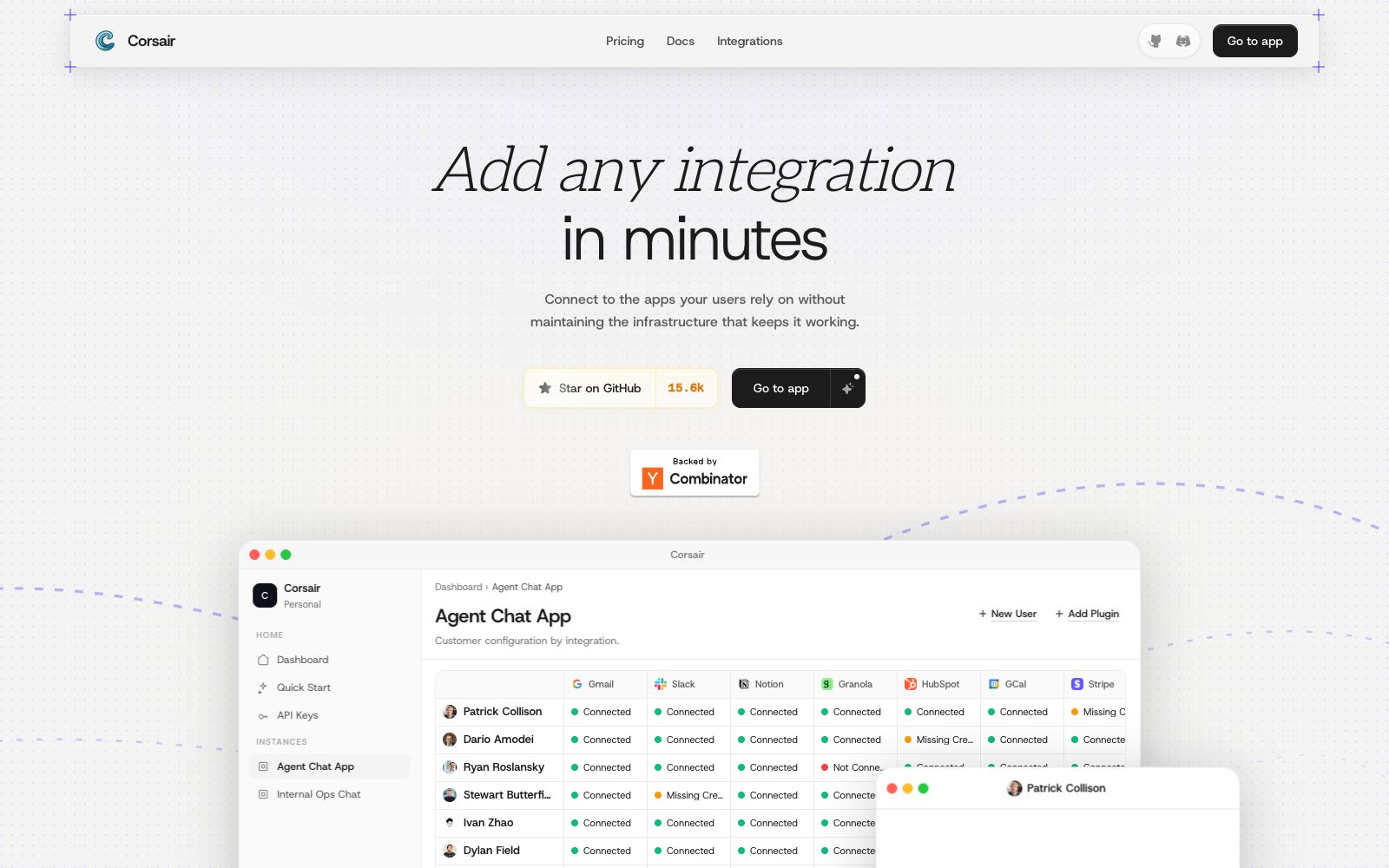
Corsair is an open-source integration layer for AI products: it connects applications like Gmail, Slack, and Notion to agents via plugins, unifies the handling of OAuth, multi-tenant credentials and authorization pages, requires explicit approval for destructive operations, and can be either cloud-hosted or fully self-hosted.
Updated: 2026-10-26
What is Corsair?
Corsair is an open-source integration layer for AI products, positioned on its official website as "Open Source Integration Layer for AI Agents". It handles the tedious work of integrating external applications into agents: OAuth authorization, multi-tenant credentials, permission approval, and Webhooks. Compared to common closed-source integration platforms, the official website highlights three differences: Apache 2.0 open source for forking, fully self-hostable without seat-based billing, and the ability to set permission modes individually for each integration.
Who is it for?
- Teams building AI assistant and agent products that need to let end users connect their own SaaS accounts
- Multi-tenant B2B services that need to isolate credentials and connection statuses by customer
- Companies with data residency or compliance requirements that cannot hand over tokens to third-party managed services
- Engineering teams that have handwritten numerous OAuth callbacks and been repeatedly disrupted by changes to various API interfaces
Key features
5Plugin-based Integration
Integrate via plugin declarations like notion(), slack(), gmail(), googlecalendar(). The official Quick Start example can be run directly with createCorsair({ multiTenancy: true, database, kek, plugins }).
Protect your permissions by default
Set permission modes on a per-integration basis. Destructive operations require explicit approval before execution, and users receive a review link rather than an accomplished fact. The official example offers a choice between Deny and Approve before sending an email.
Self-hosted for free
The complete SDK can be run for free on your own infrastructure. The official website states that there is no seat-based pricing, your data stays within your tech stack, and there are no markups on your already paid API calls.
Open-source means no lock-in
If a integration is missing, you can submit a PR to have it merged, or directly fork the repository and build it yourself; the official website states that the infrastructure has "Thousands of eyes" watching, so you don't have to trust a black box.
Authentication & Triggers
Supports authorization, triggering, and workflow execution within conversations. An official example is "After someone uploads Q4 financial reports to Drive, remind me on Slack". The FAQ states that it can also be used independently without an AI agent.
How to use Corsair
- First, get an integration up and running with the Hobby tier: the official price is $0/month, which includes 50 connections, 100,000 Webhook events, and up to 3 members.
- After that, evaluate the Pro tier ($200/month, unlimited connections) or self-hosting.
- Set the permission mode for each integration one by one before launch, and set all destructive actions such as sending emails, writing to databases, and making payments to require explicit approval.
- When self-hosting, store keys like `kek` in environment variables or a key management service, and do not commit them to the code repository.
- Before connecting users' third-party accounts, confirm that the privacy policy and consent page cover these data usage purposes.
- the FAQ states that the AI agent will not see the API keys, but you still need to verify the storage location of the credentials yourself.
- For new integrations, prioritize submitting a PR or forking the repository.
- do not build a separate solution in parallel while waiting for official scheduling.
Traffic & popularity
Data month Sep 2026
Corsair receives about 5.6K visits per month and ranks #3,338,239 worldwide.
Monthly visits
12 monthsTraffic sources
- Direct68.3%
- Search10.8%
- Referrals8.2%
- Social6.4%
- AI assistants3.4%
- Other3.1%
Top countries
- India55.0%
- United States39.8%
- France3.5%
- Germany1.7%
Estimated from third-party traffic data.
In these collections
Similar tools
 KodusOpen-source self-hostable AI code review tool, officially claiming that you can use your own model keys with no markup, unlimited PRs, the ability to identify issues across files and enforce team-specific custom rules.
 ComposioA platform that provides tool access and authorization infrastructure for AI agents, officially claiming to connect over 1500 applications, retrieve tools on demand, host OAuth authorizations, and support CLI, MCP gateway, and sandbox execution.
 SimSim is an open-source AI workspace where enterprises build, distribute and govern AI agents. Its official website states that it supports 270+ integrations and mainstream large models, can be orchestrated with canvases, dialogues or code, and provides permission groups, quota limits and self-hosting.
 Hermes AgentNous Research's open-source and self-hostable AI agent, officially available for free under the MIT license, supports persistent memory, automatic skill generation, multi-platform access, and isolated sandboxes. It can be downloaded for desktop or terminal installation.