


Consensus
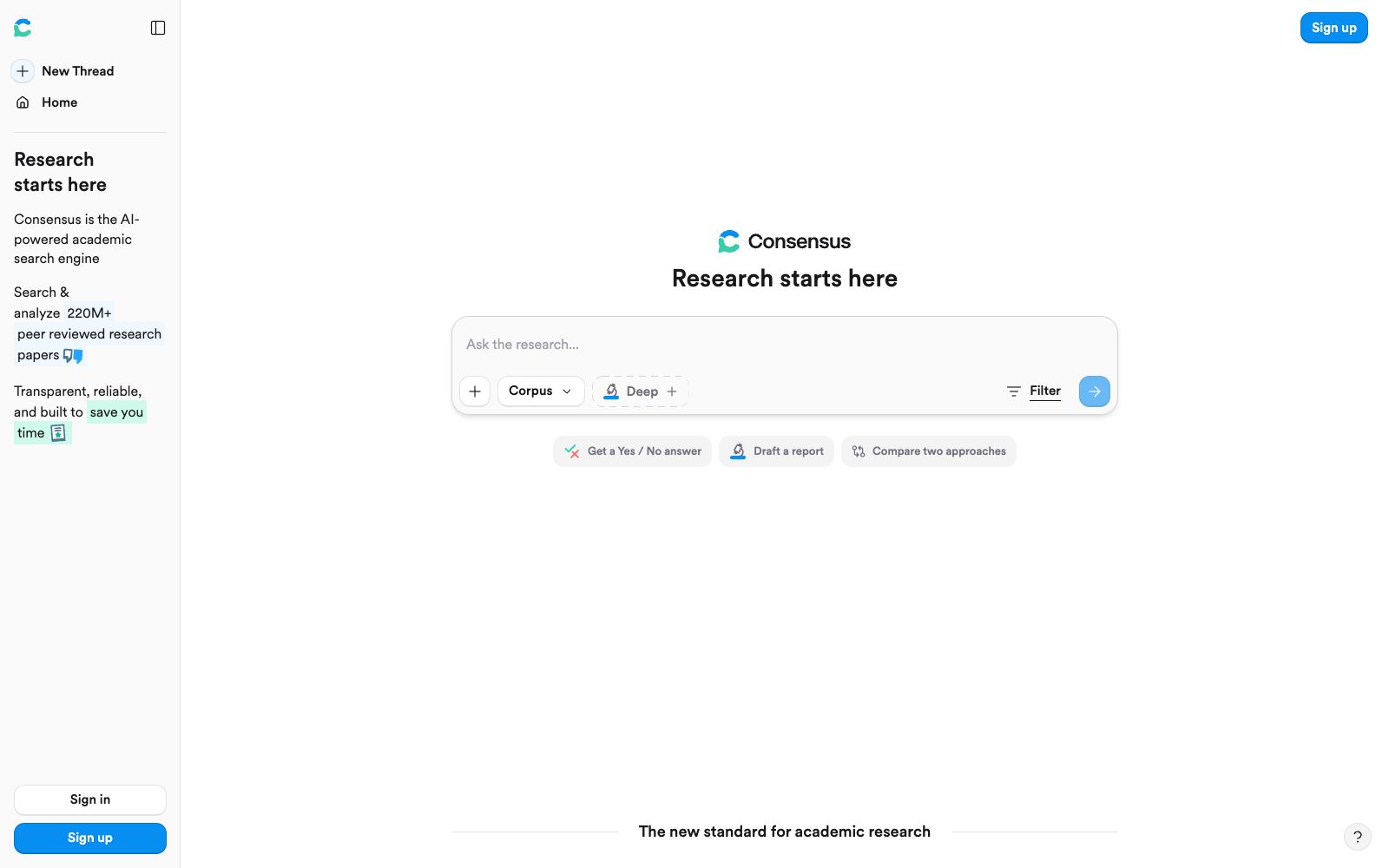
An AI academic search engine for peer-reviewed literature. You can retrieve evidence from 250 million papers by asking questions in natural language, visually present the consensus and divergence of research conclusions, and support Deep Search automated reviews and medical modes.
Updated: 2026-10-26
What is Consensus?
Consensus is an AI academic search engine for peer-reviewed literature, officially positioned as "Research Starts Here". Unlike ordinary academic search tools, it allows users to ask a direct question in one sentence. The system searches for evidence in more than 250 million papers and intuitively shows whether the research community "mostly supports" a certain question or "has disagreements" on it. Therefore, it is often hailed as the standard configuration for a new generation of academic research. According to its official website, 10 million researchers, students and clinicians are already using it, and more than 170 university libraries have partnered with it to provide access for students and faculty. Its coverage includes full-text content licensed from major publishers.
Who is it for?
- Graduate students and researchers who need to quickly determine "what the scientific community thinks about a certain issue"; evidence-based medical practitioners such as clinicians and pharmacists; students who need to find evidence to support their papers or reviews; and analysts who need to cite authoritative peer-reviewed literature in their reports. It is especially user-friendly for university users—if your library has partnered with Consensus, you can directly use it through institutional access without personal payment.
Key features
6Natural Language Querying
No need to construct search queries; start your search by describing your research question in a conversational sentence. For example, simply ask "What is the impact of intermittent fasting on metabolic health?" and the system will automatically match relevant papers.
Consensus View
The search results present the distribution of the research community's attitudes toward the question, allowing you to quickly see whether the evidence is consistent and avoid one-sided conclusions from only reading a single paper. This is Consensus's most unique selling point.
Deep Search Deep Search
Automates a single round of literature review — the system independently formulates search strategies, screens and synthesizes multiple research papers, and outputs organized review results, making it ideal for quickly getting to grips with an unfamiliar research area.
Natural Language Filtering
Describe filtering criteria in everyday language (such as "within the past five years" or "randomized controlled trials") without manually combining fields and filters, reducing the threshold for retrieval.
Medical Mode
A dedicated medical search mode designed for clinical and evidence-based practice scenarios, helping healthcare-related researchers quickly locate high-quality evidence.
Draft Reports
Based on retrieval and analysis, it organizes evidence into a draft report that can be directly edited further, shortening the distance from searching for materials to writing a paper.
How to use Consensus
- Treat it as a "starting point for finding evidence" rather than an endpoint: first use the consensus view to judge the direction of the conclusion, then use Deep Search to quickly conduct a round of literature scanning, and finally return to the original text to conduct in-depth reading of key papers.
- University users should first check whether their library has activated institutional access, which can save a lot of costs.
- developing the habit of "using abstracts to determine the direction and original texts to determine the conclusion" in daily retrieval will make the research process more rigorous.
Things to know
Traffic & popularity
Data month Sep 2026
Consensus receives about 3.5M visits per month and ranks #15,491 worldwide.
Monthly visits
12 monthsTraffic sources
- Direct49.1%
- Search32.4%
- Referrals7.2%
- AI assistants6.6%
- Social2.5%
- Other2.2%
Top countries
- United States13.8%
- Indonesia10.3%
- India5.8%
- Iraq4.0%
- Peru3.9%
Estimated from third-party traffic data.
Similar tools
 Qiewen AcademicAn AI academic search and literature discovery tool for researchers, supporting deep retrieval, citation network expansion, knowledge base Q&A, and paper reproduction. Its official website states that it can track research trends and provide personalized recommendations.
 UndermindUndermind is an AI co-researcher for researchers, focusing on the literature domain. It can read full texts and charts, retrieve along citation chains and cite point by point, and help users build a dynamic literature library from broad to in-depth.
 ElicitAI research assistant: Enter a research question to search over 125 million papers, automatically generate cited structured research reports, and support data extraction, systematic literature reviews, and library alerts.
 AMinerAn AI-driven technology intelligence and academic search platform, which, according to the official, provides scholar portraits, paper retrieval and AI research assistants. It can assist in designing experiments, building review frameworks and writing paper introductions, and uses intelligent agents to track and summarize the latest papers every day.
 geneiAn AI tool for research and writing, which uses self-developed algorithms to automatically summarize literature, analyze research and locate key information, helps produce blogs, articles and reports faster, and offers a 14-day free trial.
 sciteAn AI tool for academic research, which uses intelligent citations to indicate whether papers are supported or refuted, has a search coverage of over 300 million articles, preprints and patents, can be integrated with Claude, ChatGPT and Zotero, and provides verifiable evidence.