

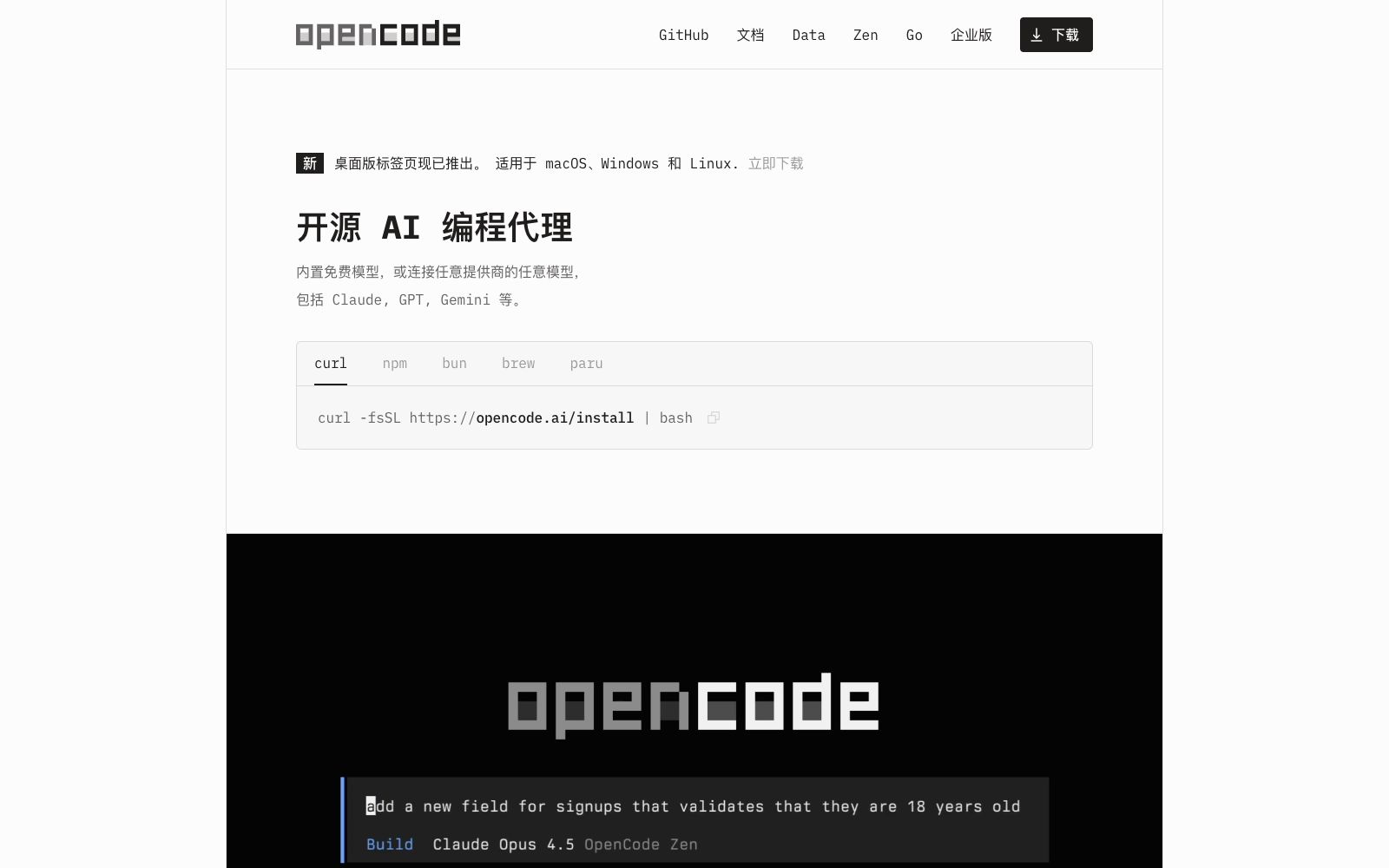

OpenCode
OpenCode is an open-source AI programming agent that can write code in terminals, IDEs and desktop clients. It supports LSP, multi-session parallelism and 75+ models, and prioritizes privacy without storing code.
Updated: 2026-10-26
What is OpenCode?
OpenCode is an open-source AI programming agent, officially positioned as an "open-source AI programming agent" that focuses on writing code across terminals, IDEs, and desktop clients. Different from closed-source commercial coding assistants, its core selling point is "privacy first" — the official states that it does not store any of the user's code or context data, making it suitable for operation in privacy-sensitive environments. The platform integrates more than 75 LLM providers through Models.dev, including Claude, GPT, Gemini, and local models, and also supports direct invocation via GitHub Copilot or ChatGPT Plus/Pro accounts. According to its official website, it has over 195,000 GitHub Stars, 950 contributors, and is used by more than 16 million developers every month.
Who is it for?
- Developers and enterprise teams who value code privacy and want tools that do not store code or contextual data in the cloud
- Engineers who are used to working in the terminal and want an AI programming assistant that stays within the command line
- Users who want to use local or self-built models and avoid sending code to third-party APIs
- People who have subscribed to GitHub Copilot or ChatGPT Plus/Pro and wish to directly reuse their existing accounts
- Developers who enjoy tinkering with open-source tools and are willing to read documentation and contribute code
Key features
6Multi-editor Support
It provides three forms: terminal interface, desktop application and IDE extension, enabling code writing on terminals, IDEs or desktops to adapt to different working habits.
Access to Any Model
Through Models.dev, it supports over 75 LLM providers, including Claude, GPT, Gemini, and local models. You can also use GitHub Copilot or ChatGPT Plus/Pro accounts.
Automatic LSP Loading
Supports the Language Server Protocol. The official states that it will automatically load the appropriate LSP for LLMs, making code completion and understanding more aligned with the current language and project.
Multi-session Parallelism
You can start multiple agents in parallel within the same project to handle different tasks separately, which is suitable for scenarios that require advancing multiple modifications simultaneously.
Session sharing links
You can generate sharing links for any session to facilitate others' reference and debugging, eliminating the need to share logs back and forth during collaborative troubleshooting.
Zen Curated Models
The official team has launched Zen, which provides a curated set of AI models tailored for programming agent testing and benchmarks, eliminating the cost of comparing performance and quality across multiple providers.
How to use OpenCode
- It is recommended to start with the terminal version: the official website provides various installation methods such as curl, npm, bun, brew, paru, etc.
- Just pick the one that matches your system.
- When accessing the model, prioritize using a GitHub Copilot or ChatGPT account for a trial run.
- Verify the experience before deciding whether to configure other paid or local models to avoid being distracted by numerous providers right away.
- Multi-session parallelism is suitable for separating "developing new features" and "fixing old bugs", but too many parallel tasks will consume more context and quota.
- It is recommended to get a single session working properly before enabling parallelism.
- Privacy-first is a relative commitment.
- when dealing with highly sensitive code, it is still advisable to confirm the deployment form and data flow, and keep local backups.
- Official data (such as Stars and monthly active users) is for promotional purposes only and should be used for rough reference.
Traffic & popularity
Data month Sep 2026
OpenCode receives about 10.4M visits per month and ranks #4,860 worldwide.
Monthly visits
12 monthsTraffic sources
- Direct55.5%
- Search31.5%
- Referrals7.2%
- Social4.0%
- AI assistants1.2%
- Other0.6%
Top countries
- China26.5%
- United States11.7%
- India6.0%
- Brazil4.5%
- Indonesia3.6%
Estimated from third-party traffic data.
In these collections
Similar tools
 KiloOpen-source AI coding agent, covering VS Code, JetBrains, CLI and cloud, supporting access to more than 500 models and zero markup for self-provided keys, and using local models can protect code privacy.
 MausBotMausBot is an open-source desktop AI agent app that gives each agent its own dedicated computer. It supports models including Claude, Codex, Grok, and Kimi, and connects to the apps you use every day through Composio.
 Lobe ChatOpen-source multi-model AI workspace, positioned by the platform as the Chief Agent Operations Officer, supports centralized scheduling and management of multiple Agents, provides a skill marketplace and MCP servers, and can be used in common chat tools via an IM gateway.
 aiderAn AI pair programming tool that runs in the terminal, automatically maps codebases, supports over 100 languages and multi-model access, directly commits every change to Git, and is fully traceable throughout the process.
 Cherry StudioAn open-source cross-platform desktop AI client that allows switching between large models from over 50 service providers in a single window. Conversations, drawings, translations, and knowledge bases are all stored locally, making it ideal for users who need to configure their own API keys and keep their data private.
 CrushA terminal AI coding tool by Charm, which connects your tools, code and workflows to the large model of your choice, and is officially available on macOS, Linux, Windows and BSD.