


Verse
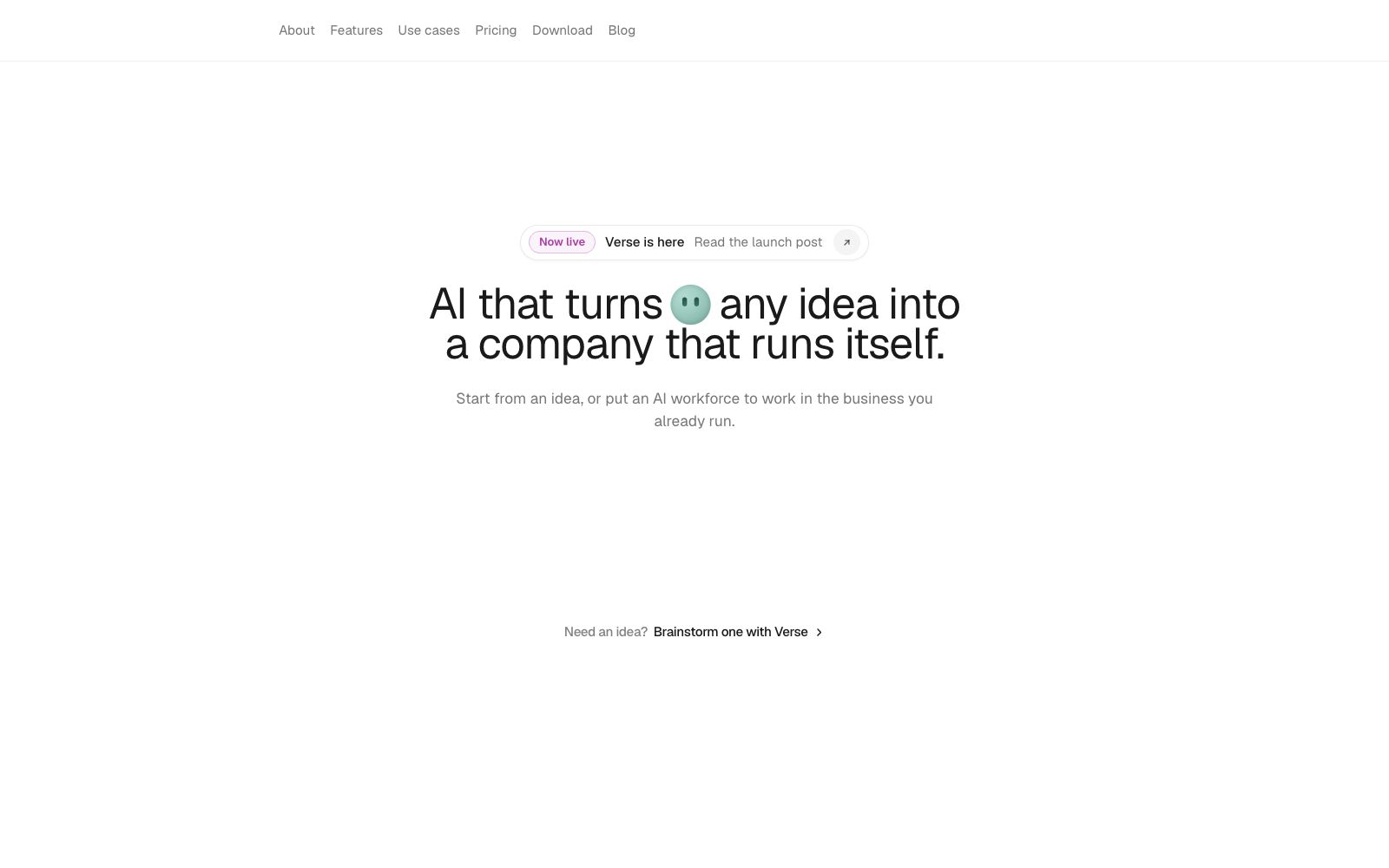
Verse is an AI employee platform oriented towards business processes: according to its official website, you can hire employees for roles such as sales, marketing, product, and engineering. These employees can use tools, write code, collaborate, and execute continuously, and they can also turn a process description into an automatically running one.
Updated: 2026-10-27
What is Verse?
The proposition of Verse official website is to build and operate a company with AI employees. It targets two types of starting points: when starting from an idea, the system designs the company structure and researches the market; for existing businesses, it hires AI employees by role to handle repetitive work. The official website emphasizes that these are not one-time task robots, but persistent, role-based workers with their own inboxes and computers, capable of retaining context and collaborating within teams.
Who is it for?
- Solo founders and early-stage teams that want to validate new businesses at a low cost first and then gradually supplement human resources.
- Small teams that already have a business and hand over repetitive tasks such as email management, marketing, customer support, and reporting to AI employees.
- Agencies that manage multiple brands or client companies and need to deploy different teams for each company.
- Business leaders who don’t write code and are more used to managing workflows with natural language.
Key features
6Hire by Role
The official website lists roles such as researcher, marketer, personal assistant, product manager, and technical co-founder, and states that there are more than 200 ready-made employees distributed across 12 teams.
Process Automation
The official website states that once a workflow is described, it can run continuously. An example is that a new lead in CRM triggers an AI to write a personalized initial outreach email, which is then sent via Gmail.
Universal Tool Capability
The official website states that employees can use any tool, read, write and run code, access systems, browse the web, build tools and use computers.
Independent Identity
The official website states that each employee has their own email address, computer, and browser; the FAQ further clarifies that the user owns their accounts, code, domain names, data, and customer lists.
Team Collaboration
The official website states that employees collaborate, delegate tasks, and report to each other in group chats; work is displayed in a feed, and users can message, pause, or redirect anyone.
Connecting Existing Systems
The official website lists integrations such as Gmail, Slack, HubSpot, Notion, Dropbox, Trello, and Linear, and states that it supports MCP, API, and custom tools.
How to use Verse
- 1Start with clear-cut, deliverable repetitive workflows, such as email triage, research, or weekly report compilation, and gradually expand permissions.
- 2Assign each employee clear responsibilities, budgets, and reporting rhythms; the official website states that users can view work, reasoning, messages, pause, or redirect anyone at any time.
- 3Retain manual confirmation for actions such as sending emails, modifying CRM systems, writing code, or releasing content publicly; review the results first before enabling full automation.
- 4Integrate commonly used tools by priority, first verify that reading and writing align with existing workflows, then configure cross-system triggers.
- 5The official pricing page shows Solo at $99 per month, Professional at $249, and Scale at $699, with no commission on sales; the actual budget also needs to be evaluated based on credit consumption.
Traffic & popularity
Data month Sep 2026
Verse receives about 1.4K visits per month and ranks #14,247,725 worldwide.
Monthly visits
8 monthsTraffic sources
- Direct32.8%
- Search30.1%
- Referrals12.7%
- Social6.8%
- Display ads6.5%
- Other11.1%
Top countries
- United States60.8%
- Brazil25.6%
- Canada13.6%
Estimated from third-party traffic data.
In these collections
Similar tools
 OdellaOdella is a labor platform for "hiring AI employees": you can select employees from the market or create your own position-based employees. Each employee has an independent sandbox computer, connects to over 100 applications and channels such as Slack, email and phone, is scheduled according to the calendar and triggered by events, and requires manual approval at key steps.
 TadataTadata is an AI employee that runs in collaboration software: According to its official website, it prepares call summaries, identifies duplicate work, drafts follow-up emails and populates CRM fields, with results pending manual confirmation first. It can also connect to internal and external tools to obtain context.
 Script.itAccording to its official website, Script.it is an AI-driven workflow automation platform that can generate and run processes using natural language. It supports over 600 integrations, scheduled and Webhook triggers, message entry points such as Slack, and saves the output of each step as a file for easy auditing.
 Jeeva AIJeeva AI is an enterprise-level digital employee platform that hosts autonomous digital employees for customer service, IT, revenue, security, finance and other functions through a shared runtime. It supports deployment described in natural language and has built-in permission approval and audit functions, making it suitable for enterprises that need large-scale automation.
 TipKayTurn roles such as Xiaohongshu operation, Douyin operation, official account editing, and video production into "download and start working" AI employees that run on the desktop. They first understand your business, then complete the entire set of work from research and planning to content delivery.