


Sim
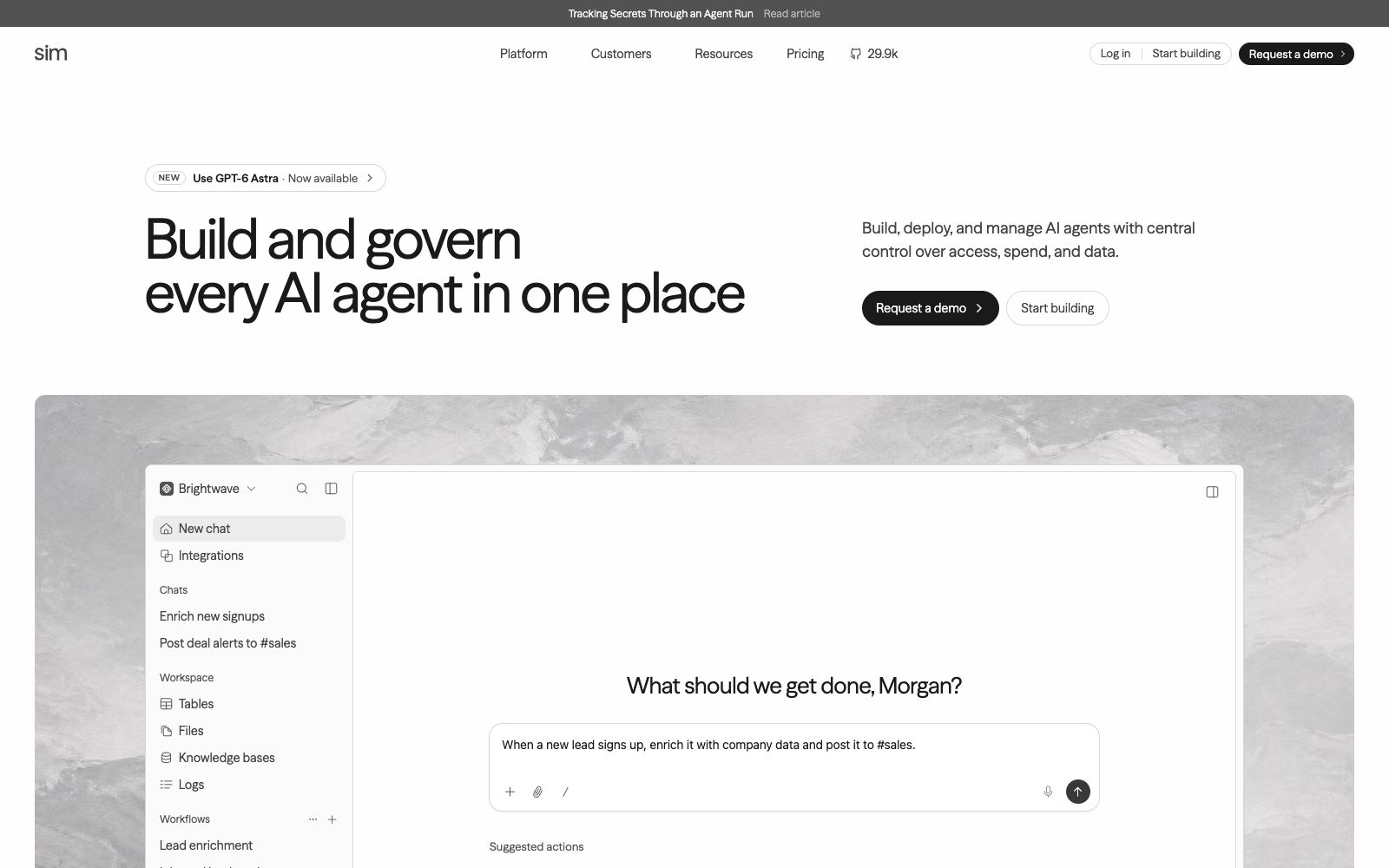
Sim is an open-source AI workspace where enterprises build, distribute and govern AI agents. Its official website states that it supports 270+ integrations and mainstream large models, can be orchestrated with canvases, dialogues or code, and provides permission groups, quota limits and self-hosting.
Updated: 2026-10-26
What is Sim?
Sim is an open-source AI workspace whose official website positions itself as "build, distribute & govern AI agents" — enterprises build, deploy and govern their own AI agents here, rather than just connecting an automated pipeline. Its difference from automation tools like n8n and Zapier lies in the governance layer: permission groups, quota limits, audit records, data retention and self-hosting are all first-class citizens. The official website lists SOC 2 Type II, ISO 27001 and GDPR in the Trust Center.
Who is it for?
- Enterprise IT and platform teams that need to roll out AI agents across multiple departments while uniformly controlling permissions and costs.
- Operations and growth teams that want to connect Slack, spreadsheets, work orders, and CRM into automated workflows.
- Organizations with data isolation requirements and the need to deploy AI agents on their own cloud infrastructure.
- Teams that are evaluating migration from tools such as n8n, Zapier, and Make, which are listed as comparison targets on the official website.
Key features
6Three Construction Methods
The official website states that you can create and deploy AI agents through conversation, a visual canvas, or code, and provides a CLI for building, running, and managing them in Claude Code or the terminal.
270+ Integrations & Major Models
The official website states it can connect to 270+ integrations and "every major LLM", with the model list including OpenAI, Anthropic, Google, DeepSeek, xAI, Cerebras, etc.
Automatic Knowledge Base Synchronization
Connectors for Notion, Google Drive, Confluence, Slack, GitHub, SharePoint and other platforms sync continuously, and the official website states that each AI agent is provided with credible memory.
Tables & Files
Structured data tables for AI agents to read and update across runs, with team uploads and agent outputs stored uniformly in a shared file area.
Block-by-block tracked logs
The official website states that each run is tracked block by block, includes failure information, and records success rates, time consumption, and costs.
Centralized Governance
Supports SSO and SCIM, permission groups that restrict available models and tools by group, organization and member-level quota limits, audit records, configurable retention periods for operational data per workspace, and self-hosting via Docker or Kubernetes.
How to use Sim
- First, get a workflow up and running in the cloud environment (e.g., enriching new leads and sending them to Slack) and confirm its availability before considering self-hosting.
- Before self-hosting, clarify how to store model keys and integration credentials, and set up permission groups and rate limits before opening them to the team.
- Assign integrations and model access based on the principle of least privilege.
- the permission groups on the official website can restrict available models, integrations, and tools on a per-group basis.
- For AI agents involving customer data, first set the data retention period, confirm whether sensitive fields are recorded in the logs, and then connect to production data sources.
- The cost savings, runtime durations, and number of builders displayed on the official website's homepage are based on its self-reported statisticalmetrics.
- treat them only as a reference and not as a commitment to your specific use case.
Traffic & popularity
Data month Sep 2026
Sim receives about 332.3K visits per month and ranks #121,794 worldwide.
Monthly visits
12 monthsTraffic sources
- Direct50.7%
- Search30.4%
- Referrals8.5%
- Social7.7%
- Display ads1.0%
- Other1.6%
Top countries
- United States15.4%
- India12.9%
- Vietnam6.1%
- France5.0%
- Brazil4.8%
Estimated from third-party traffic data.
In these collections
Similar tools
 DustAn enterprise-oriented human-machine collaborative AI platform, which, according to the official, can connect the internal knowledge, tools and teams of the company, gather context across systems to create and share Agents, and support model switching by task and centralized governance.
 Observe Words and Numbers AskTableEnterprise-level data analysis intelligent agent, the official website emphasizes its ability to understand semantics and identify identities. After connecting to business-finance systems, databases and data warehouses, users can ask questions about data, generate charts and reports in natural language. The visibility scope is controlled by row-level and field-level permissions, and private deployment is supported.
 FlowiseFlowise is an open-source visual AI agent development platform. It builds multi-agents and chat assistants with modular building blocks, supports RAG, manual review and execution tracking, and can be deployed locally or on the cloud.
 LibraLibra is an AI agent platform that connects enterprise work tools: it unifies the indexing of contexts such as Notion, Jira, and Slack, creates dedicated end-to-end process agents through natural language, automatically routes emails and messages, and covers sales, customer service, engineering, and recruitment.
 StackAIEnterprise-level AI agent factory, which can orchestrate workflows through drag-and-drop, supports VPC and on-premises deployment, audit logs and manual review. The official website homepage announces that the company has joined Asana.
 Microsoft FoundryMicrosoft's enterprise-oriented AI application and agent development platform, according to its official website, allows users to select tens of thousands of models within a unified portal, perform fine-tuning, model routing and deployment, and provides security, compliance, and policy governance across agents.