


NAO
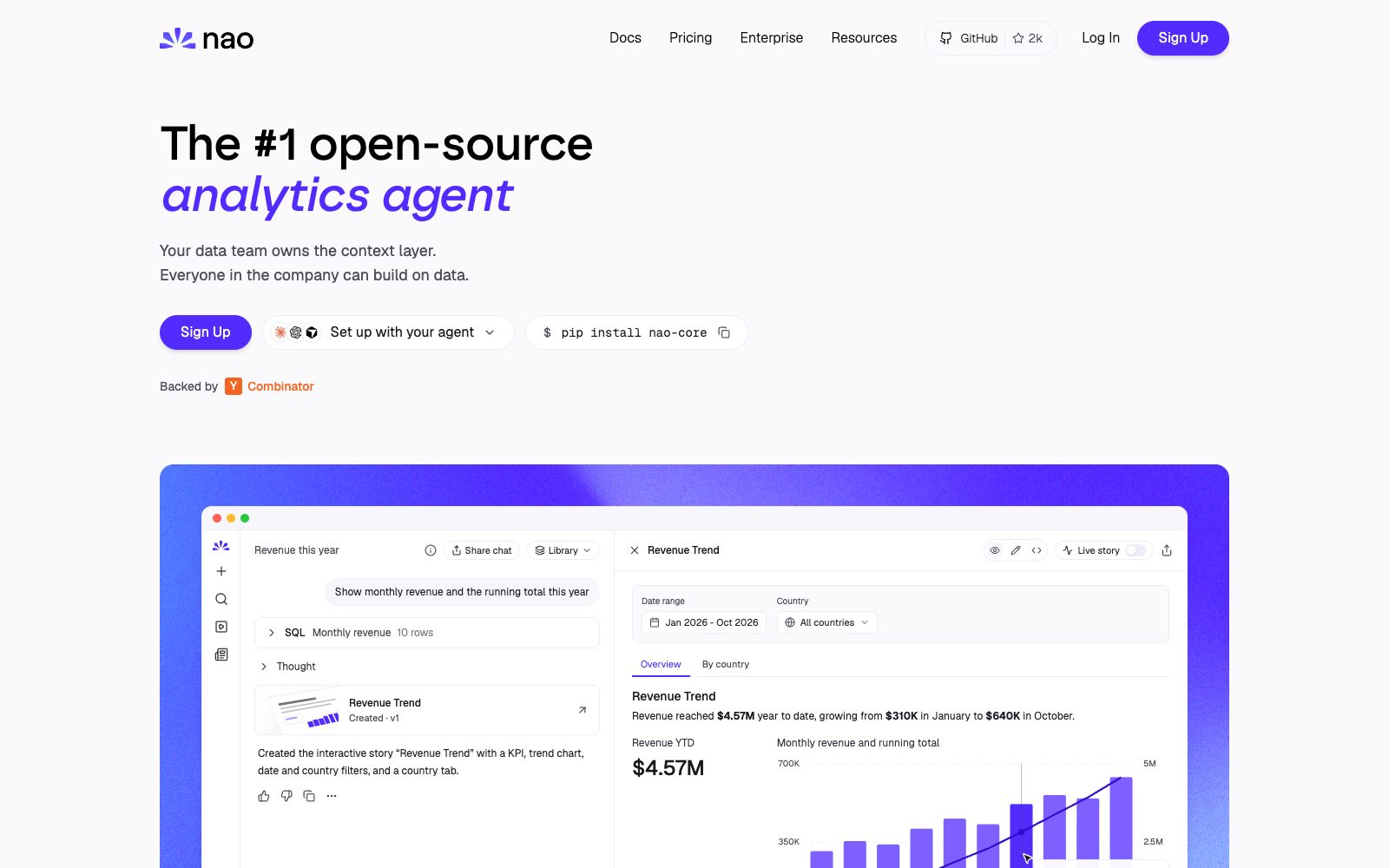
An open-source analytical AI agent building tool that compiles databases, dbt models and business documents into context and then deploys a Q&A interface capable of writing SQL and generating charts.
Updated: 2026-10-26
What is NAO?
The official title of nao is "Analytical Agent Built for Context Engineering". In plain language: it doesn't sell "smarter models", but the set of tools that solidify context engineering. Its approach is much like building a file system for an agent—with directories for databases, documents, queries, code repositories, and semantic definitions, it places table structures, field descriptions, business definitions, sample queries, and dbt models into these directories. Before answering questions, the agent reads these materials first, then runs SQL queries from the repository. It is 100% open source and can be self-hosted.
Who is it for?
- Data teams and analysis engineers: They want business users to query data independently without writing ad-hoc SQL every time.
- Teams already using dbt and Looker: Turn existing model and metric definitions directly into agent context.
- Industries sensitive to data cross-border: Require self-hosting, own API keys, and keep data within the internal network.
- Product and operations teams looking to integrate agents into Slack: The official provides MCP multi-entrance paths.
- People who only want "out-of-the-box business intelligence" are not suitable: it requires you to organize the context first, and the early stage is engineering work.
Key features
8Context as a File System
Officially, it says that running `nao init` generates a directory where you can store data, metadata, rules, documents, tools, and MCPs with no upper limit.
Synchronize Existing Context
`nao sync` automatically pulls and organizes data from sources such as databases, code repositories, and Notion.
Reliability Testing
`nao test` uses "question-to-SQL" unit tests to provide pass rates, response rates, average time consumption, and token usage.
Conversational Analysis
`nao chat` allows you to ask questions in natural language, and the agent will explore table structures and metrics one by one, execute SQL queries, and generate charts.
Publish to Others
You can deploy a chat interface with a UI, support bringing your own model keys, and only pay for token usage fees.
Multi-Entry Querying
Officially, through nao MCP, you can ask questions in Slack, Teams, WhatsApp, Telegram, Claude, Codex, and Cursor.
Self-hosting
Everything stays within your own infrastructure, using your own keys. The official team highlights this as a key data security selling point.
Data Source Coverage
Example configurations include BigQuery, dbt repositories, and Notion pages.
How to use NAO
- Run initialization first before evaluating results: If the context directory is empty, even the most powerful model will give inaccurate answers.
- first complete the field descriptions and business definitions of core tables.
- Build a regression suite with the test command: Write tests for the top ten or so business questions most frequently asked, run them every time the context is updated, and prevent degradation from over-tuning.
- Lock down permissions at the warehouse level: Assign the agent a read-only database account and only expose essential tables.
- the official configuration supports table inclusion and exclusion.
- Cost depends on tokens: Official test outputs report total token usage.
- complex queries consume a lot, so start with limits before lifting restrictions.
- Open source does not mean zero maintenance: Self-hosting requires you to manage upgrades, keys, and backups on your own.
- verify the license and official security documentation before commercial use, as the rules may be adjusted.
Traffic & popularity
Data month Sep 2026
NAO receives about 77.0K visits per month and ranks #364,619 worldwide.
Monthly visits
12 monthsTraffic sources
- Direct40.8%
- Search33.5%
- Referrals10.4%
- Social6.3%
- Display ads3.1%
- Other5.8%
Top countries
- United States25.8%
- Spain16.7%
- Russia12.7%
- Brazil9.9%
- India8.3%
Estimated from third-party traffic data.
Similar tools
 VoiceflowAn enterprise-level AI agent platform for customer service teams, which enables visual orchestration of conversation and voice processes, integrates knowledge bases and business tools, and can be launched for service on channels such as web pages, Apps, and WhatsApp.
 Coze StudioCoze Studio's open-source entry, where the official team releases a development platform, a compass for operation and maintenance optimization, and a Go-based open-source agent framework. It is suitable for technical teams that want to build their own agent platforms or perform secondary development.