


RunThisLLM
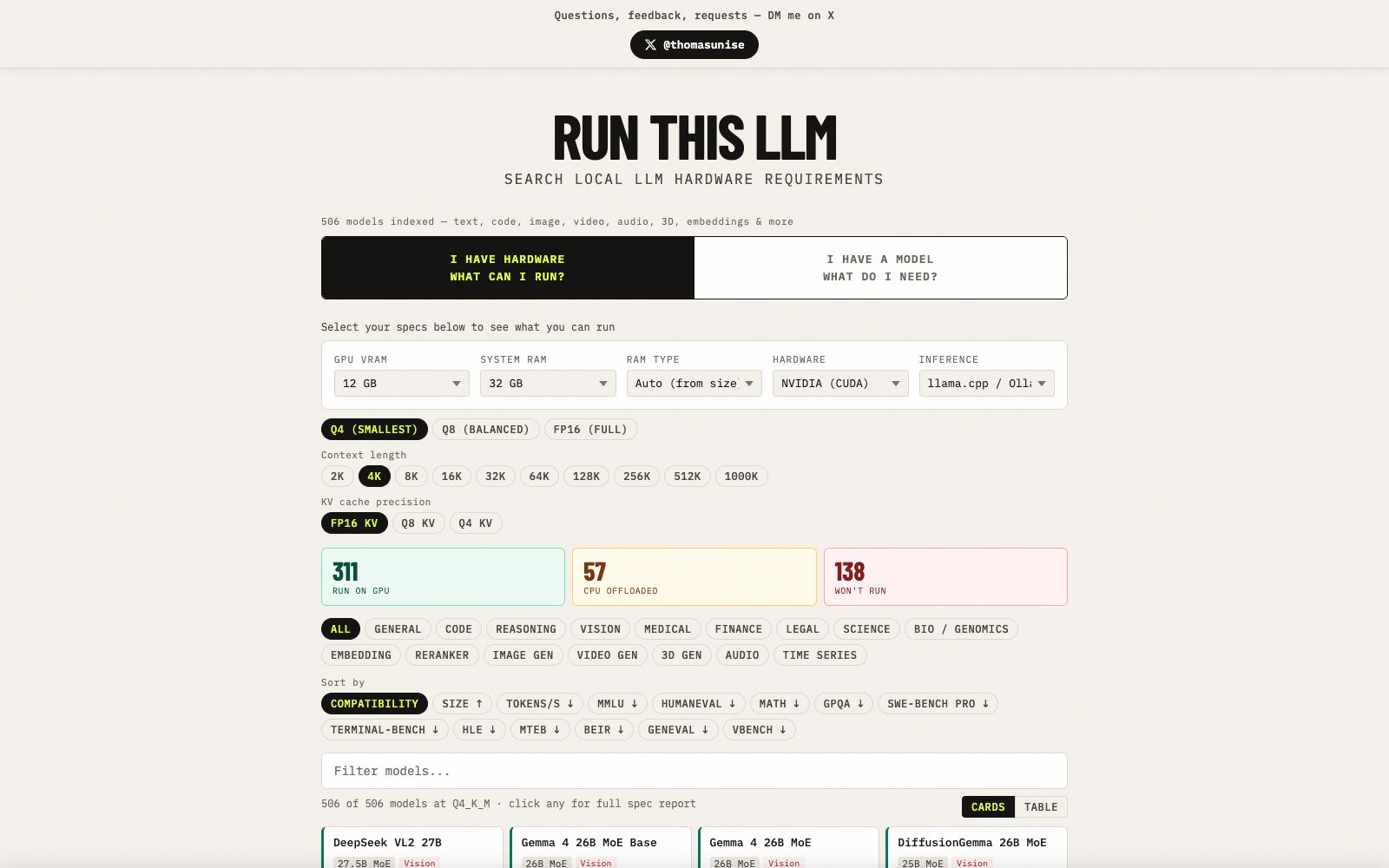
A retrieval tool for querying the hardware requirements of local models, indexing 506 text, code, image, video, audio and 3D models. It can reverse-check what can be run based on video memory and memory, and also reverse-check the required configurations and performance benchmarks based on the models.
Updated: 2026-10-26
What is RunThisLLM?
RunThisLLM is a hardware retrieval tool designed for the "locally deployed models" scenario, solving a very specific problem: what configuration is actually needed to run a certain model. It indexes 506 models covering categories such as text, code, images, videos, audio, 3D and embeddings, and supports bidirectional queries—you can either look up "what I can run" based on your hardware conditions, or "what is required to run it" for a specific model. The official claims to provide complete build specifications, performance estimates and benchmark data, helping you make judgments before buying graphics cards, replacing machines or renting cloud GPUs, avoiding the awkwardness of "finding it can't run after purchase". Such queries are particularly valuable in the current era of rapid model iteration: new models emerge almost every week, and hardware specifications are also changing. It is difficult to keep up with this by memory, and it centralizes the "model-hardware" correspondence into a retrievable entry.
Who is it for?
- Developers and enthusiasts who plan to deploy large models in local or private environments, especially those who want to confirm whether it's "worth it" before buying graphics cards, upgrading machines, or renting cloud GPUs; it is also suitable for engineers who make model selection and hardware budget decisions for their teams, as well as delivery personnel who help customers evaluate localized deployment solutions. If you just want to quickly learn "what your current machine can do", this guide is light enough to be used as a query manual.
Key features
5Dual-direction Query
Look up the list of runnable models based on hardware conditions such as GPU video memory and system memory, or check the required hardware thresholds after selecting a model.
Detailed Specification Input
VRAM options range from pure CPU to 640GB, system memory from 4GB to 512GB. It also supports custom values and memory type options, making it close to real-world machines.
Multimodal Coverage
It includes not only text models but also image, video, audio, 3D and embedding models, with a wide range of coverage.
Build and Performance Information
The official claims to provide complete deployment specifications, performance estimates, and benchmark data, rather than just a simple conclusion of "whether it can run".
Quick Filtering and Comparison
You can quickly narrow down the options based on your own machine specifications, making it suitable for batch evaluation of multiple hardware solutions or multiple variants of the same model.
How to use RunThisLLM
- Treat it as the first filter for model selection: first reverse-search for candidate models within the budget range for hardware, then run a real evaluation on the candidates to confirm the gap between "being loadable" and "running smoothly".
- Take the target scenarios (long context, concurrency, quantization precision) into account as well.
- only then will the conclusion be truly implementable.
- Also, pay attention to the types of models covered by the index.
- If your target model is not on the list, you can directly check the official documentation or community reports to supplement the information.
- In addition, don't overlook the pure CPU configuration—many lightweight models and quantized versions can also run on CPUs.
- When the budget is limited, use it to explore the lower limit first, which is often more pragmatic than directly using a graphics card.
Things to know
Traffic & popularity
Data month Sep 2026
RunThisLLM receives about 3.6K visits per month and ranks #5,695,188 worldwide.
Monthly visits
10 monthsTraffic sources
- Direct40.1%
- Search34.2%
- Referrals10.1%
- Social6.5%
- Mail3.0%
- Other6.2%
Top countries
- United States32.5%
- France14.1%
- Colombia11.5%
- Brazil11.4%
- Germany8.6%
Estimated from third-party traffic data.
Similar tools
 Hugging FaceThe world's leading open-source AI community, hosting over 2 million models, datasets and Spaces applications, providing inference services, cloud computing power and team enterprise editions, supporting the entire process of model selection, trial, fine-tuning and deployment.
 LLM StatsAn independent ranking that converts the intelligence level, speed and price of over 300 AI models into a single comprehensive score. The data is continuously updated from public benchmarks and real API metrics, supporting multi-task dimension ranking.