


PaddlePaddle
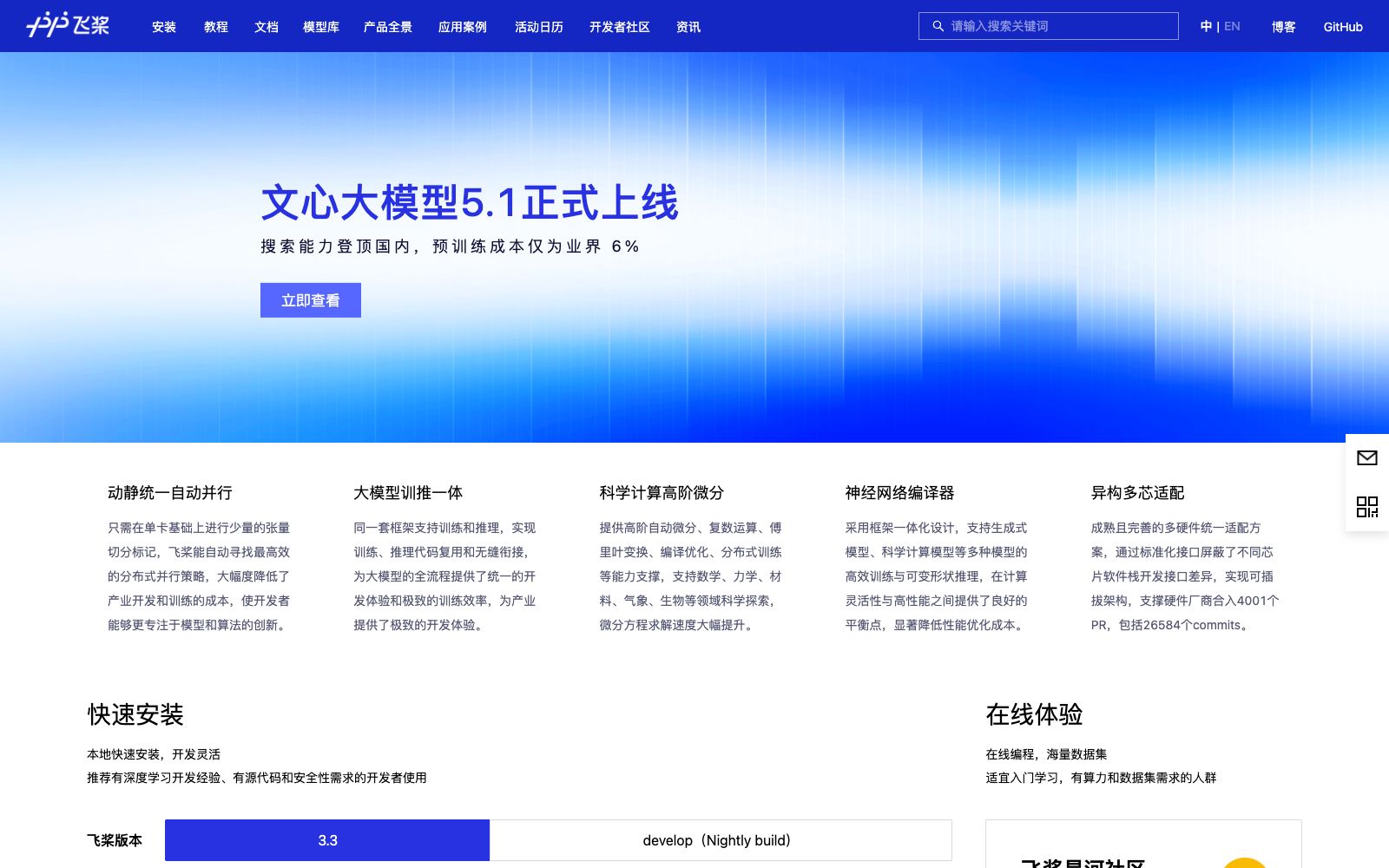
PaddlePaddle is an open-source deep learning platform developed by Baidu. Originating from industrial practices, it supports dynamic graphs and static graphs, provides large-scale parallel training and unified inference capabilities, and serves developers from beginners to industrial practitioners.
Updated: 2026-10-26
What is PaddlePaddle?
PaddlePaddle is an open-source deep learning platform launched by Baidu. Derived from real industrial practices, its goal is to make the innovation and application of deep learning technologies simpler. It supports both dynamic graphs and static graphs, balancing flexibility and efficiency, and provides industry-leading large-scale parallel training and integrated inference capabilities. The platform is also equipped with the Xinghe Community, a rich model library and multi-hardware adaptation solutions, serving developers from entry-level to industrial applications, and continuously collaborates with Wenxin Large Model for optimization.
Who is it for?
- Researchers in universities and research institutions can carry out frontier explorations such as model innovation and scientific computing on PaddlePaddle. The flexibility of the framework is suitable for verifying new methods.
- Enterprise engineers who wish to implement deep learning into their business operations can leverage mature frameworks to reduce development and deployment costs. Its industry-grade capabilities are more aligned with production environments.
- Beginner learners can use the free GPU computing power, tutorials and competitions on the Star River Community to start practicing from scratch. The community also provides rich introductory courses.
- Teams requiring adaptation to domestically produced hardware can leverage multi-chip support for smooth migration and deployment on domestic chips. Collaborative optimization of hardware and software unlocks the potential of hardware.
- Users of development kits such as PaddleX and PaddleOCR can quickly build industry-level AI applications. Low-code kits further lower the threshold.
Key features
5Unifying dynamic and static graphs and automatic parallelization allow developers to perform a small amount of tensor splitting based on a single GPU, and the framework automatically finds efficient distributed strategies. This significantly reduces the engineering cost of large-scale training.
The unified training and inference for large models supports completing training and inference with the same framework, realizing code reuse and seamless connection of processes. It provides a unified development experience for the entire process of large models.
High-order differentials in scientific computing provide complex number operations, Fourier transforms and distributed training, supporting explorations in fields such as mathematics and meteorology. The speed of solving differential equations has also been improved.
Heterogeneous multi-core adaptation shields differences between various chips through standardized interfaces, and has supported multiple hardware devices such as NVIDIA, Kunlunxin, and Ascend. The pluggable architecture makes it convenient for hardware manufacturers to integrate and adapt.
The industry-grade open-source model library includes over 600 algorithms and leading pre-trained models, covering multiple fields such as natural language processing, computer vision, and speech. The large number of algorithms means there is ample room for selection.
How to use PaddlePaddle
- For beginners, first experience online programming and massive datasets on the PaddlePaddle Star River Community, and then decide whether to install the framework locally.
- The community is suitable for people who need introductory learning and computing power.
- Experienced developers are recommended to deploy locally using pip, Docker or source code compilation, which facilitates customization and debugging.
- Choose the installation method according to the operating system and chip.
- For large model projects, prioritize the unified training and inference capability to reuse code and reduce the conversion cost between training and inference.
- The unified framework delivers an ultimate development experience.
- When deploying on domestically produced chips, refer to the multi-hardware support list to confirm the compatibility and version status of the target hardware.
- The framework will release updates synchronously for multi-hardware support.
- Make good use of mature suites such as PaddleOCR and PaddleNLP, avoid reinventing the wheel, and speed up delivery.
- Official suites usually undergo sufficient verification.
Traffic & popularity
Data month Sep 2026
PaddlePaddle receives about 216.2K visits per month and ranks #169,138 worldwide.
Monthly visits
12 monthsTraffic sources
- Search58.4%
- Direct23.0%
- Referrals16.6%
- Social1.0%
- AI assistants1.0%
Top countries
- China71.7%
- Singapore3.0%
- United States2.7%
- Russia2.3%
- Vietnam1.6%
Estimated from third-party traffic data.
Similar tools
 PaddlePaddle AI StudioA learning and training community for AI learners under Baidu PaddlePaddle, integrating free courses, cloud GPU computing power, classic datasets and sample projects, supporting Wenxin Yiyan large model development, one-click deployment and algorithm competitions.
 MindSporeHuawei's open-source self-developed full-scenario AI framework supports training and inference on edge, end, and cloud devices. It provides automatic differentiation, distributed parallelism, and a rich set of toolkits, targeting algorithm engineers and data scientists, and covers the entire process from training to deployment.