


Nabla
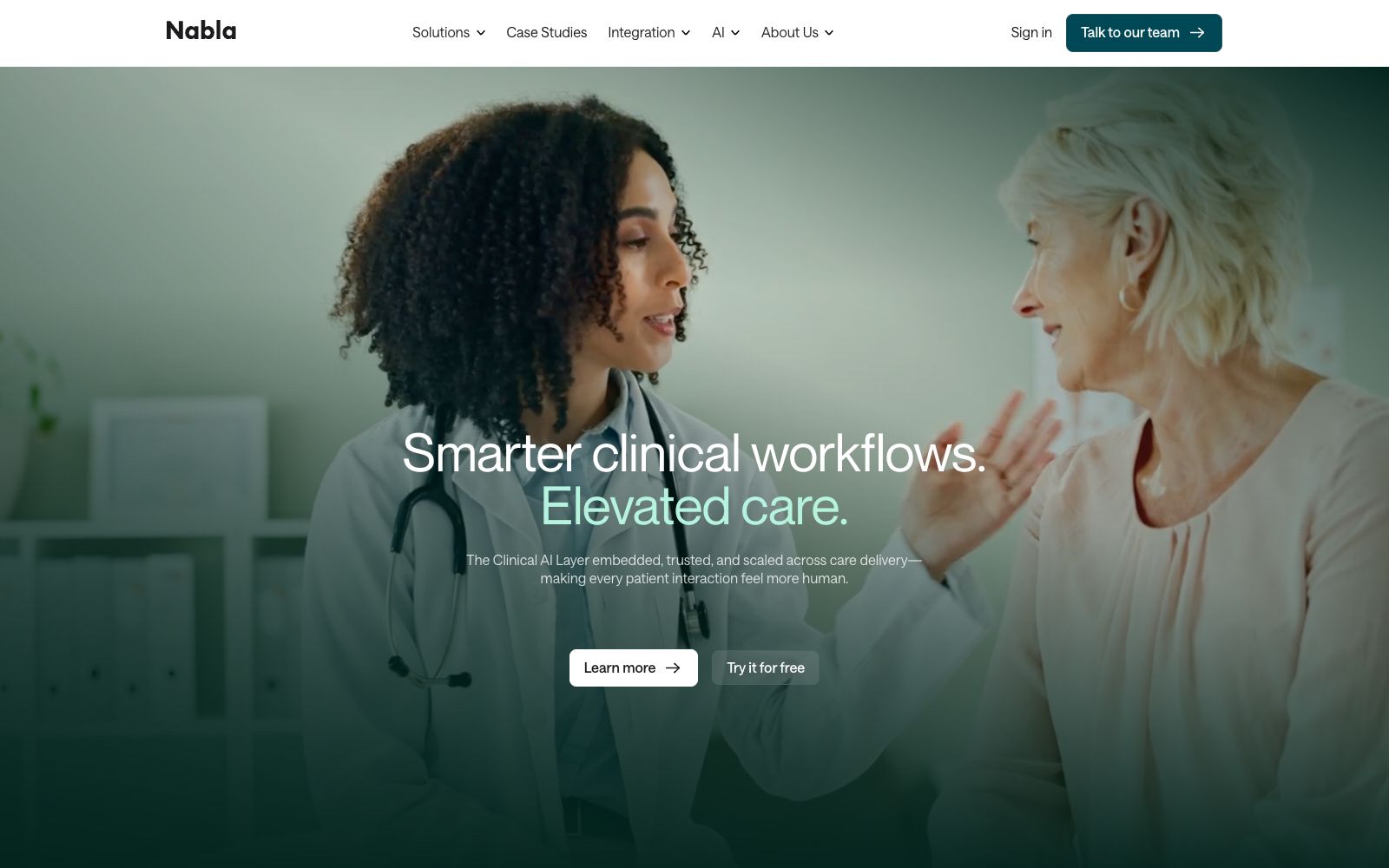
Nabla is a clinical environment-oriented AI assistant that automatically converts doctor-patient conversations into structured medical records, and provides clinical voice dictation as well as E/M and ICD-10 coding suggestions. The notes and coding need to be confirmed by doctors.
Updated: 2026-10-26
What is Nabla?
Nabla is a clinical ambient AI assistant, positioned as a clinical AI layer that is "embedded in clinical delivery, trusted, and scalable". It restores the human connection between doctors and patients by turning conversations into medical records. Unlike general transcription software, it integrates ambient documentation, voice-to-text, coding, and EHR into a single workflow, serving every step from pre-appointment to final coding.
Who is it for?
- Outpatient and inpatient physicians who want to reduce medical record writing and professional burnout.
- Medical institutions that have deployed EHR systems such as Epic and require voice dictation and coding assistance.
- Healthcare system management teams focused on physician retention and the quality of patient interactions.
- Multi-specialty, high-volume healthcare networks with high requirements for data security and compliance.
- Partners who want to integrate AI documentation capabilities into their own products (Nabla Connect and API are provided).
Key features
6Ambient Documentation
Captures clinician-patient conversations and automatically generates accurate, structured clinical notes, allowing physicians to focus on patients rather than screens. The company claims it saves over 1 hour of documentation time per day.
Clinical Speech Dictation
Built with clinical-grade speech recognition, it integrates directly with mainstream EHRs such as Epic, enabling fast and accurate documentation that aligns with doctors' actual recording habits.
Smart Coding
Provides recommendations for E/M and ICD-10 codes based on medical records and AMA guidelines, but the final decision always rests with the physician.
Deep Customization
Flexible configuration allows each physician to adjust note styles by specialty, preference, and workflow, rather than a one-size-fits-all approach.
Enterprise-grade Reliability
Delivers integration and infrastructure tailored for large, complex organizations, with data retention policies configurable to meet governance requirements.
Compliance & Trust
Complies with HIPAA, SOC 2 Type 2, ISO 27001, and GDPR, and collaborates with the CHAI Alliance to drive healthcare AI governance.
How to use Nabla
- 1The generated notes and coding are only auxiliary; they must be reviewed, modified, and confirmed by the physician before use, and the final draft cannot be submitted automatically.
- 2New users can try it for free (Try it free is officially provided) and run through small specialties before expanding.
- 3Before launch, confirm the scope of EHR integration, informed consent for audio recording, and data retention policies to ensure compliance with local privacy regulations.
- 4Use the saved time to improve in-person communication; the official claims it enhances doctor-patient interaction and reduces burnout, but the effect depends on the implementation approach.
- 5Before corporate procurement, verify the SLA, model update frequency, and compliance certificates (HIPAA, SOC2, ISO), and take the contract as the final reference.
Traffic & popularity
Data month Sep 2026
Nabla receives about 516.7K visits per month and ranks #71,740 worldwide.
Monthly visits
12 monthsTraffic sources
- Direct84.5%
- Referrals7.5%
- Search5.6%
- Social1.1%
- Mail0.7%
- Other0.6%
Top countries
- United States94.9%
- France2.1%
- Canada0.9%
- India0.6%
- Brazil0.5%
Estimated from third-party traffic data.
Similar tools
 AbridgeAbridge is a generative AI clinical documentation tool for doctors. It real-time generates structured medical records, coding and summaries during doctor-patient conversations. It is built by clinicians for clinicians, and the notes need to be reviewed by doctors.
 FreedAI medical record assistant for independent clinics organizes consultation dialogues into notes that can be synchronized with electronic medical records, provides coding suggestions and cited clinical Q&As, helping doctors spend less time writing medical records.
 HeidiAn AI medical assistant for clinic consultations can sort doctor-patient conversations into medical records, retrieve guidelines and literature and mark sources during diagnosis and treatment, while emphasizing compliance. It is suitable for outpatient doctors and residents.
 TalknotesTalknotes is an AI voice note-taking app that can convert voice recordings into structured text, generate to-do lists, transcripts, blogs, etc. It supports more than 50 languages and is available on Web, iOS and Android platforms.
 OpaliteOpalite is a real-time medical interpretation service for medical scenarios. According to its official website, it supports more than 150 languages and dialects, enables bidirectional voice translation, and can be integrated into medical record systems. It also provides sentence-level security checks and compliance audits.
 Lyrebird HealthA clinic recording assistant for clinicians, which real-time converts consultation dialogues into structured medical records, synchronizes bidirectionally with EMR, and automatically generates referral letters and care plans, suitable for general practice and specialized departments.