


Lettertrace
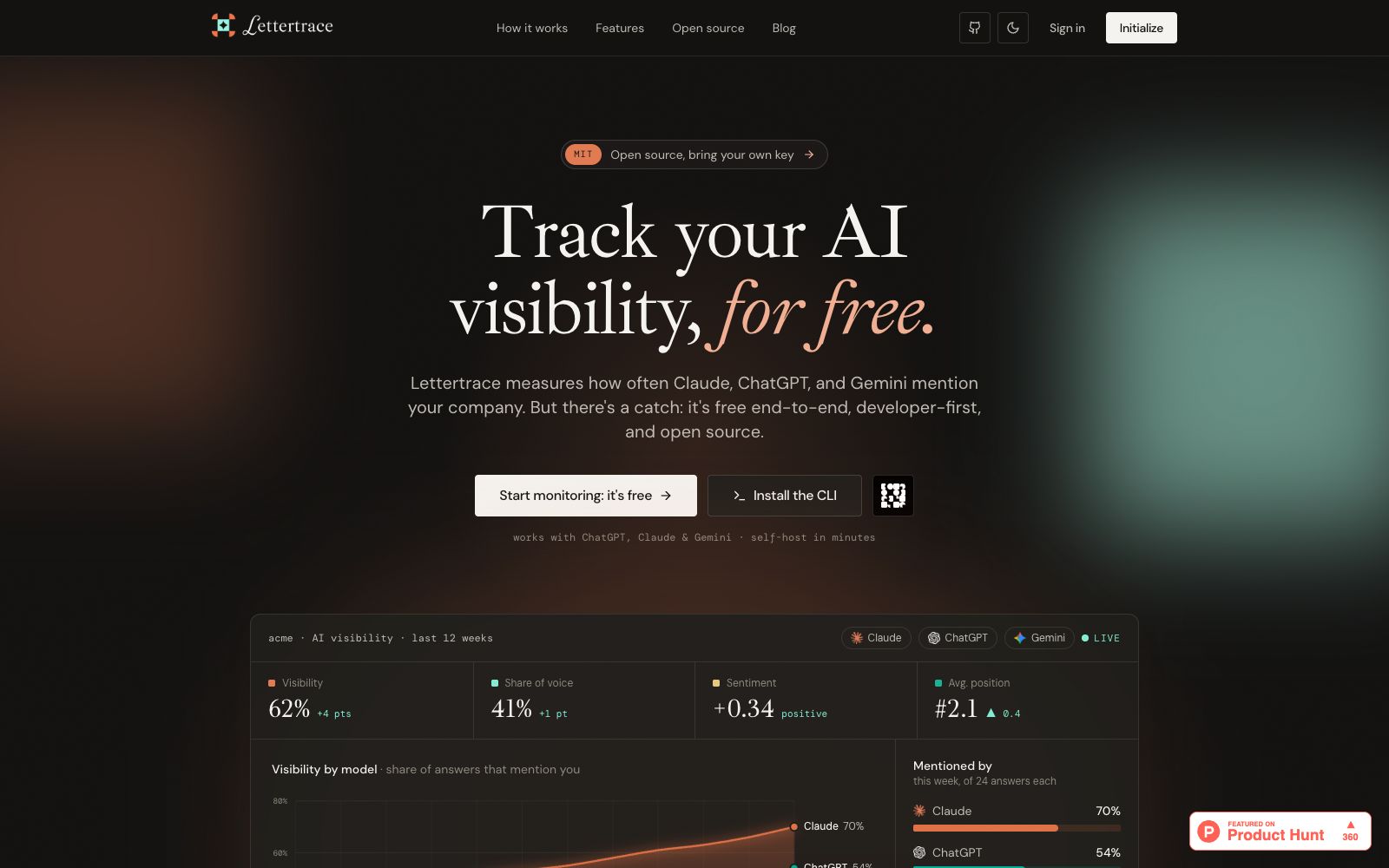
Lettertrace is an open-source AI visibility monitoring tool with a built-in proprietary key: after entering a topic, it automatically expands into dozens of questions, asks Claude, ChatGPT, and Gemini, counts mentions, rankings, emotions, and competitor voice share one by one, and can also generate trend lines at regular intervals.
Updated: 2026-10-26
What is Lettertrace?
Lettertrace measures "how quickly Claude, ChatGPT and Gemini mention your company in their responses". The official website positions it as an open-source, bring-your-own-key AI visibility monitoring tool. Its difference from common SEO tools lies in the metrics: instead of tracking rankings on search engine results pages, it expands topics into specific questions, queries each model directly, and then analyzes the mentions, positions and sentiment in the responses one by one. The official website emphasizes that it is completely free end-to-end, developer-first, open-source under the MIT license, self-hostable, and your data resides in your own Supabase.
Who is it for?
- Marketing and growth teams working on AEO/GEO who need to quantify the brand's presence in AI assistant responses as a metric.
- Brand and product marketing teams with a clear set of competitors who want to see the ebb and flow of share of voice.
- Content teams that want to verify whether actions like publishing comparison pages and striving for citations have actually increased the rate of AI mentions.
- Engineering teams who are comfortable with the command line, willing to self-host, and keep their data on their own infrastructure.
Key features
6Automatic Generation from Topics to Queries
The first step in the official website's process is "Track a topic". Just write one line describing the question buyers care about, and Lettertrace will automatically generate dozens of prompts that resemble real queries, eliminating the need to write prompts manually.
Multi-Model Parallel Querying
Run queries to Claude, ChatGPT, and Gemini at once. The official website states that each response will be analyzed for mentions, position, and sentiment; the monitoring scope also includes Google AI Overviews, and more answer engines can be added as needed.
Sentiment and Recommendation Analysis
The official website states that it not only judges whether your company is mentioned but also assesses how the model evaluates your brand in its responses and whether it recommends your company.
Share of Voice and Competitor Benchmarking
Share of Voice breaks down and compares your share against the tracked competitors. In the official website example, Acme's share rose from 22% to 41% within 12 weeks. You can also mark events such as "Launch Comparison Page" and "Cited by Claude" to explain the changes in the curve.
CLI and Scheduled Monitoring
The `lettertrace run` command outputs the number of mentions, share of voice, and sentiment in a single run. The official website states that it can be automatically run daily or weekly, with each run counting as a data point to form a trend line.
Built-in API Keys & Self-Hosting
Use your own Anthropic, OpenAI, and Google API keys. The official website states that the keys are statically encrypted and never leave your infrastructure. The MIT license allows forking and self-hosting, with data stored in your own Supabase instance—no middleman markup.
How to use Lettertrace
- 1Add only one or two core topics first to run a baseline, then gradually add more topics and competitors; otherwise, the first round of data points will be too scattered to identify the trend.
- 2Write the topic description in one line using the buyer's exact words; do not write it as a brand slogan, as the question generation is expanded based on this sentence.
- 3The costs are borne by your own model accounts. Before running, estimate the number of prompts × the number of models × the frequency, and use a low frequency for scheduled monitoring.
- 4Focus on trends, not single runs: The official website emphasizes that every run is a datapoint, as single runs have large fluctuations. Analyze the data together with the launch events you have marked.
- 5For self-hosting, you need to prepare your own Supabase and model keys in advance; follow the steps on the official website to clone the project and configure the .env.local file.
Traffic & popularity
Data month Sep 2026
Lettertrace receives about 42.8K visits per month and ranks #543,128 worldwide.
Monthly visits
5 monthsTraffic sources
- Direct49.5%
- Display ads18.0%
- Referrals12.2%
- Search11.1%
- Social6.5%
- Other2.8%
Estimated from third-party traffic data.
Similar tools
 GrackerAIGrackerAI is an AEO and GEO platform for B2B SaaS, continuously monitoring brands' visibility in AI search engines, diagnosing the reasons for non-citation, and producing citable content.
 Brand24Brand public opinion monitoring platform, officially claims to track brand mentions, sentiment and source distribution from sources such as social media, news, forums and podcasts, supports mentions in competitor comparison, real-time reminders and AI answers, with the full version starting at $199 per month after a 14-day free trial.
 ClearscopeClearscope is an SEO and AI search optimization platform for content teams. It builds writing workflows around search intent and term suggestions and tracks brand visibility in AI answers.
 Nightwatch AI TrackingNightwatch AI Tracking helps brands monitor their visibility, position, share of voice, and sentiment across ChatGPT, Claude, Gemini, and Perplexity. It also connects AI citations with Google ranking data, giving teams a clearer view of how their brand performs in AI-powered search.