


KNIME
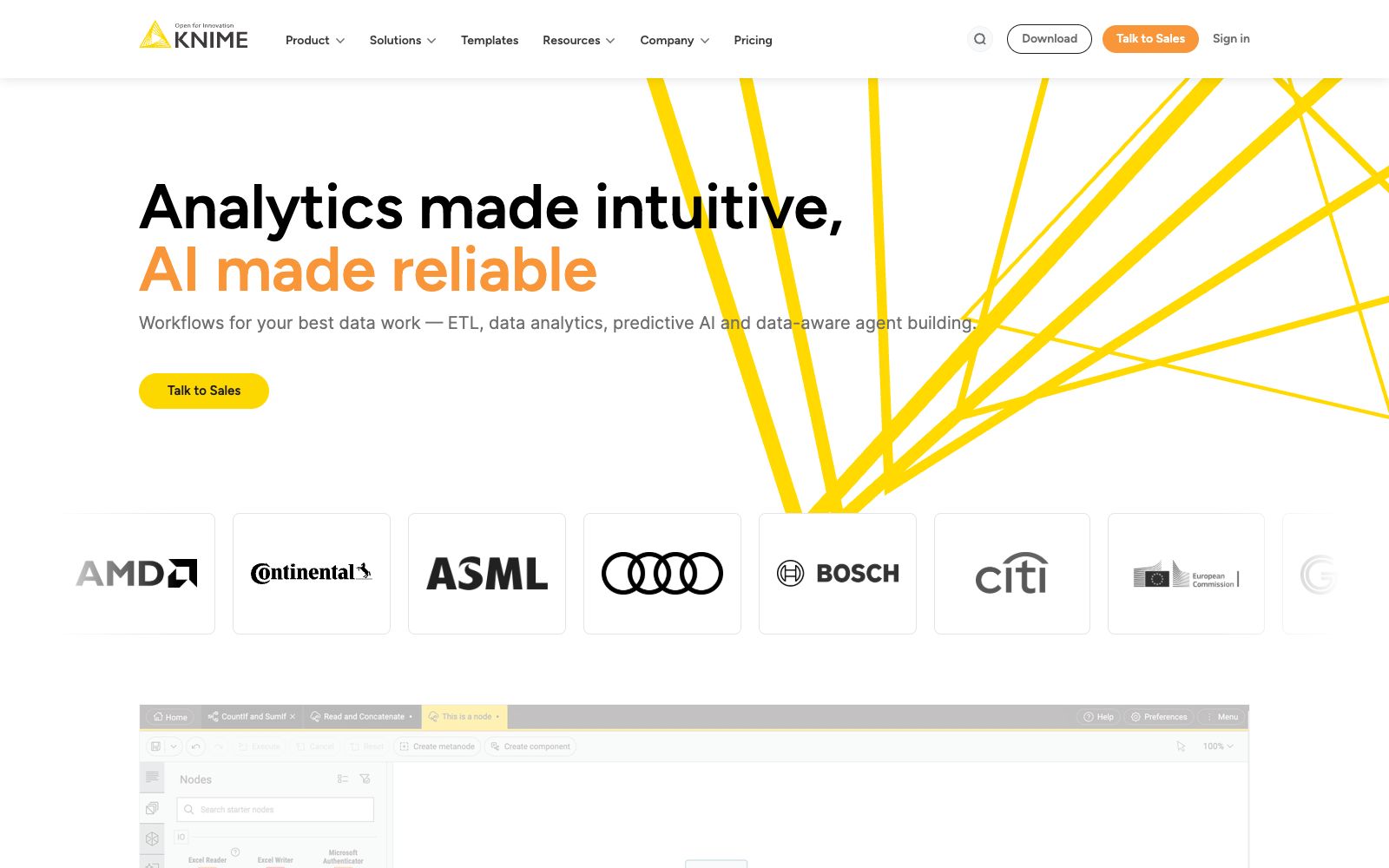
KNIME is a free and open-source data analysis platform. It uses visual nodes and workflows for ETL, analysis, predictive AI and agent building, and can connect to numerous data sources and be deployed in enterprise production.
Updated: 2026-10-26
What is KNIME?
KNIME is a free and open-source data analysis platform. Officially, it enables the creation of data science solutions with a visual workflow builder and their deployment into enterprise production. Its core concepts are "nodes" and "workflows": each node performs a discrete task on data (reading, transforming, merging, learning, predicting, visualizing), and connecting nodes from left to right forms an analysis process that can be run repeatedly. Unlike code-based modeling, KNIME emphasizes intuitiveness and interpretability, covering areas from ETL, data analysis, predictive AI to "data-aware intelligent agent construction". The enterprise edition also highlights sensitive data protection as well as model verifiability and monitorability.
Who is it for?
- Analysts who want to perform data analysis and modeling in a low-code manner without having to write code throughout the process.
- Data teams that need to string ETL, analysis, and predictive models into reusable workflows.
- Enterprises and public sector organizations that require model interpretability and data governance.
Key features
5Nodes and Workflows
Assemble analysis workflows using visual nodes, which can be run node by node, in segments, or as a whole, and re-run at any time.
Connect any data source to the model
The official listing includes extensive connections such as Microsoft Fabric, Redshift, Azure, Snowflake, Databricks, BigQuery, Oracle, SAP, and Salesforce.
From Analysis to AI
Covers data cleaning and filtering, basic and advanced analytics (such as decision trees for customer churn analysis), geospatial and image analysis, deep learning, and generative AI.
Enterprise-grade Governance
Business teams use KNIME to ensure the security of sensitive data, the verifiability and monitorability of models, and the interpretability of results.
Phased Capabilities
End-to-end process of Blend & Transform, Model & Visualize, Deploy & Monitor, and Consume & Interact.
How to use KNIME
- 1Start by modifying an official template to create a node workflow, understand the rhythm of "nodes - connections - execution", and then build your own.
- 2Use version and permission management for enterprise scenarios to ensure that sensitive data is not leaked and models can be monitored.
- 3Generative AI and deep learning nodes consume significant resources; validate them in small-scale local tests before deploying to production.
- 4The open-source version is free; enterprise features and pricing are subject to the descriptions on the official website under Pricing and Enterprise.
Traffic & popularity
Data month Sep 2026
KNIME receives about 1.0M visits per month and ranks #38,559 worldwide.
Monthly visits
12 monthsTraffic sources
- Direct46.4%
- Search41.2%
- Referrals8.0%
- Social1.7%
- Mail1.3%
- Other1.4%
Top countries
- United States19.8%
- Germany15.0%
- India8.0%
- Brazil3.6%
- Indonesia3.5%
Estimated from third-party traffic data.
Similar tools
 n8nAn open-source workflow automation platform that integrates AI capabilities with business processes. It features a visual canvas for building while retaining code editing space, with full traceability of Agent reasoning on the canvas. It supports over 500 integrations and can be self-hosted for deployment.
 marmosA conversational data analysis tool under the Tencent ecosystem that can connect to databases or local files, generate SQL, visual dashboards and reports through conversations, and support workflows, subscription alerts and team collaboration.
 ChatSPSSThe online statistical analysis tool launched by Chengdu Nature Intelligence Technology supports uploading CSV, Excel, SPSS and Stata data. According to the official website, it covers more than 27 statistical methods and automatically generates three-line tables and interpretations.
 Tableau GPTA business intelligence and data analysis platform under Salesforce, it can connect to almost all databases and generate visualizations through drag-and-drop, and has integrated Agentic AI and conversational analysis (Tableau Agent) into its entire product line.
 DomeryA domestic full-link data AI assistant for data teams, according to its official website, it covers event tracking design and code generation, multi-source data access, semantic library management and AI visualization, and supports switching of multiple models.
 Julius AIAn AI workspace for knowledge workers that connects to databases, analyzes data, and generates reports, presentations, charts, and multimodal content in natural language. It supports data sources such as Postgres and Snowflake and has obtained SOC 2 certification.