


Docus AI
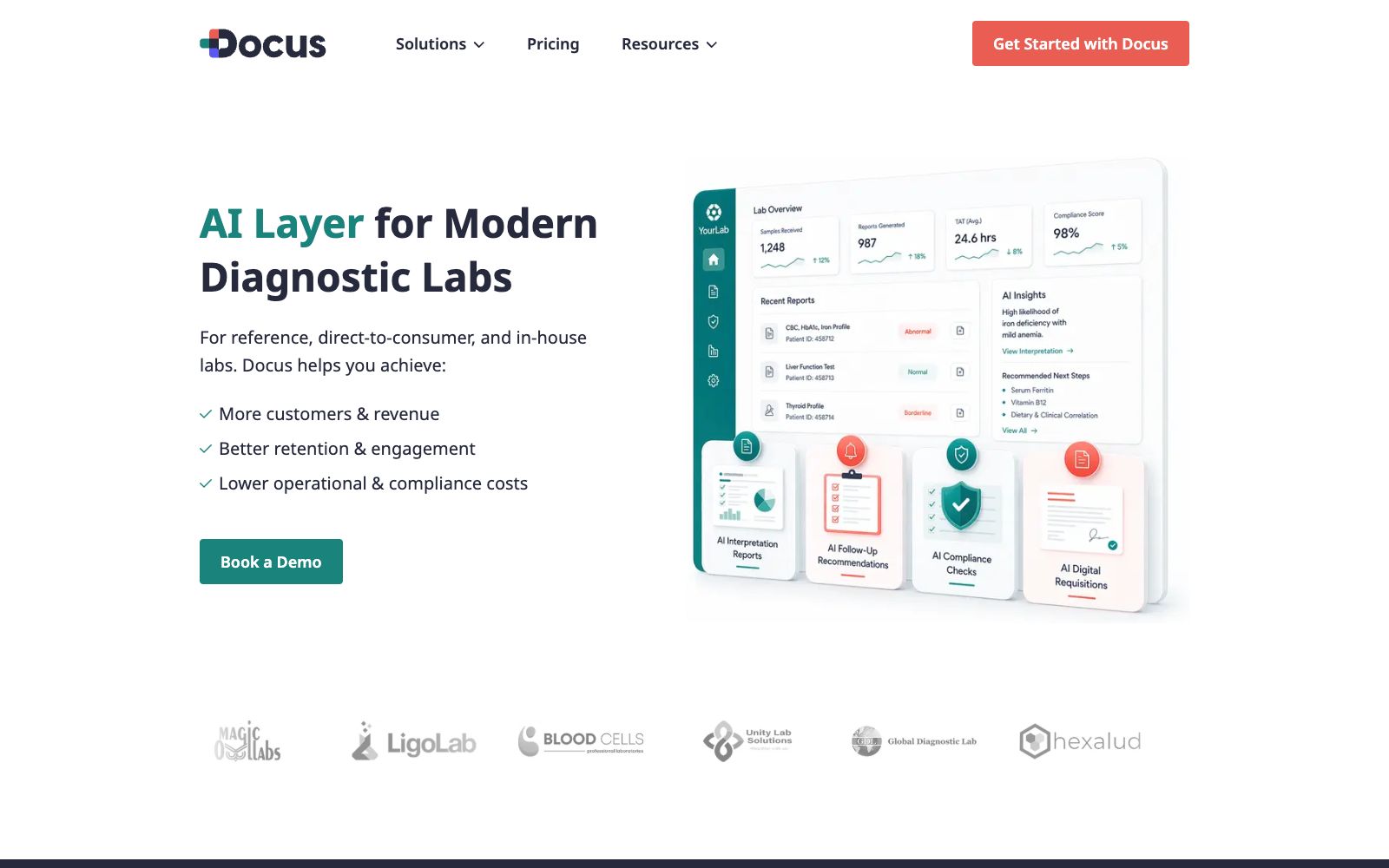
Docus is an AI platform for medical testing institutions, providing test report interpretation, follow-up suggestions, compliance verification, and digital order forms, helping laboratories increase retest rates and operational efficiency.
Updated: 2026-10-26
What is Docus AI?
Docus is an AI platform for medical testing institutions, officially referred to as an AI middle layer added to testing laboratories. It does not serve individual patients but reference laboratories, direct-to-consumer testing labs and in-hospital laboratories, automating processes such as report interpretation, follow-up, compliance verification and application forms. Compared with clinical auxiliary tools for doctors, it is closer to the operation and revenue processes of testing laboratories.
Who is it for?
- Independent testing laboratories and chain labs: Those looking to increase the retest rate and reduce the labor input required for report interpretation.
- Direct-to-consumer testing laboratories: They need to convert professional reports into versions that patients can understand and are willing to share.
- In-hospital laboratories: looking to reduce the workload of report interpretation and speed up in-hospital decision-making.
- Compliance and Operations Managers of Testing Institutions: Need to pre-emptively intercept the risk of payment rejection at the order entry stage.
Key features
6Report Interpretation
Generates two sets of results at once. The clinical report for doctors includes differential diagnosis, follow-up suggestions, and treatment plans, while the version for patients presents the same data in easy-to-understand conclusions.
Follow-up Recommendations
Based on test results and identified risks, it recommends the next examinations to be conducted and reminds patients to return for follow-up at the appropriate time to drive retests.
Compliance Agent
Performs matching verification between billing items and diagnostic codes, identifies medical necessity issues before claim denials occur, and checks the frequency of duplicate tests.
Digital Requisition Form
It provides auto-completion and guided input when doctors fill out the form, automatically generates a medical necessity explanation, supports electronic signatures, and is directly delivered to laboratories and LIS.
Scenario-based Assistant
It provides separate assistants for doctors and patients, with responses tailored to the patient's data and medical history rather than being generic Q&A.
Two Access Methods
It can be integrated via API or HL7 to feed structured reports back into LIS, CRM, or EHR systems; alternatively, it can be used directly through a ready-made interface without the need for integration.
How to use Docus AI
- First, clarify which segment to solve: Report interpretation, follow-up, compliance, and order forms are four relatively independent matters.
- you can launch one module first and then expand.
- Align the interface with IT early on: You can take either the API route or the non-integration interface.
- The former offers a smoother experience but requires scheduling and joint debugging.
- Take the case figures as a reference: In the 12-month case officially announced, the testing volume increased by 230%, the retest rate rose from 5% to 27%, and the satisfaction rate was 99.4%, all from a single laboratory.
- Compliance First: Officially claims compliance with HIPAA, GDPR, and SOC 2, with end-to-end data encryption and no mandatory requirement for personal identity information in core processes.
- The patient-facing module can be evaluated separately: The official website also offers a patient health assistant and a physician decision support tool, which do not need to be bundled with the laboratory's solution.
Traffic & popularity
Data month Sep 2026
Docus AI receives about 218.9K visits per month and ranks #187,120 worldwide.
Monthly visits
12 monthsTraffic sources
- Search72.2%
- Direct18.3%
- Referrals8.3%
- Social1.2%
Top countries
- United States26.0%
- Malaysia7.7%
- India6.2%
- Canada4.8%
- United Kingdom4.8%
Estimated from third-party traffic data.
Similar tools
 PearlPearl is an imaging AI for dental clinics. Officially, it can detect 37% more lesions, color-code findings in images and convert them into patient-friendly reports. It covers 2D and 3D imaging and is suitable for clinics and chain organizations.
 HeidiAn AI medical assistant for clinic consultations can sort doctor-patient conversations into medical records, retrieve guidelines and literature and mark sources during diagnosis and treatment, while emphasizing compliance. It is suitable for outpatient doctors and residents.
 DoctronicDoctronic connects AI consultations with real doctors. The official statement says you can describe your symptoms anonymously for free and get a treatment plan. A 39-dollar video consultation is available, suitable for pre-visit inquiries and prescription refills.
 Lyrebird HealthA clinic recording assistant for clinicians, which real-time converts consultation dialogues into structured medical records, synchronizes bidirectionally with EMR, and automatically generates referral letters and care plans, suitable for general practice and specialized departments.
 SnapEat AIAI calorie logging and diet tracking app that can recognize food and calculate nutritional information with just a photo, providing personalized meal suggestions, goal progress tracking, and fitness device data synchronization, targeting people who need weight loss and diet management.
 FreedAI medical record assistant for independent clinics organizes consultation dialogues into notes that can be synchronized with electronic medical records, provides coding suggestions and cited clinical Q&As, helping doctors spend less time writing medical records.