


Connected Papers
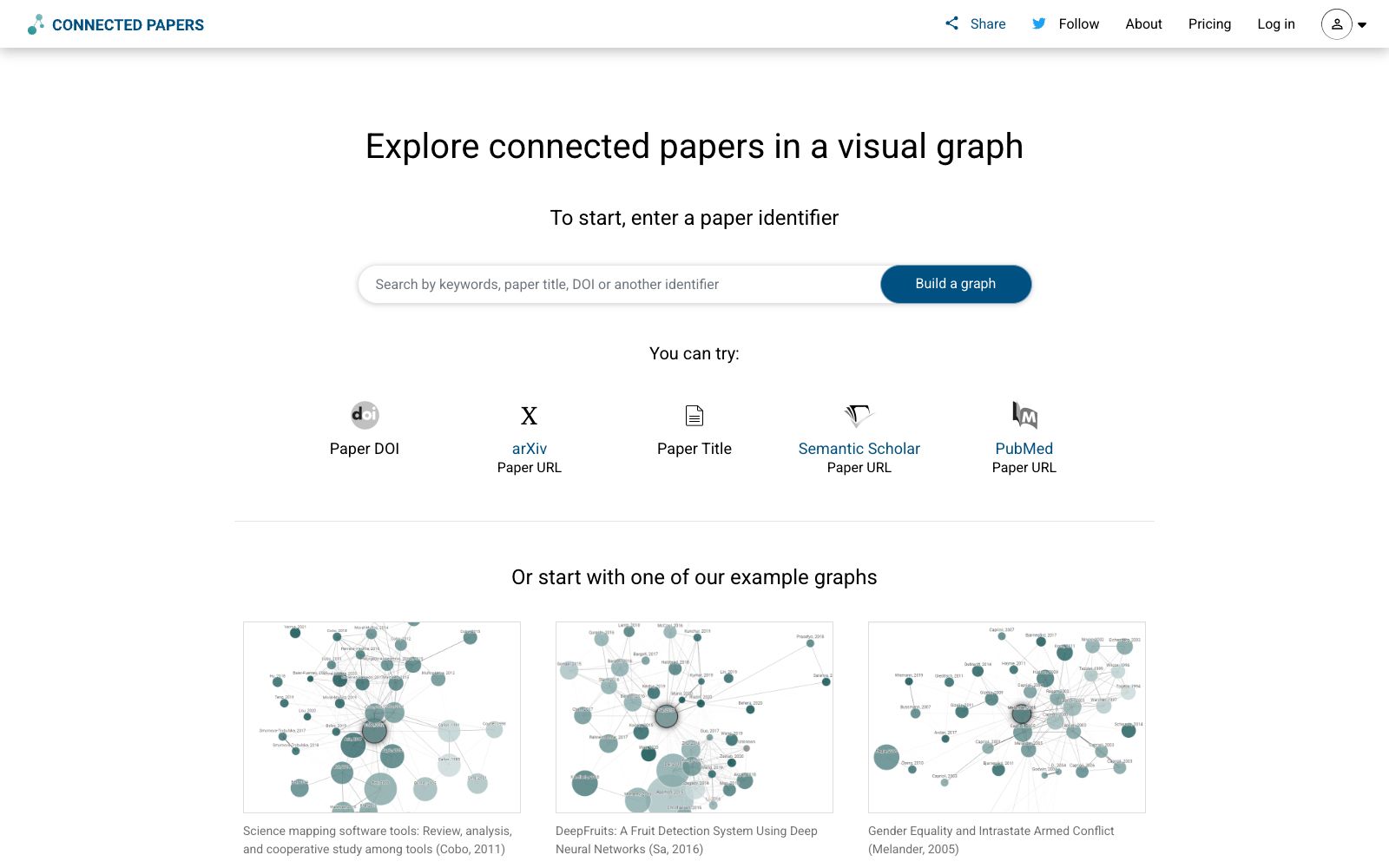
Connected Papers is a tool that helps researchers visually explore academic literature. Entering a single paper generates a relational graph of related papers, which is used for topic selection research, filling knowledge gaps, and constructing reference lists.
Updated: 2026-10-26
What is Connected Papers?
Connected Papers is a tool that helps researchers and applied scientists visually explore academic literature. Its official value proposition is "finding and exploring papers relevant to your field". Its core usage is simple: input an identifier of a paper (DOI, arXiv ID, URL, title, or a link from Semantic Scholar or PubMed), and it will generate a relationship graph of similar papers around this seed paper. For those who are new to a field or worried about missing important literature, such a graph presents the field's context more intuitively than keyword searches. The official website states that it is built on the Semantic Scholar database and covers hundreds of millions of papers from various disciplines.
Who is it for?
- Graduate students and researchers who are entering a new research direction and need to quickly establish a comprehensive overview of the field
- People writing review articles or proposal reports who are worried about missing important literature
- Scholars conducting topic research who want to find prior work and the latest progress
- Paper authors who need to efficiently compile their reference lists
- Interdisciplinary researchers who wish to use the graph to understand the connections between papers in unfamiliar fields
Key features
6Visualized Literature Graph
Input a typical paper to generate a graph of similar papers, with node distances representing relevance, enabling quick intuitive understanding of the field.
Prior and Derivative Literature Views
The Prior Works view helps identify important foundational work in the field, while the Derivative Works view discovers review articles and subsequent latest progress.
Catch Important Papers
In fields with explosive growth of papers such as machine learning, graph-based discovery helps avoid missing key recent literature without the need to maintain your own list.
Build Bibliographies
Start with a set of papers you've definitely included in your references, then use the graph to complete the remaining relevant literature, assisting in compiling the bibliography for your thesis.
Multi-entry retrieval
Supports various starting methods such as DOI, arXiv, paper URLs, titles, and links from Semantic Scholar and PubMed, and provides example graphs.
Interdisciplinary Coverage
It can generate graphs for any paperslistingd in Semantic Scholar, whether in machine learning, biology, philosophy, or any other field, with no restriction to a single discipline.
How to use Connected Papers
- It is recommended to start with a seed paper that you have already read and are sure is relevant.
- the generated graph will usually be more aligned with your direction than searching from scratch.
- For the nodes of interest in the graph, you can continue to build new graphs and expand gradually.
- When writing a review or reference, first use Prior Works to lock the foundational literature, and then use Derivative Works to supplement the latest SOTA, which will result in a more stable structure.
- The free and paid scope is subject to the official website's pricing page.
- The graph data relies on the inclusion of Semantic Scholar, and a very small number of unincluded literatures may not appear.
- Always return to the original text for verification before citing.
- the graph is only an entry for discovering clues, not an endorsement of the authority of the literature.
Traffic & popularity
Data month Sep 2026
Connected Papers receives about 1.5M visits per month and ranks #30,643 worldwide.
Monthly visits
12 monthsTraffic sources
- Direct39.7%
- Search39.3%
- Referrals14.9%
- Social2.4%
- AI assistants2.3%
- Other1.4%
Top countries
- United States12.6%
- Indonesia9.8%
- China9.5%
- India6.2%
- Germany5.2%
Estimated from third-party traffic data.
Similar tools
 ResearchRabbitAn AI tool focused on literature review, which generates citation maps from a seed paper and continuously recommends relevant literature, new authors and emerging directions. Its official website shows that it has access to over 310 million papers, and registration is free.
 Semantic ScholarSemantic Scholar is an academic search tool developed by the Allen Institute for Artificial Intelligence (Ai2). According to its official website, it can search more than 200 million papers, provides TLDR summaries, high-impact citations and literature libraries, and also offers paper Q&A and APIs.
 R DiscoveryA literature reading and retrieval application for researchers, officially claiming to include hundreds of millions of papers and preprints. It offers AI abstracts, paper Q&A, literature review generation and translation, and supports web and mobile access.
 SciSpaceSciSpace is an AI academic research assistant developed by PubGenius. According to the official statement, it can conduct systematic literature reviews across more than 280 million papers and write papers with citations, covering scenarios such as literature retrieval, PDF reading, and review writing.
 LitmapsA literature management software for literature reviews connects the process of finding papers and sorting out the context through four steps: discovery, visualization, collaboration and monitoring, and it can also generate BibTeX citations. It is suitable for graduate students and researchers who write literature reviews and prepare research proposals.
 ReadPaperA domestic paper reading tool integrates academic translation, AI-assisted reading, literature management and citation generation into a single client, and also features a citation graph covering all disciplines. It is suitable for students and researchers who need to read a large number of literatures and write review articles.