


CartAI
CartAI is a programmatic checkout API for developers: its official website states that it provides a unified interface for product discovery, checkout and payment, enabling cross-merchant product search, valuation generation, transaction execution, and order tracking. It also offers MCP services and hosted checkout components.
Updated: 2026-10-27
What is CartAI?
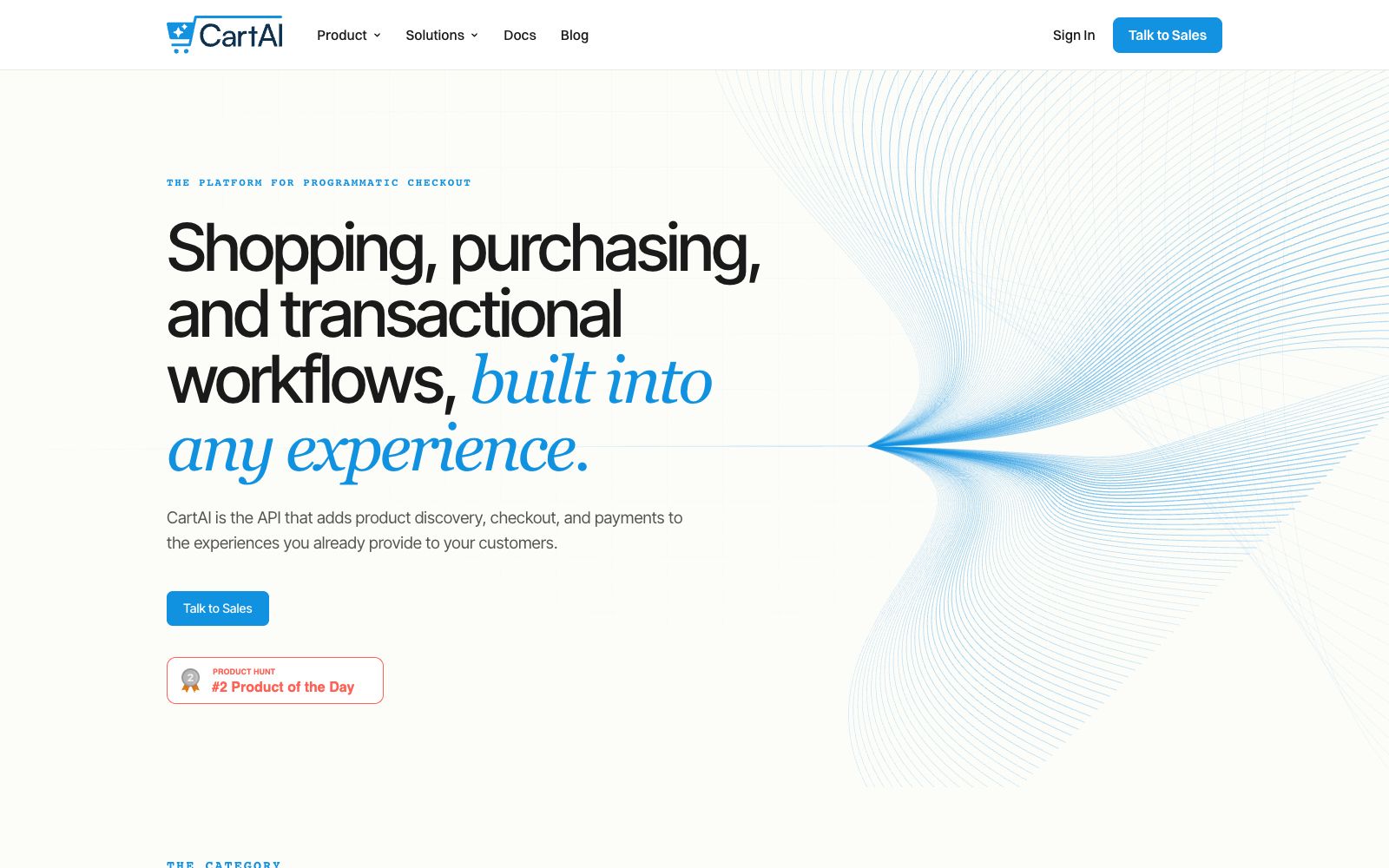
CartAI's official website refers to its product as a platform for programmatic checkout. In one sentence, it integrates shopping, purchasing, and transaction workflows into existing experiences. The website states that it sits between browser automation and agent payments: the former targets general tasks on open web pages, while the latter handles identity, trust, and payment channels. CartAI, by contrast, specializes in processing transaction-completion workflows.
Who is it for?
- Developers looking to add real purchasing capabilities to shopping assistants, vertical agents, or recommendation interfaces.
- Teams that need to automate processes such as e-commerce checkout, subscription changes, bill payments, or procurement submissions.
- Publishers who want to enable direct transactions on content pages, creator pages, or recommendation feeds without redirects.
- Business infrastructure teams that need to unify multi-merchant catalogs, shopping carts, payments, and order receipts.
Key features
6Product Catalog Capability
The official website states that it can search for products across merchants, read variants and real-time prices, and return checkout estimates before creating the shopping cart.
Checkout & Orders
The official website states that it can complete orders on real merchant pages, track them to a confirmed status, and output standardized orders and status-change Webhooks.
Payment Capability
The official website states that it provides hosted payment sessions, supports Visa Intelligent Commerce and Mastercard Agent Pay, and keeps the PCI scope on the platform side rather than in the user's system.
Monetization Capability
The official website states that agents can still earn commissions when purchases are made through the user interface, with built-in attribution for retaining affiliate and creator revenue shares.
Three Integration Methods
The official website states that you can directly integrate the API, connect the MCP service to existing AI agents, or embed a hosted checkout component that requires no development; the component supports variants, addresses, payments, confirmation, and white-label themes.
Transaction Trust
The official website states that it uses signed agent identities, KYA, and robot management integrations to enable legitimate automated transactions to be identified and processed, rather than being blocked by merchants.
How to use CartAI
- First clarify whether you are integrating with the API, MCP, or the hosted component.
- the product boundaries and development costs differ for these three methods, and the official website states that the underlying platform is consistent.
- Trial transaction-related functions in low-risk scenarios first, and only connect to real fund flows after confirming order status, Webhook, retry and idempotency behaviors.
- Verify the amount, address, taxes, and merchant terms before payment.
- the differences in cross-merchant processes cannot be covered by a single joint debugging.
- If integrating with existing agents, first use the product search and valuation tools provided by MCP for read-only verification, and then grant payment and checkout permissions.
- The official website states that the MCP service is open-sourced under Apache 2.0.
- You can first review the source code and interface documentation, and evaluate the permission model before deployment.
Traffic & popularity
Data month Sep 2026
CartAI receives about 1.0K visits per month and ranks #18,346,806 worldwide.
Monthly visits
8 monthsTraffic sources
- Direct39.1%
- Search32.8%
- Referrals10.2%
- Social6.2%
- Display ads3.6%
- Other8.1%
Top countries
- United States100.0%
Estimated from third-party traffic data.
Similar tools
 AlphaWebAlphaWeb is an e-commerce infrastructure for AI: agents generate pages, checkout flows, and funnels through conversation, while the platform handles hosting, payment routing, order data, and security controls, and can sync with existing stores.
 ZincZinc is an API that covers the entire e-commerce procurement lifecycle. According to its official website, it enables cross-retailer product search, real-time price and inventory retrieval, order placement, logistics tracking, and return initiation through a single interface. It also provides access methods such as MCP, sandbox, and SDK for agents and developers.
 NileA brand-oriented agentic commerce platform, according to its official website, provides product catalogs, pricing, and checkout to AI shopping assistants such as ChatGPT and Gemini, enabling AI to recommend your products and charge commissions based on transactions.