


Antigma
Antigma is a terminal coding agent and agent runtime: a single command to install a single-file program, switch between cloud or local models in a session, built with Rust and with no external runtime dependencies.
Updated: 2026-10-27
What is Antigma?
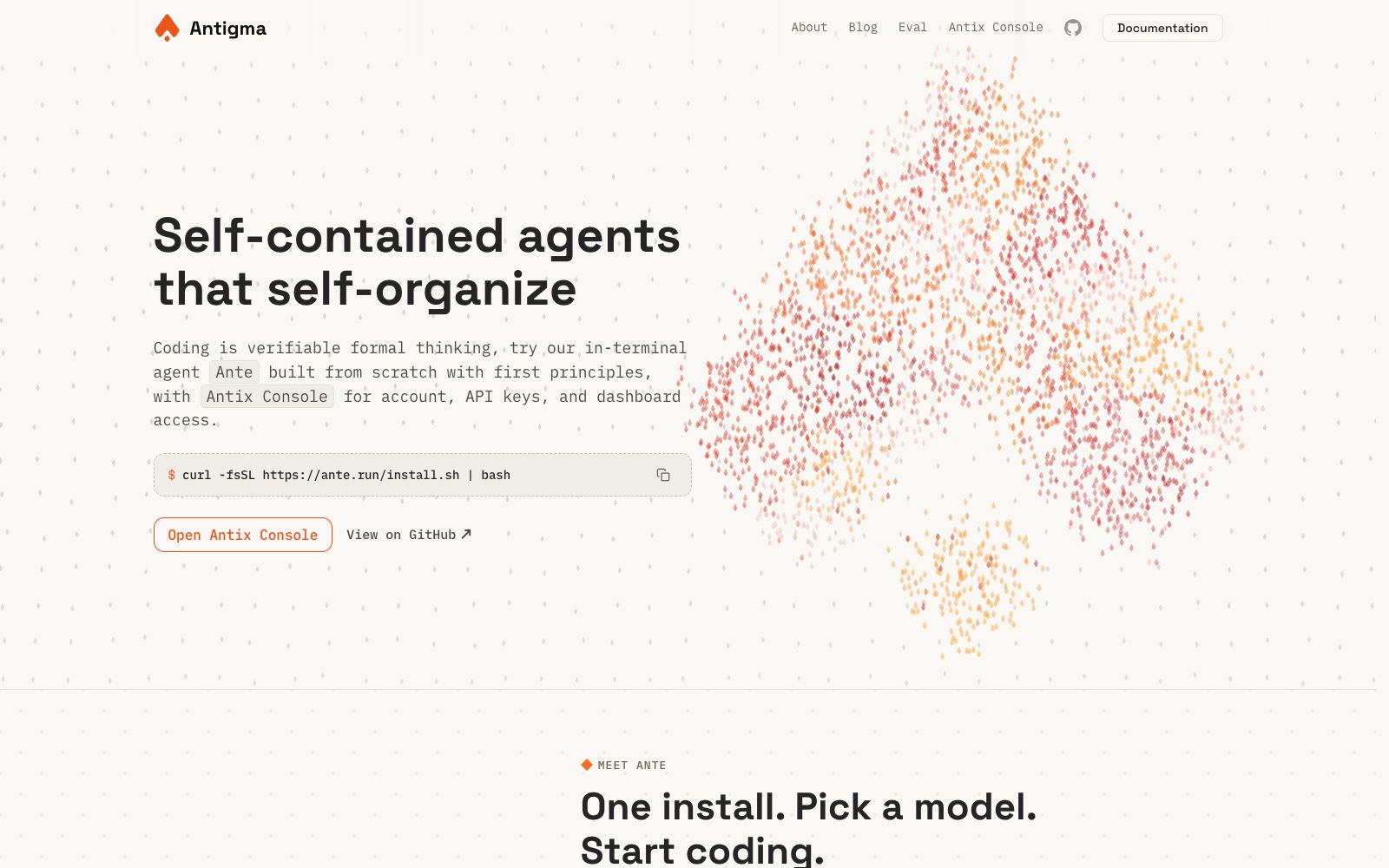
Antigma's official website describes Ante as a self-contained, self-organizing terminal agent, stating that its underlying layer is an AI-native, cloud-native, local-first agent runtime. The installation method provided on the official website is a single curl command. After installation, users can start coding by selecting a model without the need for an account, configuration file, or installation guide. Its product narrative is to enable formalized, verifiable thinking such as coding to be executed by terminal agents, and it offers the Antix Console for managing accounts, API keys, and dashboards.
Who is it for?
- Independent developers who want to complete scaffolding, testing, debugging and delivery in the terminal.
- Engineers who value local execution, offline capabilities, and keeping data on their devices.
- Teams that need to switch between different model providers and adjust costs and inference intensity based on tasks.
- Engineering teams that want to build custom agent interfaces based on a lightweight runtime.
Key features
6One-command Installation
The official website states that installation only requires a single `curl` command, resulting in a single-file binary of approximately 13 MB with a checksum, no account, configuration file, or Node environment required.
Flexible Model Switching
The official website states that you can switch between providers and models within a session, adjust the level of commitment from faster to smarter, and supports both cloud and local models.
Local Model Execution
The official website states that it has built-in llama.cpp integration, allowing models to run entirely on the local machine without requiring API keys, internet access, or the transfer of data off the device.
No Vendor Lock-In
The official website lists supported providers including Anthropic, OpenAI, Gemini, Grok, and Open Router, allowing users to bring their own API keys, subscriptions, or local models.
Lightweight Agent Core
The official website states that the runtime is written in native Rust, a single self-contained binary with no external dependencies, designed for large-scale replication and self-healing agent systems.
Streaming Extension Interface
The official website states that its agent engine is protected by typed streams, allowing developers to build custom interfaces, IDE integrations, and team workflows without coupling to the core.
How to use Antigma
- 1First verify its capabilities with a clear coding task, for example, ask Ante to create a small API with rate limiting and tests from a single sentence, then observe how it runs tests and fixes issues.
- 2Prepare both cloud and local models for official projects: use fast models for daily tasks and switch to higher-capability models for complex refactoring.
- 3When handling private code, prioritize enabling the local model mode and ensure that the dependency, disk, and network boundaries comply with team policies.
- 4Before adoption, verify the current binary size, checksum and installation script content, then conduct a trial run in an isolated environment.
- 5If you want to build an IDE or team workflows, first read the documentation on the official website about the streaming interface to avoid direct coupling with the internal engine.
Traffic & popularity
Data month Sep 2026
Antigma receives about 2.2K visits per month and ranks #8,189,015 worldwide.
Monthly visits
12 monthsTraffic sources
- Direct39.6%
- Search33.1%
- Referrals10.6%
- Social6.2%
- Display ads3.4%
- Other7.2%
Top countries
- United States32.9%
- Vietnam23.9%
- United Kingdom18.6%
- Netherlands15.1%
- Japan5.9%
Estimated from third-party traffic data.
In these collections
Similar tools
 LM StudioA desktop local AI application, now positioned as a Bionic agent for writing and programming, supports local model operation, document and code generation, and real-time speech transcription. The official states that cloud-based inference features zero data retention within the United States.
 MstyA private AI workbench for individuals and teams integrates private workspaces, restricted Agents, a unified model gateway, and controllable knowledge bases into a single system. It supports both local and cloud-based models, balancing efficiency and data control.
 OpenComputerOpenComputer is a high-performance infrastructure for coding agents as described on the official website: the agents run on its cloud and can be mentioned in chat tools or called via APIs; the official website states that responses are returned in a streaming manner, the reading, writing and execution processes are visible, and interface changes come with screenshots and previews.
 SigmaA privacy-focused AI browser, its official website states that it has built-in offline models running locally, keeping sensitive data on the device, and also offers capabilities such as web chat, in-depth research, image generation, and built-in ad blocking.
 Jan.aiAn open-source local AI chat client, which the official says can run open-source models locally and also connect to cloud models, supports multi-model switching and memory, is developed by Menlo Research, and is free and open-source on the desktop version.
 Google AntigravityGoogle has launched an agent development platform that offers desktop, command-line, IDE extensions and SDK forms, enabling parallel management of multiple local agents; the personal version is free, with additional Pro and Ultra subscription tiers.