


SenseNova
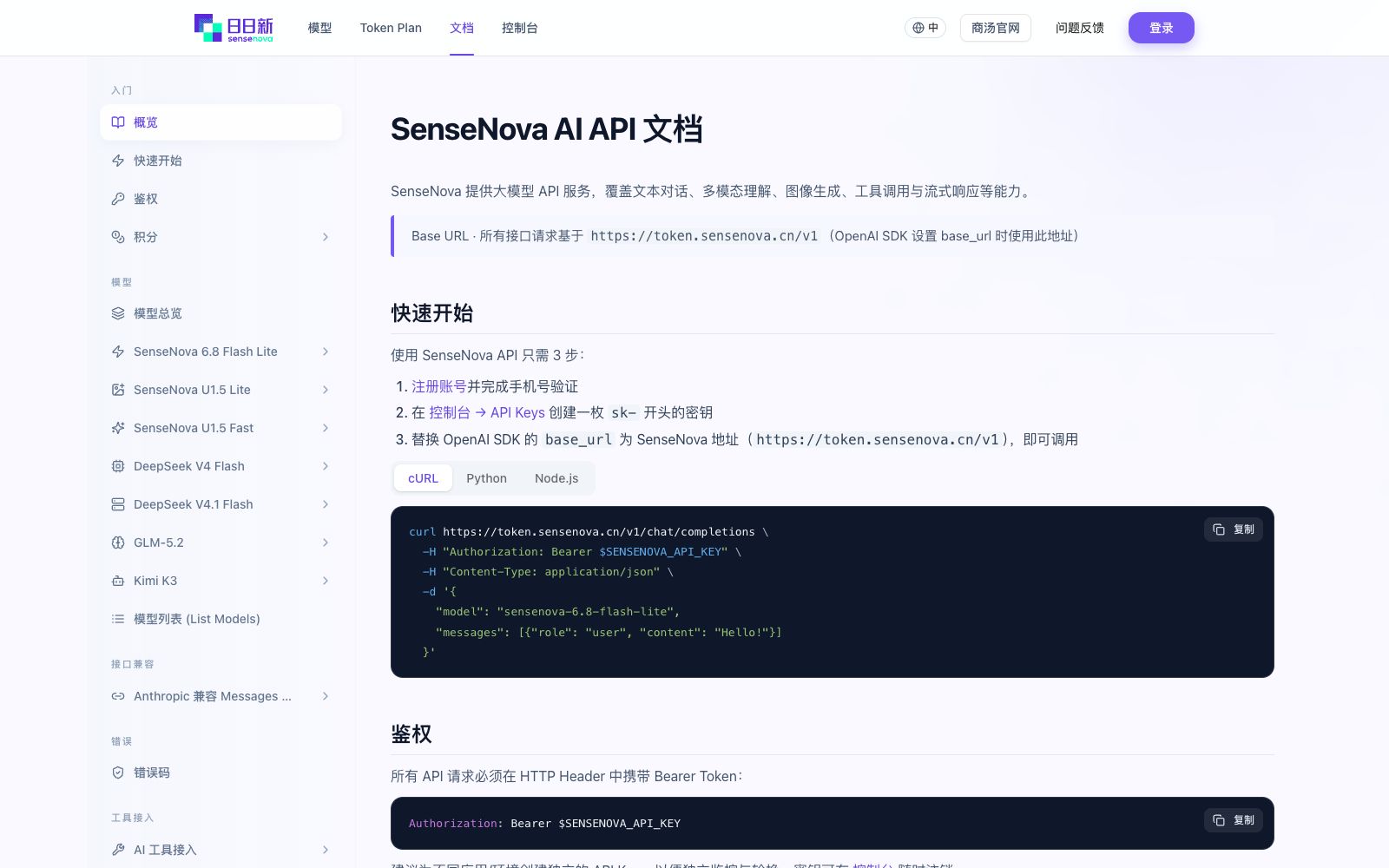
SenseNova is SenseTime's large model API service platform, providing capabilities such as text dialogue, multimodal understanding and text-to-image generation. It is compatible with the OpenAI interface, facilitating business integration.
Updated: 2026-10-26
What is SenseNova?
SenseNova (SenseTime Daily Innovation) is a large model API service platform launched by SenseTime, providing developers with capabilities such as text dialogue, multimodal understanding, image generation, and tool calling. Through standard OpenAI-compatible interfaces, it enables teams to quickly integrate large model capabilities into their own businesses.
Who is it for?
- Developers who need to integrate large model capabilities into their products can use the standard interfaces to reduce migration and joint debugging costs, and speed up the pace of function launch.
- Teams engaged in image generation and editing can call models based on the Neo-unify architecture to achieve reference image-driven creation and improve the efficiency of visual output.
- Projects already using the OpenAI or Anthropic SDK can switch to domestically produced and compliant model supply at a low cost, balancing compliance and continuity.
- Researchers who want to compare the performance of multiple models can test in-house developed and third-party models in parallel on the same platform, facilitating objective model selection.
Key features
5Provides general large language model APIs, covering text dialogue, multimodal understanding and streaming responses, which meet the basic needs of dialogue and agent-based applications and ensure stable calls.
The image creation models are based on the Neo-unify architecture, integrating generation and editing. They support reference images and flexible modifications, making them suitable for text-to-image and image modification scenarios and enabling more controllable creation.
The model list is compatible with the interface specifications of OpenAI and Anthropic. Developers can directly call the service by pointing the base_url of their existing SDK to the SenseNova address, resulting in low migration costs.
In addition to the self-developed series, the platform also integrates third-party models such as DeepSeek, GLM, and Kimi, making it convenient to compare and select models on the same console for flexible combination.
It provides the TokenPlan points system and Flash-Lite consumption rebate activities, helping users flexibly combine different models and control expenses during the public beta period.
How to use SenseNova
- When accessing, first create an API Key in the "Getting Started" section of the documentation, then change the base_url of the SDK to token.sensenova.cn/v1 to make calls.
- the steps are clear.
- Create independent API keys for different applications or environments to monitor usage and rotate them separately, enhancing account security and facilitating troubleshooting.
- When using the Flash-Lite series, pay attention to the credit rules: exclusive credits are deducted first, and general credits are deducted if the exclusive ones are insufficient.
- Rebates are settled daily and valid for thirty days.
- Cost-effective lightweight models are suitable for daily Agent tasks, while high-performance open-source models are reserved for complex reasoning.
- Combine them on demand to control costs and avoid waste.
- The platform is in public beta, and the points and activity rules may be adjusted.
- It is recommended to pay attention to the announcements and check the real-time balance and deduction records in the console to stay informed.
Traffic & popularity
Data month Sep 2026
SenseNova receives about 1.7M visits per month.
Monthly visits
12 monthsTraffic sources
- Referrals48.6%
- Direct44.9%
- Search3.3%
- Social2.5%
- AI assistants0.7%
Top countries
- China74.5%
- Taiwan, China5.2%
- United States4.9%
- Japan4.5%
- South Korea4.4%
Estimated from third-party traffic data.
Similar tools
 Tencent HunyuanTencent's self-developed multimodal large model product system provides capabilities such as Hunyuan Image Generation in the image direction. It supports Chinese prompt understanding and controllable image generation, can be accessed through open APIs and cloud services, and is targeted at scenarios such as content creation, marketing materials, and brand design.SShuyanAIShuyanAI provides enterprise-level AI data and model cloud services. Officially, it claims to cover the entire process of web parsing, web search, model API, OCR and so on. It aggregates models such as Kimi, DeepSeek, Hunyuan and Zhipu, and supports unified interface calls.
 Tongyi WanxiangAn AI creative creation platform under Alibaba's Tongyi, officially offering text-to-image, image-to-image, text-to-video, image-to-video, and image editing capabilities. Wanxiang 3.0 supports native 30-second duration generation with multi-material reference and is targeted at productivity scenarios.
 MiniMaxMiniMax's multimodal large model platform covers text, speech, video, music and code. Its flagship model M3 focuses on million-level context and Agent capabilities, while H3 is open-weighted. The official claims that the number of global users exceeds 200 million, and it provides AP.
 QwenAlibaba Tongyi Qianwen's official unified platform serves both ordinary users and developers. It allows one-stop access to the Qwen series of open-source and closed-source models, covering dialogue, image and video understanding, image generation and editing, document processing, and voice and video dialogue.
 SiliconFlowAll-in-one large model cloud service platform, which, according to the official, provides out-of-the-box APIs covering language, speech, images and videos, as well as products such as reserved instances, inference acceleration and private deployment. It optimizes latency and throughput performance based on a self-developed inference engine.