

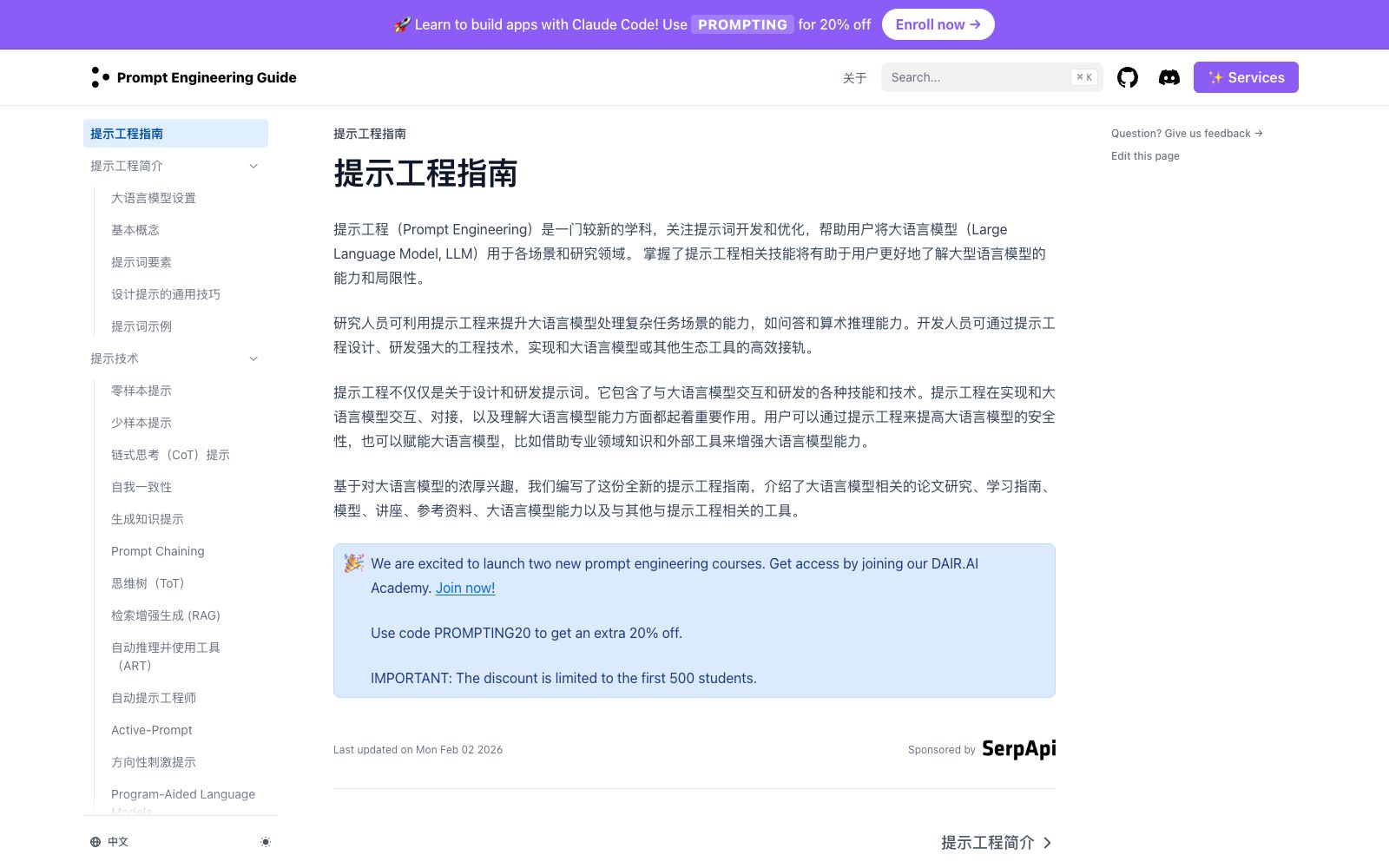

Prompt Engineering Guide
A Chinese learning platform that systematically explains prompt engineering. Its official website catalog includes prompt design techniques, advanced methods such as Chain-of-Thought and Retrieval-Augmented Generation, numerous application examples, as well as chapters on risks like hallucinations, biases, and adversarial prompts.
Updated: 2026-10-26
What is Prompt Engineering Guide?
The "Prompt Engineering Guide" is a systematic learning website that explains prompt engineering, with a Simplified Chinese version available. Its official website describes itself as "A Comprehensive Overview of Prompt Engineering". It does not sell any tools. Its content covers everything from the setup of large language models, elements of prompts, and general design tips, to advanced techniques such as Chain-of-Thought, Tree of Thoughts, Retrieval-Augmented Generation, ReAct, and Reflexion, complete with runnable examples. In addition to tutorials, the website also includes sections on model introductions, risks and misuse, as well as adversarial content such as prompt injection, prompt leakage, and jailbreaking.
Who is it for?
- Product managers and operations professionals who want to systematically build up their knowledge of prompt engineering
- Developers and algorithm engineers who need to engineer prompt engineering
- Training instructors who teach AI application courses and need systematic lecture materials
- Researchers studying model hallucinations, biases and adversarial attacks
- Students who want to learn prompt engineering from scratch and need Chinese-language materials
Key features
7Basic Tutorials
The official website's table of contents includes an introduction to prompt engineering, setup of large language models, basic concepts, elements of prompts, and general techniques for designing prompts.
Prompting Techniques
The official website lists zero-shot prompting, few-shot prompting, Chain-of-Thought (CoT), Self-Consistency, Generated Knowledge Prompting, Prompt Chaining, Tree-of-Thoughts (ToT), Retrieval-Augmented Generation (RAG), ART, Automatic Prompt Engineer, Active-Prompt, Directional Stimulus Prompting, Program-Aided Language Models (PAL), ReAct, Reflexion, Multimodal Chain-of-Thought, Graph-Based Prompting, and meta-prompting.
Prompt Applications
The official website lists cases such as data generation, code generation, graduate job classification case studies, prompt functions, Function Calling, context-caching, finetuning, and synthetic RAG.
Prompt Hub
The official website provides examples categorized by classification, code, creativity, evaluation, information extraction, image generation, mathematics, question answering, reasoning, text summarization, authenticity, and adversarial prompts.
Model Introduction
The official website lists entries such as Flan, ChatGPT, LLaMA, GPT-4, Mistral 7B, Gemini, Phi-2, Mixtral, Code Llama, OLMo, and Sora.
Risks and Misuse
The official website features sections on adversarial prompts, authenticity, bias, and LLM Research.
Chinese & Community
The site offers a Simplified Chinese version and links to GitHub and Discord.
How to use Prompt Engineering Guide
- 1Follow the table of contents to read the basic chapters first before moving on to advanced techniques; jumping around may make you only learn the example sentence structures.
- 2The models and parameters in the examples are mostly historical versions; re-verify them according to the model you are currently using when practicing.
- 3Technologies such as RAG and ReAct are more about engineering implementation, so it is recommended to read them together with official documents and code.
- 4The Risks and Misuse section is worth reading separately, especially when providing external services.
- 5The content is updated with the community; verify the original text and sources before formal citation.
Traffic & popularity
Data month Sep 2026
Prompt Engineering Guide receives about 122.5K visits per month and ranks #418,964 worldwide.
Monthly visits
12 monthsTraffic sources
- Direct45.9%
- Search35.4%
- Referrals11.8%
- Social3.6%
- AI assistants2.4%
- Other0.9%
Top countries
- China18.4%
- India13.2%
- United States12.7%
- Germany4.3%
- Vietnam3.7%
Estimated from third-party traffic data.
Similar tools
 PromptHubA team-oriented prompt management and collaboration platform, officially positioned as the home of prompt engineering, supporting prompt discovery, hosting, version management, batch testing and branch deployment, and providing AI writing and enhancement tools.
 PromptmetheusAn integrated development environment for prompt engineering targeting large model applications, officially said to enable writing, testing and optimizing prompts, supporting over a hundred models, modular combination, automatic evaluators and test datasets, and providing complete change traceability and cost calculation.
 PrompTessorPrompt Workbench, according to its official website, provides capabilities such as generating, analyzing, optimizing, refining and reverse-deriving prompts. It allows saving a prompt library and viewing historical versions, and is compatible with models like ChatGPT, Claude and Gemini.
 LearnPromptingA prompt engineering learning platform with over 60 modular courses translated into 9 languages. It offers free courses, a certification system and corporate training programs. Official sources state that more than 3 million people have learned from it.