


Paperspace
The cloud GPU platform under DigitalOcean offers GPU computing power and hosts such as H100, covering the entire process from model development, training to deployment, and also provides cloud desktops and rendering workflows.
Updated: 2026-10-30
What is Paperspace?
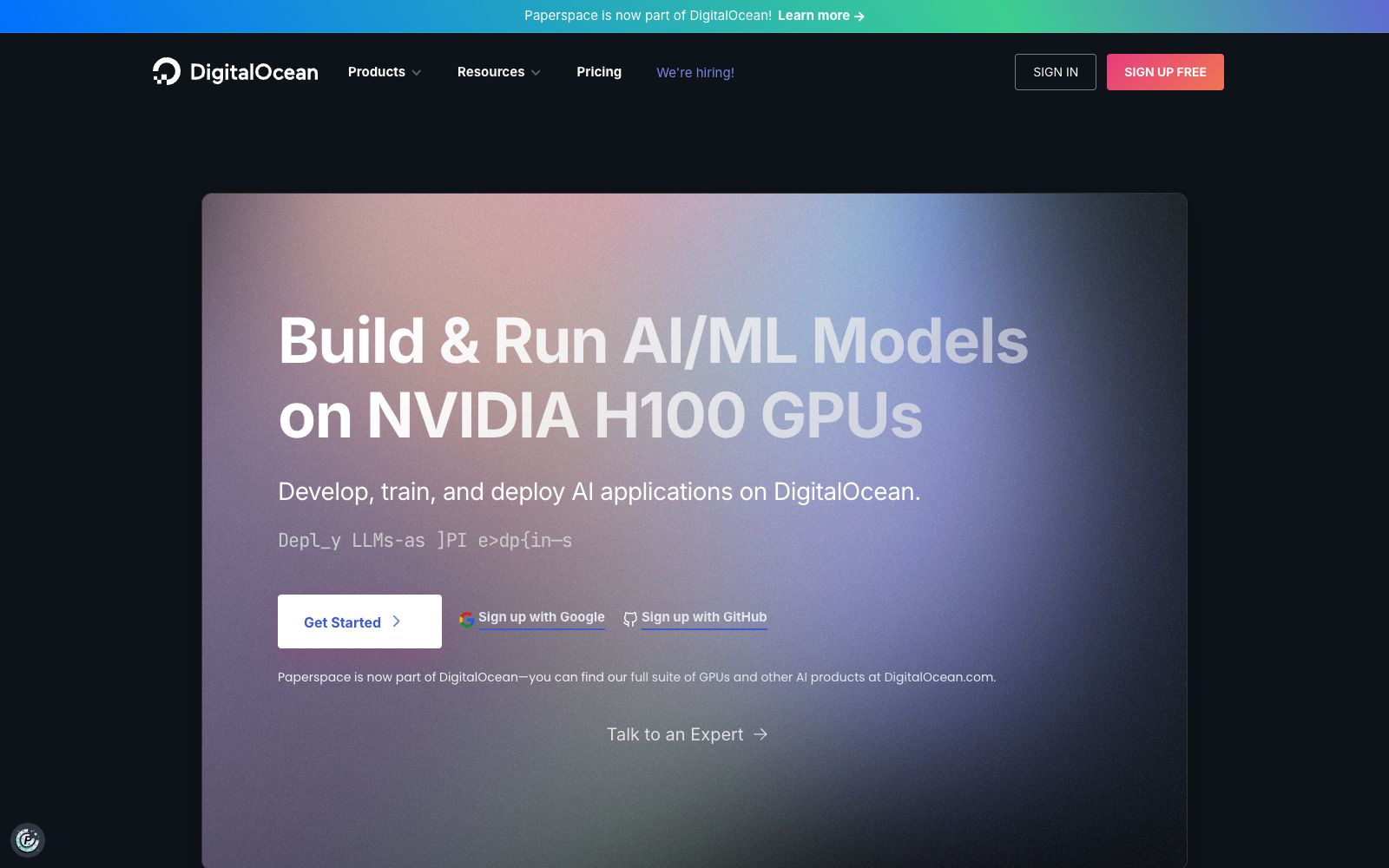
Paperspace is a cloud GPU platform under DigitalOcean, and its official homepage clearly states "Paperspace is now part of DigitalOcean". Its main offerings are a set of GPU computing power and workflow products: Gradient is responsible for the development, training and deployment of models, and Core provides cloud-hosted desktops for individuals and organizations. The official website summarizes the process in three steps: "Develop, Train, Deploy", and claims that more than 500,000 developers are already using it.
Who is it for?
- Researchers and engineers who lack sufficient local GPUs and need to temporarily borrow computing power for fine-tuning or model training.
- Creators who need high-performance workstations for 3D rendering, simulation or video special effects.
- Enterprise IT that wants to uniformly provide standardized cloud-hosted desktops to teams for centralized operation and maintenance.
- Startup teams that need to run model inference interfaces available to the public on the cloud.
Key features
6Develop (Notebooks)
Develop AI models in a cloud-based Notebook environment, eliminating the hassle of locally configuring graphics card drivers and environment dependencies.
Train (Machines)
Run training tasks on cloud hosts, and the official website mainly promotes GPU models such as the NVIDIA H100.
Deploy (Deployments)
Deploy the trained models into callable services, completing the entire pipeline from concept to launch.
Core Cloud hosted desktops
Cloud-hosted desktops for individuals and organizations, usable for remote work and centralized management.
Workflows (Beta)
GPU cloud workflow capability marked as Beta on the official website.
Solutions
The official website lists solutions such as machine learning and AI, GPU infrastructure, enterprise virtual desktops, cloud gaming, rendering, and 3D graphics simulation.
How to use Paperspace
- 1Choose the instance type based on the task type first: use Notebooks for development and debugging, and launch hourly-billed instances for long-duration training.
- 2Be sure to set checkpoints and auto-shutdown for training tasks to avoid incurring additional charges from idle machines after the tasks are completed.
- 3Confirm the storage region and bandwidth pricing structure before uploading data, as the cost of transferring large-scale datasets back and forth is quite high.
- 4Paperspace has been integrated into DigitalOcean, and accounts, billing and product entry may be adjusted; confirm the current affiliation and package rules before long-term use.
- 5When dealing with corporate compliance or sensitive data, confirm the availability zones, storage locations, and data processing agreements with the official party in advance.
Traffic & popularity
Data month Sep 2026
Paperspace receives about 781.4K visits per month and ranks #46,619 worldwide.
Monthly visits
12 monthsTraffic sources
- Direct66.5%
- Search22.6%
- Social3.0%
- Referrals3.0%
- AI assistants2.6%
- Other2.3%
Top countries
- Japan48.8%
- United States16.6%
- Thailand4.5%
- India2.9%
- Germany1.4%
Estimated from third-party traffic data.
Similar tools
 AutoDL Computing Power CloudA domestic GPU computing power rental platform operated by SightCloud (Nanjing) Technology offers second-level billing for GPU rentals, high-spec computer rooms, and 24/7 services. It also features built-in AI images and a technical community, allowing one-click reproduction of algorithms out of the box.
 GPUStackEnterprise-level AI infrastructure platform, officially stating that it can deploy, govern and scale large models and GPU computing power on any hardware, supports heterogeneous graphics cards, automatic matching of inference engines, distributed inference, and provides standard interfaces and quota management.
 RunPodAn AI cloud platform for developers offers four forms: on-demand GPUs, serverless endpoints, multi-node clusters, and model deployment. It covers inference, Agent, fine-tuning, and compute-intensive tasks, and discloses the unit price of each GPU model.
 LambdaCloud computing power service providers for AI training state on their official websites that they offer on-demand instances and cluster reservations of various high-end graphics cards, along with supporting orchestration tools and engineering support, covering scenarios ranging from startup teams to governments and enterprises.
 OpenDataLabThe open data platform launched by the Shanghai Artificial Intelligence Laboratory is officially said to provide high-quality open-source datasets for domestic large models, support dataset retrieval and download, and be equipped with data annotation and governance tools as well as open-source community capabilities.
 Lightning AIAn AI cloud platform built by the original team of PyTorch Lightning. The official website provides on-demand GPUs, clusters and coding agents, covering the entire process from dataset construction to training and inference, targeting teams that develop dedicated models independently.