

PaperPass
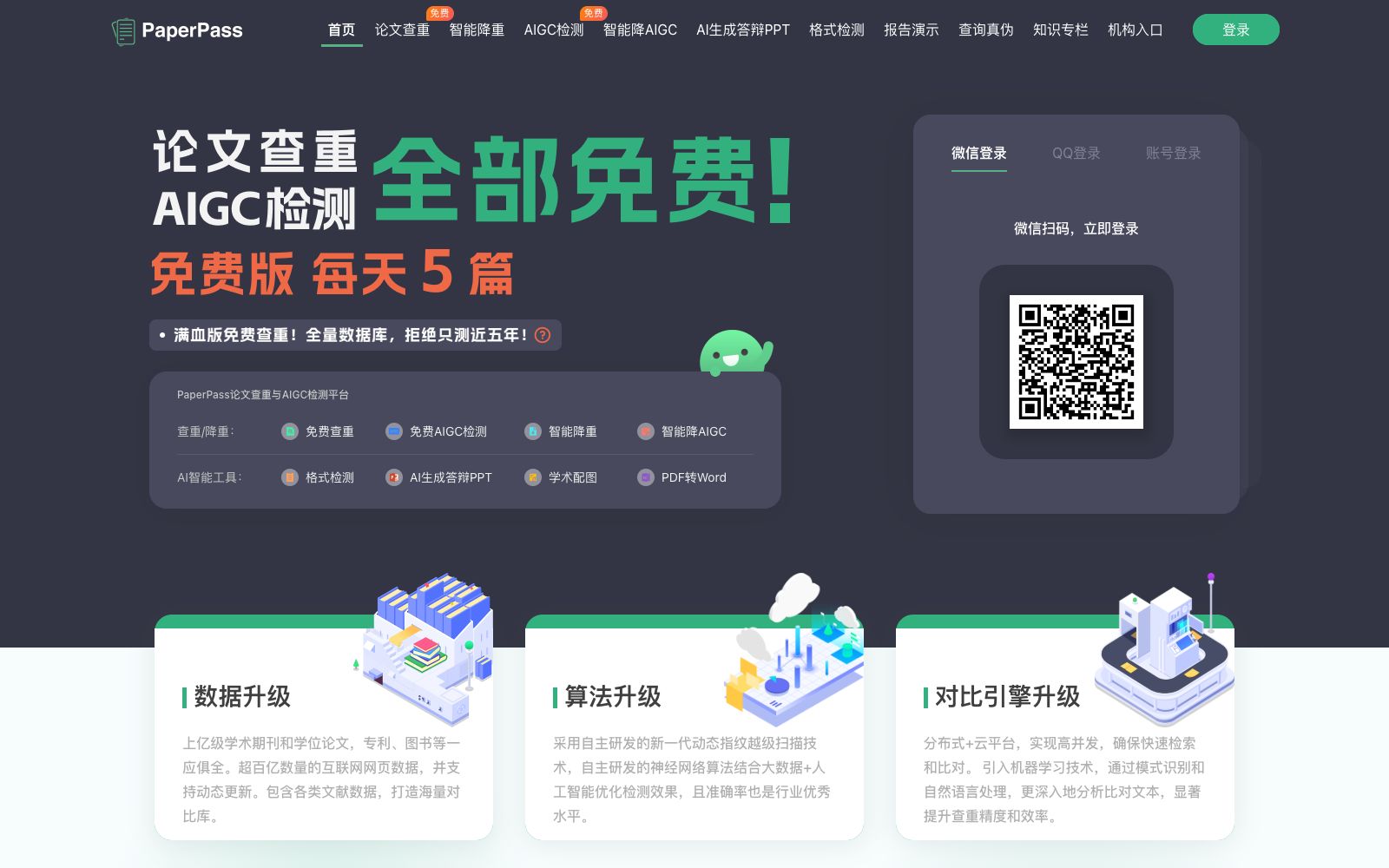
A plagiarism and AIGC detection platform for Chinese academic writing (operated by Zhishu Shuhui) offers free plagiarism check, intelligent similarity reduction, AIGC reduction, format detection and self-built database. The report supports sentence-by-sentence annotation and source traceability.
Updated: 2026-10-26
What is PaperPass?
PaperPass is a detection and revision assistance platform for Chinese academic writing. Its official website calls itself the "PaperPass Thesis Plagiarism Check and AIGC Detection Platform", and the page's copyright information shows that the operating entity is Zhichi Shuhui. It places thesis plagiarism check and AIGC detection in the same entry: the plagiarism check side offers free plagiarism checking, intelligent reduction of repetition, self-created database, format detection and report demonstrations, while the AIGC side provides free AIGC detection and intelligent reduction of AIGC-generated content, along with derivative functions such as AI-generated defense PPTs. The official claims that its comparison database covers hundreds of millions of academic journals, dissertations, patents, books, as well as over 10 billion pieces of Internet webpage data that are dynamically updated; the detection adopts its self-proclaimed "new-generation dynamic fingerprint leapfrog scanning technology" and neural network algorithms, and the reports support sentence-by-sentence analysis, visual annotation, traceability of similar sources and detailed revision suggestions.
Who is it for?
- College students preparing for their graduation theses who need to check their own repetition rates in accordance with university requirements
- Researchers and teachers who submit to journals and need to check their papers for plagiarism before submission
- Writers who care about the AIGC ratio and want to reduce AI traces before submission
- Students who need to check the format of their papers according to school templates or quickly generate defense PPTs
- Research groups that have a large amount of internal literature and wish to build a self-built library to expand the comparison scope
Key features
6Thesis Plagiarism Check
After submitting the thesis, it is compared with the database. The official states that it adopts a dynamic fingerprint hierarchical scanning technology, combined with neural network algorithms and big data to optimize the detection effect.
AIGC Detection
The official website states that it uses a comprehensive recognition algorithm based on an integrated discriminator and PPL to judge the degree of AI generation of the text, and provides a free AIGC detection entry.
Intelligent Similarity Reduction
A similarity reduction engine is built based on the attention mechanism of transformer. The official claims that the fluency of the reduced content has increased by 45% compared with the previous generation.
AI-Generated Content Reduction
Provides corresponding AI-generated content reduction processing based on AIGC detection results, and is listed alongside intelligent similarity reduction in the official website's navigation bar.
Self-built Library
Allows users to upload local files to create a personal comparison library, which is used to expand the scope of plagiarism check detection and supports multiple file formats.
Reports and Multi-Device Support
It provides demonstrations of both plagiarism check and AIGC detection reports, allows exporting Word-format reports with detection results annotated in the original text, and is accessible via PC, tablet web browsers, and WeChat Mini Programs.
How to use PaperPass
- First confirm the detection system and judgment criteria specified by your school or journal.
- The results from PaperPass are more suitable for self-inspection reference.
- Different systems have different comparison databases and algorithms, so the repetition rates will not be completely consistent.
- Before submission, it is recommended to allow sufficient time for the final draft: first use free plagiarism check to locate highly similar paragraphs, then rewrite each paragraph one by one in light of the traceability and modification suggestions in the report, instead of only replacing synonyms.
- for parts involving literature viewpoints, questionnaire items and method descriptions, do not change the original meaning just to reduce the repetition rate.
- AIGC detection also has the possibility of misjudgment.
- The official states that its accuracy and misjudgment rate are at an excellent level in the industry, but no specific values are given.
- Do not take a single result as a conclusion.
- Before submitting for external review or defense, you must take the results of the system finally used by your school as the standard.
- the package prices, free quotas and report retention periods shall be subject to the instructions on the official website's current page.
Traffic & popularity
Data month Sep 2026
PaperPass receives about 633.8K visits per month and ranks #53,825 worldwide.
Monthly visits
12 monthsTraffic sources
- Search48.1%
- Direct39.8%
- Social4.3%
- Display ads3.4%
- Referrals3.3%
- Other1.1%
Top countries
- China87.3%
- Hong Kong, China3.1%
- Singapore2.5%
- United States2.3%
- Taiwan, China1.4%
Estimated from third-party traffic data.
Similar tools
 PaperYYThe thesis plagiarism detection platform under Wuhan Yiciyuan provides thesis plagiarism detection, AIGC plagiarism detection and rewriting, intelligent rewriting, class team plagiarism detection and self-built library comparison, and is equipped with PDF conversion, translation and polishing tools.
 PlagiarismSearchPlagiarismSearch is an online plagiarism and AI detection service that outputs similarity rates and matching sources, while also providing paper analysis, readability checks, and spell checks. Its official website states that it supports APIs and instant messaging robots.
 CNKI AIGC DetectionCNKI's plagiarism check and AIGC detection services for individual users adopt the adaptive multi-order semantic fingerprint detection technology, which discriminates the AI generation features of text through two links: language patterns and semantic logic, according to the official statement.
 TurnitinAn academic integrity platform for educational institutions, officially claiming cooperation with more than 16,000 institutions worldwide; AI writing detection is provided as an additional feature of Similarity Report and is only visible to teachers and administrators.
 Gezi DaA workbench for academic content detection, which provides one-stop services including paper plagiarism check, format detection, format correction and AIGC detection. It supports tracking the status after uploading and unified management of detection records, serving the paper writing and self-inspection scenarios of university teachers and students.
 Weipu AIGC DetectionThe Weipu Paper Detection System provides plagiarism check, format checking, AIGC detection and intelligent evaluation services, which are distinguished by versions for college students, postgraduates, editorial departments and professional titles, and supports unified management of personal versions and institutional versions.