


Gezi Da
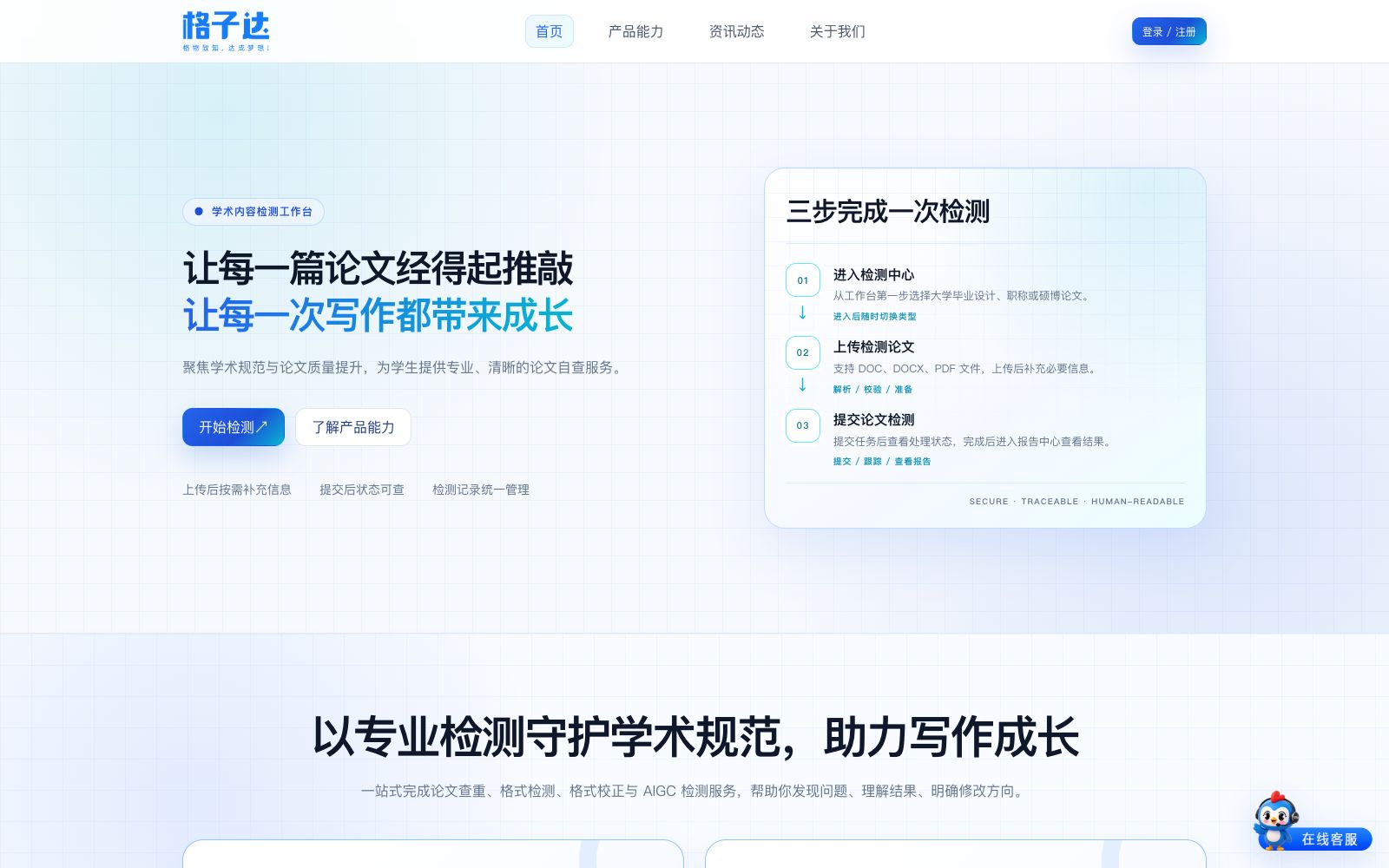
A workbench for academic content detection, which provides one-stop services including paper plagiarism check, format detection, format correction and AIGC detection. It supports tracking the status after uploading and unified management of detection records, serving the paper writing and self-inspection scenarios of university teachers and students.
Updated: 2026-10-26
What is Gezi Da?
Gezi Da is a workbench for academic content detection. Its official positioning is to ensure that every thesis stands up to scrutiny and that every writing process leads to growth. It centralizes thesis plagiarism check, format detection, format correction and AIGC detection on a single platform. After students upload their theses, they can supplement information as needed, track the processing status and uniformly manage detection records. The official states that it is oriented towards academic norms and the improvement of thesis quality.
Who is it for?
- Undergraduate graduates: Resolve plagiarism check and formatting issues in a single test, reducing repeated typesetting and repeated submissions for inspection.
- Master's and doctoral students: Check the thesis structure and format specifications against the school's templates to reduce the risk of getting stuck on format issues.
- Teachers and academic affairs staff: Randomly check the similarity and format of students' papers for process management.
- Authors in need of format proofreading: Use automatic correction to handle font, line spacing and caption issues, saving time on manual adjustments.
- Students concerned about AIGC compliance: Self-check the proportion of AI-generated content and adjust their writing methods accordingly.
Key features
6Paper Plagiarism Check
Identify similar fragments and potential sources through text comparison, present relevant indicators and paragraph details to help verify citations.
Format Checking
Based on the selected university template or general template, it checks the paper structure as well as formatting issues such as fonts, paragraphs, and punctuation.
Format Correction
Automatically correct identifiable and processable formatting issues to reduce the workload of repeated typesetting.
AIGC Detection
It is claimed by the official that it covers mainstream AI tools, identifies machine-generated ghostwritten content, and helps authors cope with the increasingly stringent AI detection requirements.
Three-step detection process
Select the detection type, upload the paper and supplement information, submit the detection, and then view the results in the report center.
Detection Record Management
Unifies the management of detection records, supporting the viewing of processing status and historical results by type and time.
How to use Gezi Da
- Uploads in DOC, DOCX and PDF formats are supported, but the official note indicates that PDF may affect footnote recognition, so DOCX is recommended for priority use.
- The results of plagiarism check and AIGC detection are for reference only and serve as a self-inspection basis.
- They do not represent the school's final review conclusion, and a margin for revision should be left.
- Before conducting the format check, confirm that you have selected the correct university template.
- Choosing the wrong template will generate a large number of invalid issues and waste time.
- After automatic correction, it is still necessary to manually read through the table of contents, chart numbers and reference formats to avoid new errors and omissions.
- A low AIGC detection score does not mean AI-generated content can be copied.
- academic standards shall still be subject to the specific requirements of your school.
- In addition, it should be specially noted that the output of AI detection is a "probabilistic judgment" rather than a final conclusion: misjudgments are not uncommon in scenarios such as short texts, content dense with professional terms, or content that has been deeply rewritten by humans, and it is not recommended to use it as the sole basis for academic misconduct or content violations.
Traffic & popularity
Data month Sep 2026
Gezi Da receives about 20.6K visits per month and ranks #905,622 worldwide.
Monthly visits
12 monthsTraffic sources
- Direct40.8%
- Search39.5%
- Referrals12.4%
- Social3.0%
- Mail1.5%
- Other2.8%
Top countries
- Japan100.0%
Estimated from third-party traffic data.
Similar tools
 Weipu AIGC DetectionThe Weipu Paper Detection System provides plagiarism check, format checking, AIGC detection and intelligent evaluation services, which are distinguished by versions for college students, postgraduates, editorial departments and professional titles, and supports unified management of personal versions and institutional versions.
 CNKI AIGC DetectionCNKI's plagiarism check and AIGC detection services for individual users adopt the adaptive multi-order semantic fingerprint detection technology, which discriminates the AI generation features of text through two links: language patterns and semantic logic, according to the official statement.
 WenchaoThe academic quality inspection platform launched by Wanfang Data can simultaneously complete multi-element detections such as text similarity, text AIGC, image reuse, reference risk and language specification in one submission.
 DayaThe document detection system under Chaoxing provides similarity detection, AIGC detection, format detection, one-click typesetting and AI intelligent evaluation. The official claims that it relies on book resources to achieve dual detection of books and periodicals.PaperPassA plagiarism and AIGC detection platform for Chinese academic writing (operated by Zhishu Shuhui) offers free plagiarism check, intelligent similarity reduction, AIGC reduction, format detection and self-built database. The report supports sentence-by-sentence annotation and source traceability.
 PlagiarismSearchPlagiarismSearch is an online plagiarism and AI detection service that outputs similarity rates and matching sources, while also providing paper analysis, readability checks, and spell checks. Its official website states that it supports APIs and instant messaging robots.