


Model Context Protocol
MCP is an open-source standard promoted by Anthropic that enables AI applications such as Claude and ChatGPT to connect data sources, tools, and workflows in a unified manner. A single set of interfaces opens up the external world, and ecological support is becoming increasingly extensive.
Updated: 2026-10-26
What is Model Context Protocol?
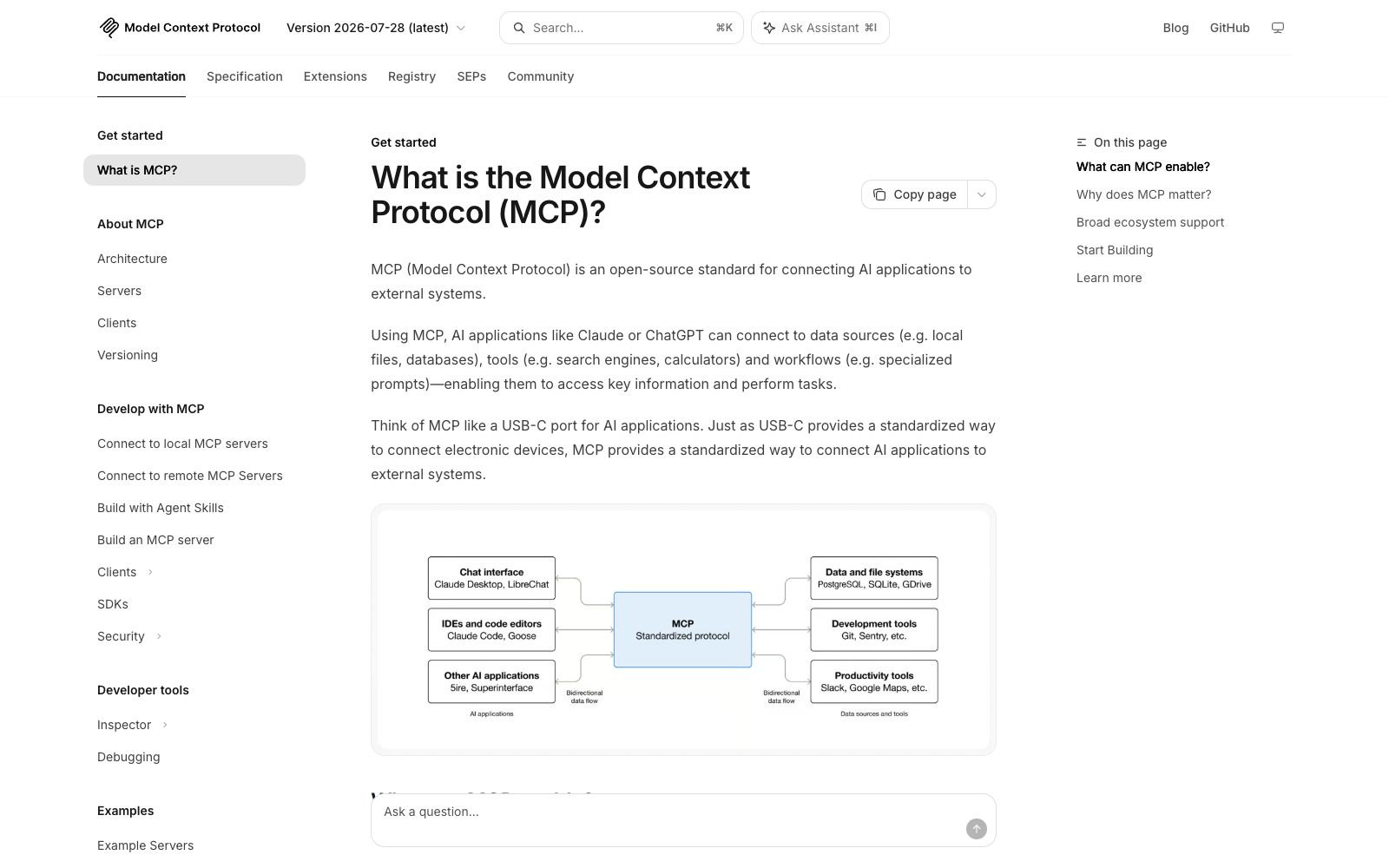
MCP (Model Context Protocol) is an open-source standard used to connect AI applications to external systems. According to official documentation, with MCP, applications like Claude or ChatGPT can connect to data sources (local files, databases), tools (search engines, calculators), and workflows (dedicated prompts), thereby accessing key information and performing tasks without having to write a separate integration for each "model × system" combination. The official compares it to a USB interface in the AI world: one standard that connects all peripherals. For developers, this means one-time development and multi-party reuse, and it also means that AI applications have a unified "peripheral standard" for the first time.
Who is it for?
- Application developers who want to add the capability to "connect to the outside world" to their products, as well as engineering teams that need to securely expose internal systems to AI; in scenarios with more than two or three integration requirements, the marginal benefit of MCP will be very obvious. For platform teams that need to connect to multiple AI clients at the same time or want to unify and expose their capabilities externally, it is even an infrastructure worth betting on early.
Key features
6Unified Connection Protocol
It condenses the explosive combination of "models × data sources/tools" into a set of standard interfaces, enabling one-time integration and universal reuse to reduce redundant development.
Three types of capabilities
Data sources (what can be read), tools (what can be done), and reusable workflows (specialized prompts), covering the most common access requirements.
Server and Client
You can either develop an MCP Server to expose internal data and capabilities, or build a Client to consume various services, with flexible roles.
MCP Apps
The official support allows building MCP applications with a user interface, which is not limited to command-line or code access, thus lowering the entry barrier.
Ecosystem-wide support
The official emphasizes broad ecosystem support. Leading AI clients and development tools have gradually added native support, and the community is growing steadily.
Official Documentation & Examples
Provides comprehensive resources such as Get started, Developer tools, and Examples, offering guidance from concepts to implementation.
How to use Model Context Protocol
- Read the official Concepts section before you start.
- Clarifying the boundaries between Server, Client and Tool will save you from a lot of rework.
- It is recommended to start with the smallest "one data source + one tool" to get the link through.
- After it runs successfully, expand step by step.
- when you need to provide stable external capabilities, prioritize existing Server implementations instead of developing from scratch.
- Also, pay attention to updates in official documents — new features during the standard evolution period are often exposed in the documents first.
Things to know
Traffic & popularity
Data month Sep 2026
Model Context Protocol receives about 522.1K visits per month.
Monthly visits
12 monthsTraffic sources
- Direct49.1%
- Search23.3%
- Referrals8.0%
- AI assistants7.9%
- Display ads5.7%
- Other6.0%
Top countries
- United States23.5%
- India14.8%
- China6.7%
- United Kingdom3.6%
- Germany3.5%
Estimated from third-party traffic data.
In these collections
Similar tools
 LibraLibra is an AI agent platform that connects enterprise work tools: it unifies the indexing of contexts such as Notion, Jira, and Slack, creates dedicated end-to-end process agents through natural language, automatically routes emails and messages, and covers sales, customer service, engineering, and recruitment.
 5ireOpen-source cross-platform desktop AI assistant and MCP client, which can connect to more than ten model services, provides local knowledge base retrieval, prompt library, collection and usage statistics, and is officially marked as free.