


MeetStream
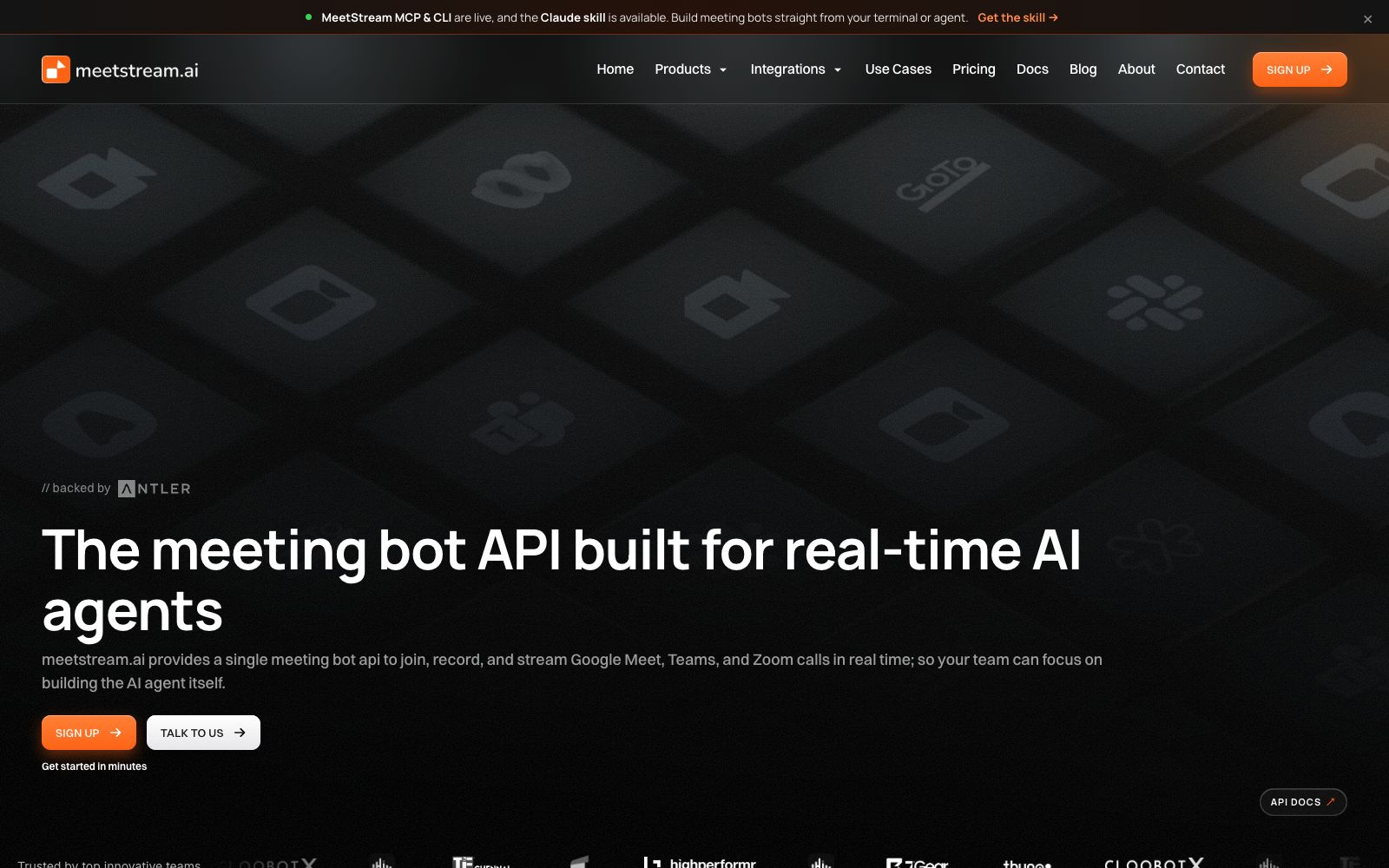
MeetStream is a meeting bot API for developers: integrate with Zoom, Google Meet and Teams with a single connection, enabling the bot to join meetings for recording, real-time streaming and transcription. It outputs independent audio tracks and speaker labels per participant, allowing you to build your own AI agents on top of this.
Updated: 2026-10-26
What is MeetStream?
MeetStream is a meeting bot infrastructure for developers, and its official website positions it as "A Meeting Bot API Built for Real-Time AI Agents". It is different from meeting note products for end users: it does not provide a finished note interface, but instead offers an interface that allows bots to join Zoom, Google Meet, and Microsoft Teams, and returns raw audio and video, participant-by-participant audio tracks, real-time transcription, and chat messages to you, letting you focus on building your own agents. The official website claims a real-time access latency of 200ms, and registration grants a $5 credit.
Who is it for?
- SaaS teams looking to integrate meeting recording and meeting minutes capabilities into their own products.
- AI application developers working on scenarios such as sales conversation intelligence, customer service quality inspection, and interview record-keeping.
- Voice agent projects that need to speak in real time during meetings.
- Independent developers and small teams burdened by the maintenance costs of the SDKs for each of the three platforms.
Key features
6One API covers three platforms
Integrate with Zoom, Google Meet, and Teams with a single connection; the official website states there is no need to write separate code for each platform; creating a bot only requires POSTing the meeting link and bot_name.
Independent audio tracks per participant
The official website states that audio is streamed out separately for each participant, with speaker labels directly sourced from the meeting platform itself rather than inferred by a diarization model, ensuring accurate transcription even when multiple people speak simultaneously.
Real-time Transcription & Low-latency Streaming
The official website advertises a 200ms latency. It retrieves real-time transcription with speaker labels and timestamps via webhooks, pushes audio and video through secure WebSockets, and also provides an asynchronous transcription interface.
Original Meeting Recording & Metadata
The platform emphasizes that it records the actual meetingscreen rather than screen capture, outputs MP4 files, and provides screenshot data, meeting metadata, the ability to read and write chat messages, and in-meeting image display.
Automatic Calendar Joining
Integrates with Google and Outlook Calendars to automatically join meetings based on schedules, eliminating the need to manually dispatch bots.
Agent-Oriented Toolchain
The official website mentions that the MIA voice agent can listen, speak, and act during meetings, and provides MCP server, CLI, and agent skills, allowing direct creation of robots in the terminal or your own agent; in terms of security, it lists enterprise-level encryption and ISO 27001 certification controls, with SOC 2 Type 2 under audit.
How to use MeetStream
- First, use the free $5 credit to run through a real meeting: create a bot → receive webhook transcriptions → pull MP4 files, and verify if the latency and speaker labels meet the standards.
- Compliance must be a priority: The onboarding and recording of meetings by the robot involve the informed consent of each participant and local recording regulations.
- In some regions, mutual consent is required.
- Before launching, you must publicly inform and obtain consent at the time of joining the meeting, and handle retention and encryption in accordance with the official website's security documentation.
- For real-time scenarios, use WebSocket.
- for post-event analysis, use asynchronous transcription and recorded files.
- Do not use real-time channels for batch historical processing.
- For scenarios where speaker accuracy is a priority, prioritize per-participant audio tracks and avoid performing voiceprint separation on your own.
- For sensitive meetings, first confirm the data storage location and the status of compliance qualifications (SOC 2 Type 2 is still under audit as stated on the official website), and restrict access permissions for transcribed content.
Traffic & popularity
Data month Sep 2026
MeetStream receives about 39.3K visits per month and ranks #674,687 worldwide.
Monthly visits
12 monthsTraffic sources
- Direct39.9%
- Search33.8%
- Referrals10.3%
- Social6.3%
- Display ads3.2%
- Other6.6%
Top countries
- United States42.8%
- India15.8%
- United Kingdom9.2%
- Spain6.3%
- Pakistan5.8%
Estimated from third-party traffic data.
In these collections
Similar tools
 RecordMeetingRecordMeeting is a recording extension for Google Meet. It allows one-click recording without adding bots or requiring host authorization. It can automatically transcribe meetings and generate AI meeting minutes, making it suitable for sales calls, user interviews, and team meetings.
 DeepgramAn enterprise-oriented voice AI interface platform that provides speech-to-text, text-to-speech, and voice agent interfaces. According to its official website, it supports real-time or batch operation, as well as cloud-based or private deployment.
 JotMeJotMe is a real-time translation tool for multilingual conferences. It supports simultaneous interpretation for over 200 languages, speaker-differentiated transcription, meeting minutes and in-meeting follow-up questions. It does not require a robot to join the meeting and is suitable for multinational teams and online events.
 NoteOwlNoteOwl is a local AI meeting notes tool for Mac that needs no bot to join your calls. It records both microphone and meeting audio, distinguishes between speakers, and generates summaries and action items, while letting you search past meetings offline.
 FathomFathom is an AI meeting minutes tool that automatically records, transcribes and summarizes Zoom, Google Meet and Teams calls. The personal version is permanently free and supports integrations such as ChatGPT and Claude.
 Happy ScribeMeeting and audio-video transcription tool, covering more than 150 languages, supporting robot-free recording, speaker diarization, glossary and one-click translation, capable of exporting subtitles, and the official website states that it is used by more than 41,000 teams.