


Litmaps
A literature management software for literature reviews connects the process of finding papers and sorting out the context through four steps: discovery, visualization, collaboration and monitoring, and it can also generate BibTeX citations. It is suitable for graduate students and researchers who write literature reviews and prepare research proposals.
Updated: 2026-10-26
What is Litmaps?
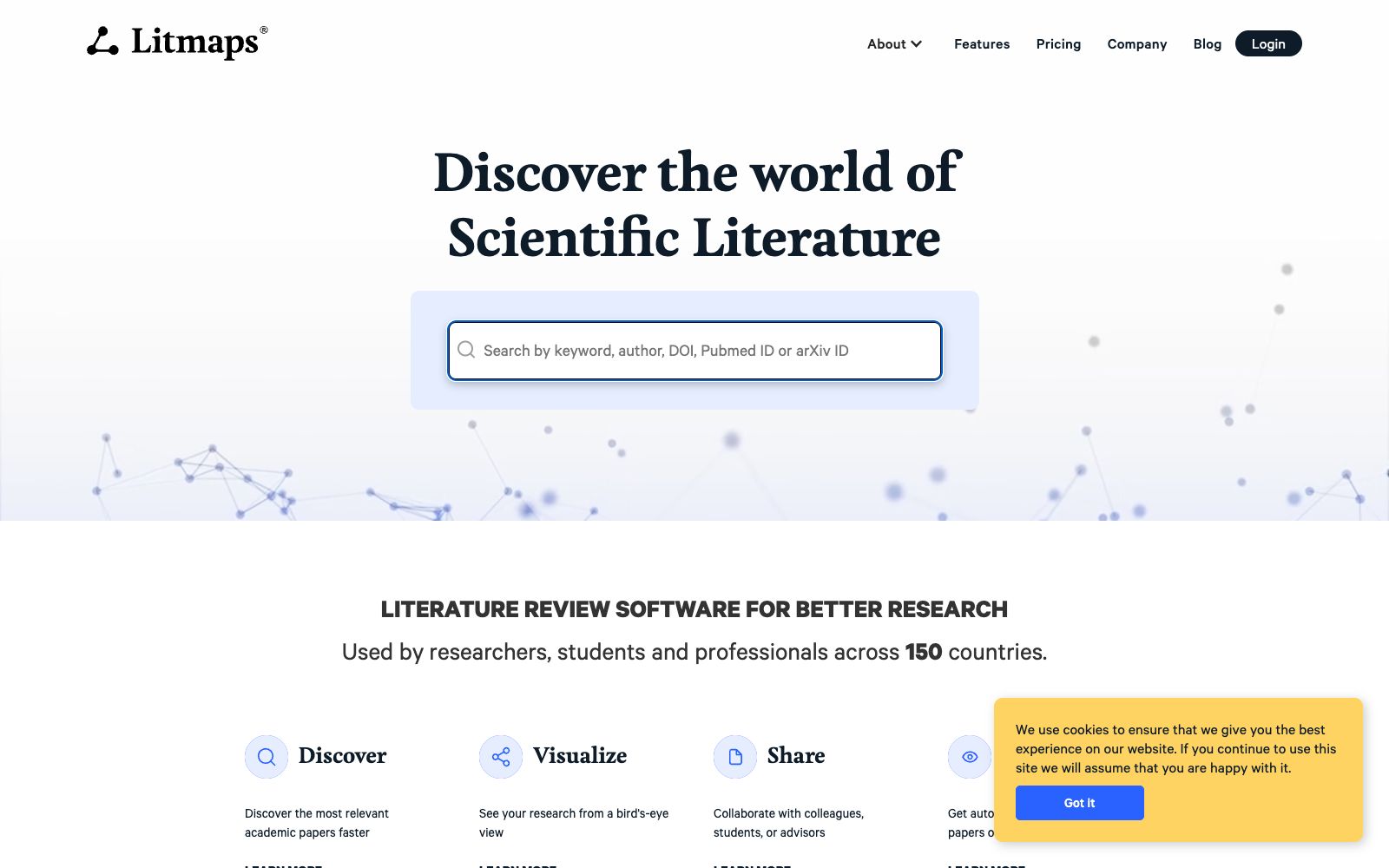
What often takes the most time in a literature review is not downloading papers, but figuring out who cites whom among a pile of them. Litmaps turns this task into visualization: it lays out the found papers into a relationship network, allowing you to see what the field looks like from a bird's-eye view, which papers are hubs, and which directions remain untouched. The official website states that researchers, students, and professionals from 150 countries use it.
Who is it for?
- Graduate students who are writing a review or proposal and need to quickly grasp the research landscape
- Researchers who need to long-term track the new progress of their own research topics
- Mentors who supervise students and need to share literature within the research group
- Early-career researchers who are new to a field and intimidated by the interfaces of traditional literature databases
- Researchers with dyslexia who find the standard database interface overly burdensome
Key features
6Discover
Discover the most relevant academic papers more quickly, with retrieval and initial screening completed in a single workspace.
Visualize
Present bibliographic relationships from a global perspective; users on the official website mention that charts arranged by date or citation relationships are more user-friendly than the interfaces of traditional databases.
Share
Share your research content with colleagues, students or supervisors, facilitating the joint progress of the same literature library by multiple people.
Monitor
Automatically receive updates on new papers for selected topics without repeated manual searches.
Citation Generation
Official user reviews mention that it can generate bibtex references, which can be directly cited when writing papers.
Project-based Organization
Manage each research project separately and see the connections between projects.
How to use Litmaps
- First, use Discover to build your literature library thoroughly before moving on to visualization.
- if the library is not well-established, the relationship diagram will be distorted, and its reference value will be greatly reduced.
- Monitor is a long-term feature.
- It’s worth setting up topic alerts for your research from the start so you don’t miss new papers right before submission.
- Unify the naming and tagging conventions before sharing with the research group.
- the organization effort will be much lower after sharing.
- Generating bibtex is convenient, but after exporting, you still need to check each entry field one by one and do not copy them directly into the manuscript.
- The official website also has a separate Pricing page.
- whether to pay and how many entries can be exported are subject to the information there.
- The user count stated on the official website is for promotional purposes only, and the source should be cited when referencing it.
- When you see a promising direction from the chart, first follow the citation links to find the original papers before reading the full text.
- The map is just a signpost, not a conclusion.
- When writing a review in its later stages, it's easy to only focus on your own research direction.
- use the chart to check if you have missed the work in adjacent fields.
Traffic & popularity
Data month Sep 2026
Litmaps receives about 751.5K visits per month and ranks #44,025 worldwide.
Monthly visits
12 monthsTraffic sources
- Search43.0%
- Direct39.8%
- Referrals9.0%
- AI assistants2.9%
- Mail2.5%
- Other2.9%
Top countries
- United States13.9%
- Iraq11.7%
- Germany8.2%
- Czech Republic4.3%
- Thailand3.7%
Estimated from third-party traffic data.
Similar tools
 ElicitAI research assistant: Enter a research question to search over 125 million papers, automatically generate cited structured research reports, and support data extraction, systematic literature reviews, and library alerts.
 iAcademicAn intelligent literature management platform built on a self-developed academic large model, which is officially said to integrate academic dialogue, literature management, AI literature reading, AI writing and format-preserving AI translation.
 ResearchPalResearchPal is an AI research platform integrating research, writing, analysis and citation. It provides research agents to help you find literature, write reviews and manage citations, and the official claims that citations are not fabricated.
 ResearchRabbitAn AI tool focused on literature review, which generates citation maps from a seed paper and continuously recommends relevant literature, new authors and emerging directions. Its official website shows that it has access to over 310 million papers, and registration is free.
 TXYZAn AI academic workbench for scientific research scenarios integrates paper retrieval, in-depth reading and writing assistance into a seamless workflow. It supports uploading and analyzing full documents, and offers annual subscription tiers ranging from free to high-end.
 logicallyLogically is a citation-supported AI research and writing space that integrates document writing, reference management, PDF annotation and research assistants, and is built with a variety of writing tools, targeting thesis and learning scenarios.