


Indent
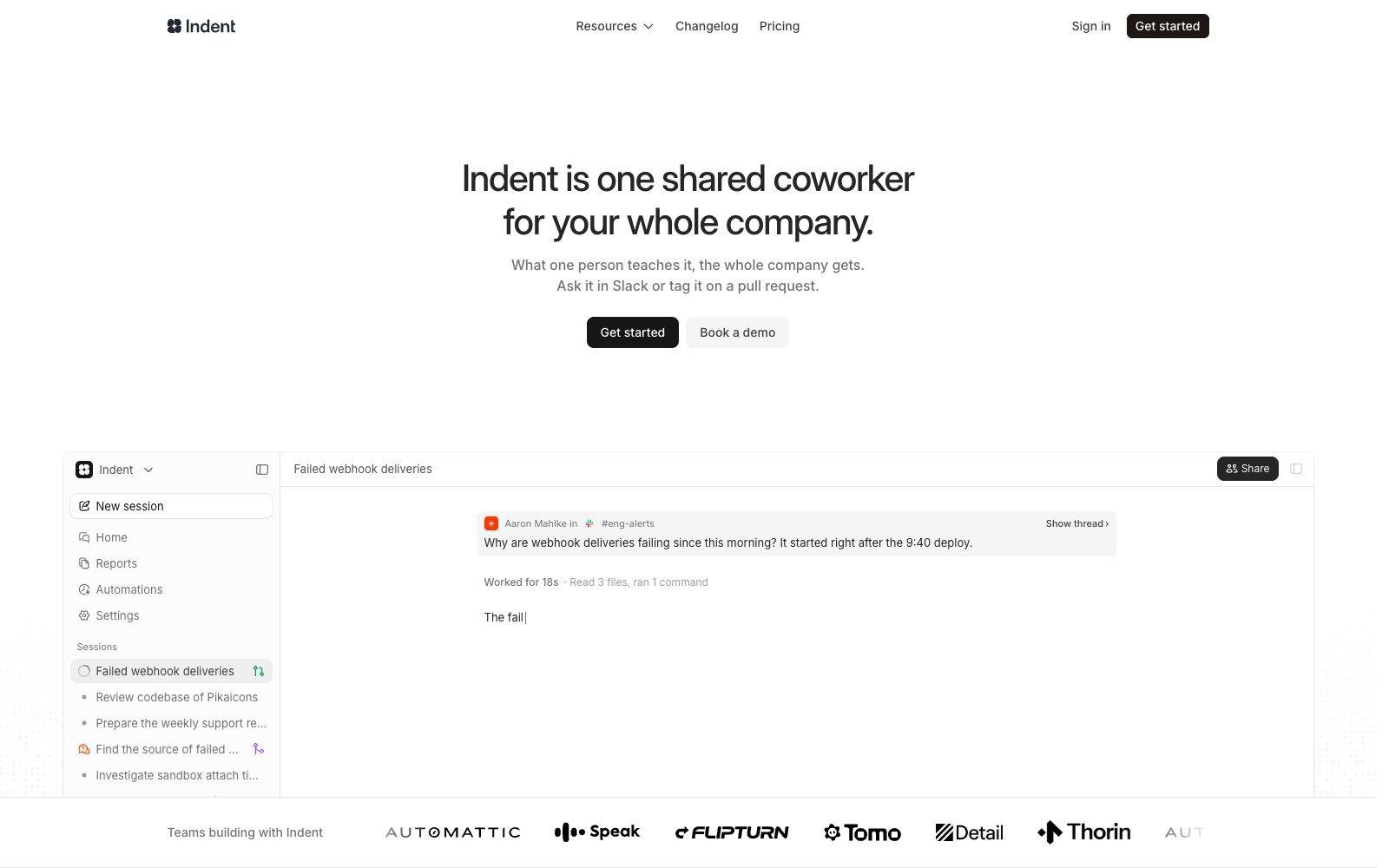
Indent is a shared AI colleague for the entire company. According to the official website, what one person teaches it benefits the whole company. You can ask it questions on Slack or @ it on pull requests. It can read code, adjust integrations, run commands, modify files, and create pull requests that pass tests.
Updated: 2026-10-26
What is Indent?
Indent's official website positions itself as "One shared coworker for your whole company" — meaning one AI coworker is shared by the entire company, and what one person teaches it in Slack is available to everyone in the company. Its differences from individual coding assistants lie in shared context and end-to-end delivery: the official website states that there is no need to purchase separate products for code reviews, coding, data analysis, and alert triage; a single Indent can cover all these scenarios. Moreover, the agreements made by the team in Slack are remembered and carried forward.
Who is it for?
- Engineering teams that handle online alerts and troubleshooting, with official examples including finding the root cause of webhook failures and investigating sandbox startup timeouts.
- Technical leaders who want to unify code reviews, data analysis, and alert triage into a single tool.
- Product, growth, and finance teams who previously had to wait weeks for data access can now perform self-service data analysis, according to the official website.
- Teams with numerous routine weekly reports and checks can use Automations to run them on a schedule.
- Companies that want their team's knowledge to be stored in shared context rather than scattered across individual conversations.
Key features
6Dual access via Slack and PR
The official website states that you can ask questions directly in Slack or @mention it in a pull request; in the demo, it answered a question about a post-deployment failure in the #eng-alerts channel and provided the root cause.
End-to-end delivery
The complete workflow demonstrated on the official website includes reporting, diagnosis, repair, verification, and delivery — identifying the root cause of regressions, editing source files, running test suites, creating mergeable PRs, and monitoring CI.
Execution with tools and integrations
The official website shows that it can use Bash, terminals and browsers, and also call integrations such as Datadog and MCP tools, and lists which files it has read and which commands it has run.
Shared Memory
The official website states that it remembers the agreements the team has made in Slack, such as assigning bill-related PRs to Maya, requiring migration PRs to be accompanied by preview results first, and prototypes only retaining interactions while the implementation can be replaced.
Automation & Reporting
The official website interface features Automations and Reports, with example tasks including weekly support reports, summarizing Slack customer feedback, analyzing database query performance, comparing infrastructure costs, and drafting release checklists.
Codebase and Multi-repo Context
The sessions demonstrated on the official website include reviewing the entire codebase and checking the status of PRs across all branches and repositories.
How to use Indent
- Start with real alerts and questions in Slack: The official website cites user feedback that the team adopted it naturally through daily collaboration, rather than setting up a separate process.
- Before letting it modify code, confirm the scope of repositories and branches.
- In the official website's demo, it directly edits files, runs tests, and creates PRs, while merging still requires manual review.
- Clearly state team agreements in Slack.
- the official website states that it will remember these and apply them to subsequent tasks.
- for agreements involving personnel and permissions, consider whether they are suitable for being stored in shared memory.
- When integrating with tools like Datadog, grant credentials following the principle of least privilege, and keep an eye on the "files read and commands run" listed in each session.
- Authorization and Compliance: It will have access to code repositories, logs and business data.
- First define the scope of accessible repositories and data sources, then verify enterprise-level controls and pricing against the official documentation.
Traffic & popularity
Data month Sep 2026
Indent receives about 139.8K visits per month and ranks #143,623 worldwide.
Monthly visits
12 monthsTraffic sources
- Direct56.5%
- Social32.5%
- Search5.5%
- Referrals4.4%
- Mail0.5%
- Other0.5%
Top countries
- United States72.6%
- India15.6%
- China11.3%
- Japan0.5%
Estimated from third-party traffic data.
In these collections
Similar tools
 BloomeBloome is an instant messaging platform that places humans and AI agents in the same chat. The official statement says that the agents will review each other and share memories, and can be connected to models such as Claude, ChatGPT, and DeepSeek to deliver research outputs.
 MuleRunA permanently online AI Agent platform, the official said that the Agent runs on a dedicated computer that is on 24 hours a day without shutdown. It can deliver PPTs, research reports, videos and Word documents end-to-end, and send them overnight to get results the next morning.
 BackdropBackdrop is an AI coworker platform that officially supports more than 1,500 integrations. It lets teams use preset skills, build custom skills, or record demonstrations to teach agents, while shared memory connects people and agents in one continuous workflow.
 StreamientStreamient is an open-source team-shared AI memory layer that organizes notes, URLs, email archives, and Git decisions into self-hostable memory, accessible for reading and writing by mainstream AI clients via MCP and API.
 ViktorViktor is an AI employee that lives in Slack and Microsoft Teams. Connect it to your business tools and it handles reports, updates, scheduled tasks, and internal apps—always requesting approval before any irreversible action.