


Illuminarty
An AI detection service that supports both images and text. The official stated that it can provide generation probabilities, mark generated image areas and suspicious paragraphs, cover tampered images and Deepfakes, and the free tier is available for long-term use.
Updated: 2026-10-26
What is Illuminarty?
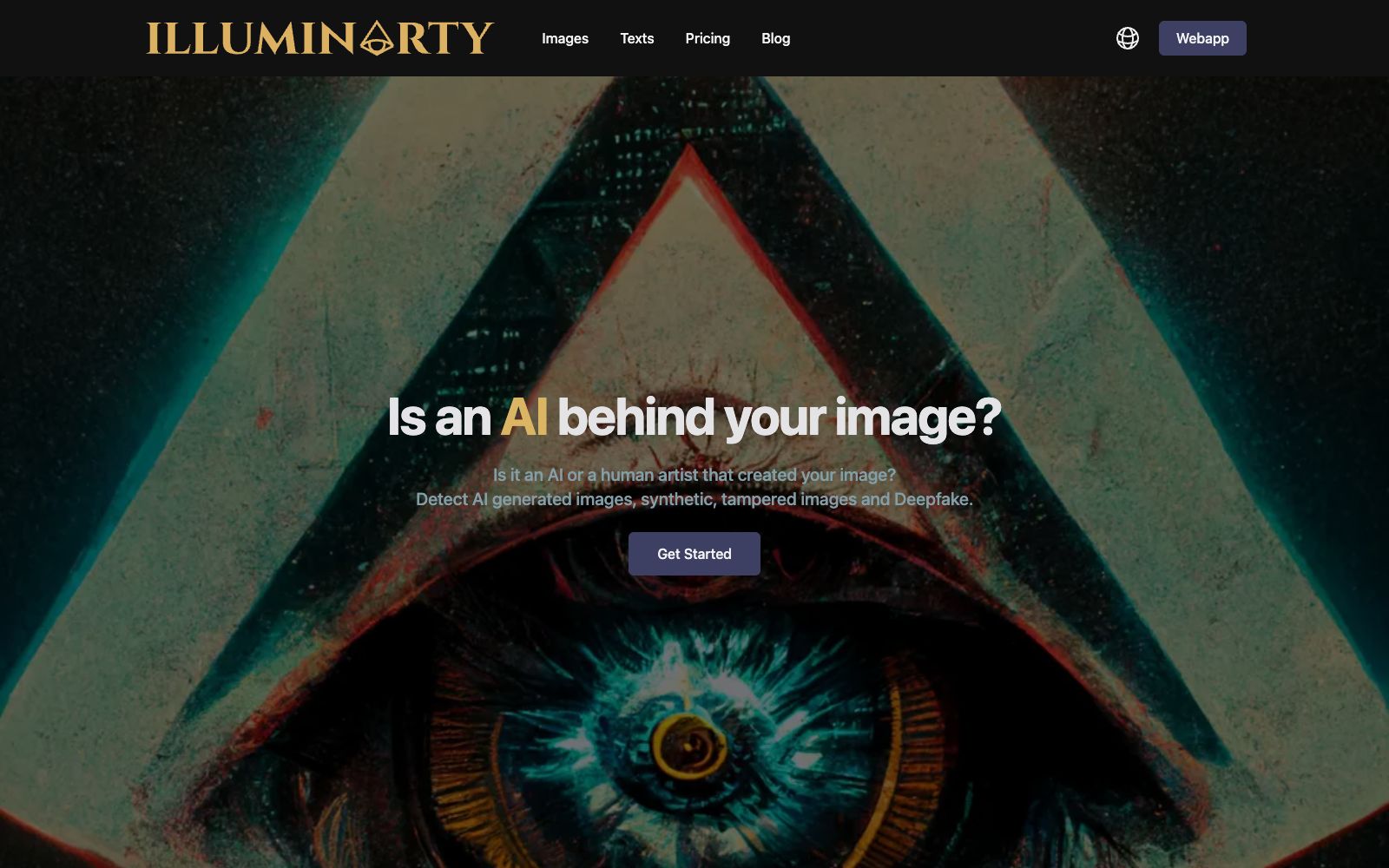
Illuminarty is an online service that performs AI detection for both images and text. The question on the homepage of its official website is "Is an AI behind your image?", which means it judges whether an image is created by AI or human creators, covering AI-generated images, composite images, tampered images and Deepfakes. Different from detectors that only give a single overall score, the official states that it will combine a variety of computer vision algorithms to provide generation probability and point out which areas in the image are generated. For the text side, it also combines multiple NLP algorithms to provide probability and mark the paragraphs most likely generated by AI. The official website indicates that AI detection will be permanently free, and paid tiers offer additional features. The page lists four tiers: Free, Basic, Pro and Enterprise, and mentions that it is developing a browser extension and an open API.
Who is it for?
- Editors, gallery reviewers, and content platforms that need to determine whether an image is AI-generated
- Investigators engaged in image forensics who want to see specific generated regions rather than a single score
- Teachers and educational institutions that need to conduct preliminary AI detection on the text submitted by students
- Developers who want to integrate detection capabilities into their own systems through API integration
- Individual users who only want to check an image occasionally and don't want to pay for it
Key features
6AI Image Detection
Provides the AI generation probability of a single image. The official states that it combines multiple computer vision algorithms and identifies which public generative model the image is likely generated from.
Generated Area Localization
Instead of just providing an overall score, it identifies which regions in the image were generated, making it convenient for cross-checking during manual review.
AI Text Detection
Provides the probability that a text is AI-generated. According to the official, it combines multiple NLP algorithms and identifies the specific paragraphs most likely generated by AI.
Tampering and Deepfake Detection
The official platform includes synthetic images, altered images, and Deepfakes in its detection scope.
API Automated Detection
Provides an API to integrate image detection into your own services. Officially, it allows direct retrieval of detection results and the most likely detector used within the program.
Browser Extension
The official website states that a browser extension is currently under development, allowing users to directly use the detection capabilities while browsing the internet.
How to use Illuminarty
- The free tier includes AI image and text classification.
- First, use the samples you have to run a test on the web version to confirm whether the result granularity meets your needs, and then consider the paid tiers.
- The official website shows that Basic costs $10 per month, and the specific content of Pro and Enterprise shall be subject to the current page of the official website.
- No AI detector can guarantee complete accuracy.
- Illuminarty provides probabilities rather than judgments.
- The accuracy rate will be affected if the image is compressed, cropped, redrawn or re-screenshot.
- before using it to draw conclusions about others' works, be sure to combine source tracing and manual review.
- Text detection is particularly unstable for short texts.
- It is recommended to only use it as one of the clues and not as the sole basis for judgment.
- The official website mentions that the browser extension is still under development, and the availability of functions shall be subject to the official announcement.
- the package price and free quota may be adjusted, and recheck the official website instructions before commercial use.
Traffic & popularity
Data month Sep 2026
Illuminarty receives about 182.9K visits per month and ranks #171,457 worldwide.
Monthly visits
12 monthsTraffic sources
- Direct43.0%
- Search40.5%
- Referrals6.0%
- Social5.5%
- AI assistants2.6%
- Other2.4%
Top countries
- United States18.4%
- Germany12.2%
- Russia8.5%
- United Kingdom7.9%
- Italy7.7%
Estimated from third-party traffic data.
Similar tools
 AI or NotAn AI detection service covering images, text, music, speech and video, which can distinguish AI-generated content from deepfakes. The official website claims an accuracy rate of 98.9%. It offers a free sandbox, API and pay-as-you-go pricing, and supports on-premises deployment.
 PangramPangram is an AI content detector that identifies text and images generated by ChatGPT, Gemini, Claude and other models, targeting colleges and enterprises, and emphasizes third-party verified accuracy and content transparency.
 GPTZeroAn AI text detection tool with over 17 million users, according to the official site. It provides overall AI probability scores and sentence-level results for ChatGPT, GPT-5, Gemini, and other models, plus writing verification, plagiarism checks, and classroom tools.
 Winston AIAn AI content detection tool for education, publishing and SEO teams, with an official accuracy rate of 99.98%; it supports OCR recognition of scanned documents, sentence-by-sentence prediction graphs, plagiarism check and AI image detection, and can generate shareable authenticity reports.
 Zhuque AI DetectionTencent has launched a free AI-generated content detection tool. Trained on a variety of advanced models and millions of data points, it delivers particularly outstanding performance in Chinese detection. It supports both text and image detection and provides an API for easy integration into review processes.
 Proofig AIProofig AI is an image integrity review tool for scientific research publishing. It detects image tampering, repeated reuse, and AI-generated images. The official statement says it is used for self-checks before submission to reduce the risks of rejection and retraction.