


AI or Not
An AI detection service covering images, text, music, speech and video, which can distinguish AI-generated content from deepfakes. The official website claims an accuracy rate of 98.9%. It offers a free sandbox, API and pay-as-you-go pricing, and supports on-premises deployment.
Updated: 2026-10-26
What is AI or Not?
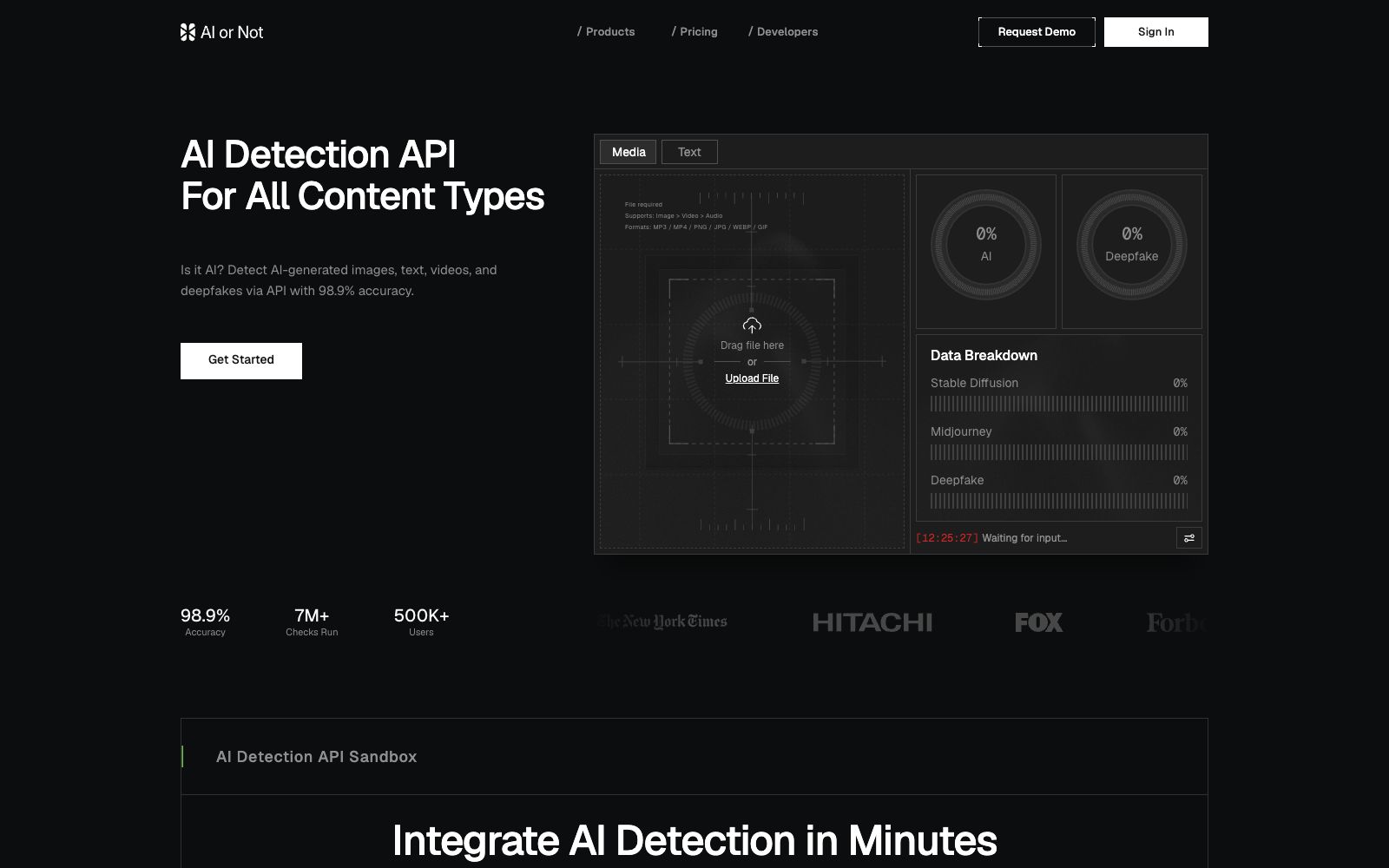
AI or Not is an AI detection service covering multiple content forms. The official website homepage features the slogan "AI Detection API For All Content Types," enabling detection for images, text, music, speech, and videos, and distinguishing between AI-generated and deepfake results. Its difference from tools that only perform text detection lies in its coverage: on the image side, it provides score breakdowns for different generation models (such as Stable Diffusion and Midjourney), and on the media side, it supports formats like MP3, MP4, PNG, JPG, WEBP, and GIF. The first screen of the official website displays self-reported data including 98.9% accuracy, over 7 million detections, and more than 500,000 users. It also offers a web sandbox, free API keys, and pay-as-you-go pricing, with data marked for immediate deletion. The FAQ also mentions support for on-premises deployment.
Who is it for?
- Editors and fact-checkers who need to verify whether images and video materials are AI-generated or tampered with
- Platforms that perform content moderation and UGC risk control and wish to integrate detection capabilities in batches through APIs
- Music and audio copyright holders who are concerned about whether their works are imitated or misappropriated by AI
- Educational and publishing institutions that need to conduct preliminary AI detection on submitted text
- Regulated teams that require no data retention and prefer on-premises deployment
Key features
6Image Detection
Determines whether an image is AI-generated, and the official sandbox provides breakdown probabilities for models such as Stable Diffusion and Midjourney.
Deepfake Detection
Provides a separate result for whether the faces in images have been tampered with by deepfake technology, and this is an independent report from "AI-generated".
Text Detection
Determines whether text is written by humans or AI. The official pricing page uses it for scenarios including essay identification and misinformation detection.
Audio and Music Detection
Distinguishes between speech and music, and the official stated that it can be used to detect cases where AI has used the voice of a specific artist.
Video Detection
Analyzes both visual and audio elements to determine if AI was used in the video, with pricing based on per-second usage on the official website.
API and Reverse Image Search
It provides REST APIs (such as /v2/image/sync) and reverse image search. The official website states that it supports Python, cURL, JavaScript, PHP, Go, Java, and Ruby, with pricing based on content types.
How to use AI or Not
- First, use the official website's sandbox to freely trial-run your own samples and check if the itemized breakdown (probabilities of different generation models) aligns with your judgment habits before deciding whether to apply for an API Key.
- Pay-as-you-go pricing means you should first estimate the number of images and the duration of audio and video before bulk access.
- The official website's pricing page lists separate prices for each content type, resulting in significant cost differences.
- The official website's FAQ specifically includes an entry titled "How accurate are AI detectors?", indicating that detection is not 100% reliable.
- Results should serve as reference clues rather than conclusions.
- Before using detection results to accuse others of fabricating content, be sure to combine source tracing, metadata, and manual judgment—compression and secondary clipping will also affect accuracy.
- Before uploading personal information or client materials, confirm the official website's current data processing and retention policies.
- paid tiers and free quotas are subject to the on-page instructions on the official website.
Traffic & popularity
Data month Sep 2026
AI or Not receives about 115.4K visits per month and ranks #442,915 worldwide.
Monthly visits
12 monthsTraffic sources
- Search37.2%
- Social36.6%
- Direct22.3%
- Referrals3.0%
- AI assistants0.9%
Top countries
- United States32.9%
- Brazil4.5%
- Mexico4.3%
- India3.9%
- France3.7%
Estimated from third-party traffic data.
Similar tools
 IlluminartyAn AI detection service that supports both images and text. The official stated that it can provide generation probabilities, mark generated image areas and suspicious paragraphs, cover tampered images and Deepfakes, and the free tier is available for long-term use.
 PangramPangram is an AI content detector that identifies text and images generated by ChatGPT, Gemini, Claude and other models, targeting colleges and enterprises, and emphasizes third-party verified accuracy and content transparency.
 DeepwareAn online scanning tool dedicated to deepfake video detection. You can paste video links or upload files to determine whether a video has been synthesized or tampered with. It is officially marked as still in beta, and the results are for reference only. An enterprise-level on-premises deployment solution is also provided.
 Winston AIAn AI content detection tool for education, publishing and SEO teams, with an official accuracy rate of 99.98%; it supports OCR recognition of scanned documents, sentence-by-sentence prediction graphs, plagiarism check and AI image detection, and can generate shareable authenticity reports.
 ZeroGPTFree AI content detection tool that highlights sentence by sentence and provides AI content ratio, supports batch files, multilingual support and report export, and also has supporting tools such as image/video detection and rewriting.
 Reality DefenderReality Defender focuses on deepfake detection, using multimodal capabilities to identify forged audio, video, images and text, and integrating into channels such as calls, conferences and logins to block fraud risks.