


Fillo
Form infrastructure for developers, officially enabling coding agents to directly build forms into products, handling validation, uploads, responses, versions, and submissions, and supporting mainstream front-end frameworks such as React.
Updated: 2026-10-27
What is Fillo?
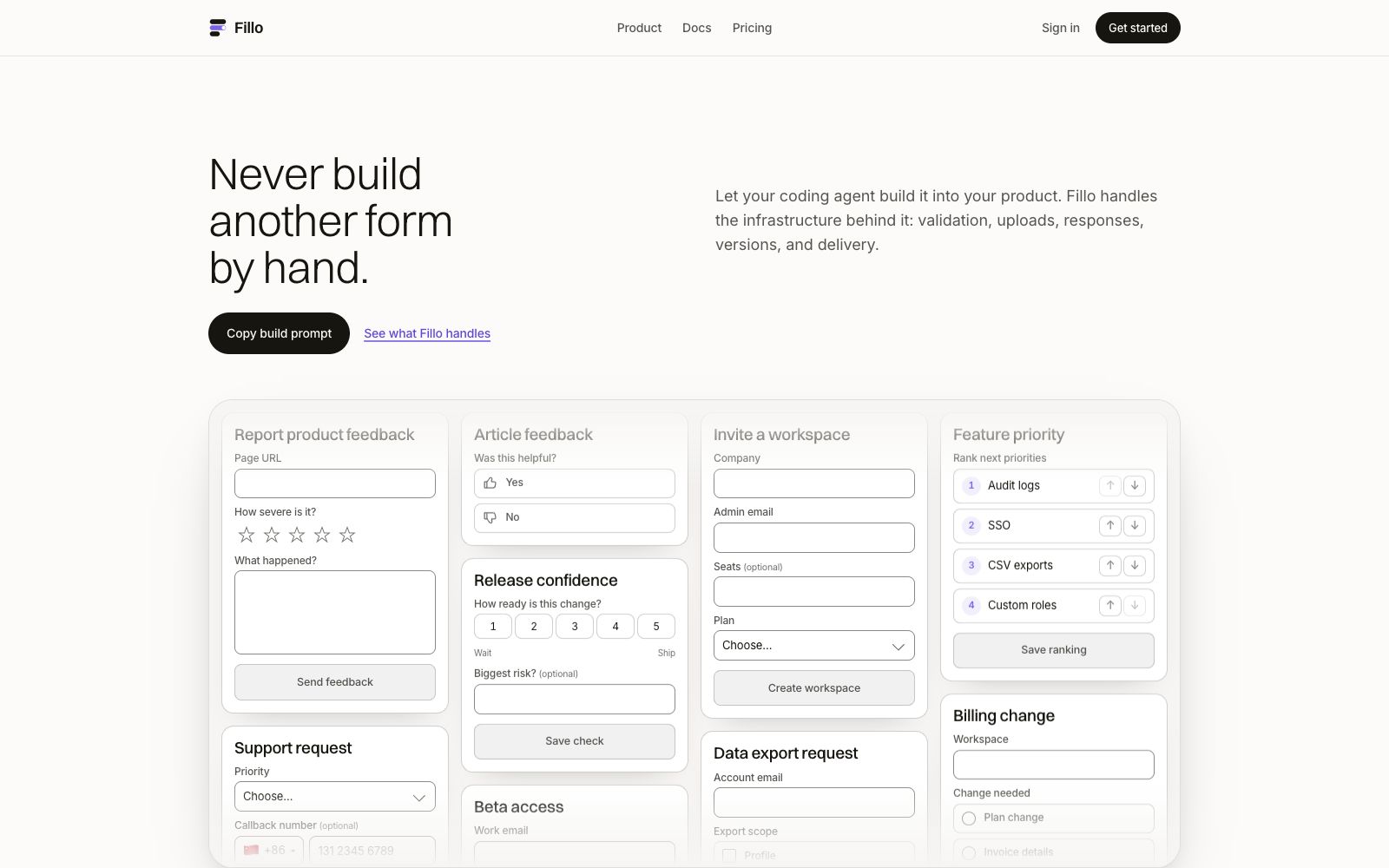
Fillo's core proposition is "no more handwritten forms". It treats forms as first-class citizens within the product: the interface is controlled by developers and its own code agent, while infrastructure such as validation, upload, response management, versioning and delivery is handled by Fillo. The official website provides real form examples rendered with @usefillo/react, supporting common scenarios like feedback, support requests, approval voting, and data export requests.
Who is it for?
- Frontend developers who need to embed forms for feedback, support, approval, data export requests and other scenarios within their products.
- Technical teams that want coding agents to directly implement forms and reduce repetitive manual work.
- Teams that want uploaded files to go directly to their own S3, Drive, Box, or R2.
- Product teams that require interface consistency and their own design system.
Key features
6Agent-driven build construction
The official method involves copying a build prompt, allowing MCP clients such as Claude Code, Cursor, Copilot, and Windsurf to directly write the form into the product. The CLI also provides an agent bootstrap process.
No iframe rendering
The form component is rendered directly within your own routes and components, without introducing iframes, non-native fonts, or disrupting the workflow. You can use default controls, replace individual fields, or create a fully custom layout.
Multi-framework support
Supports React, Vue, Svelte, Astro or regular browser applications, with the application retaining control over styles and design systems.
Login Identity Recognition
Use the app's own login system to identify form fillers. Account, plan, and page context are carried along with responses, eliminating the need for users to re-enter information.
Self-hosted Storage Upload
Files are uploaded directly from the browser to connected S3, Drive, Box, or R2, supporting multiple large files, with each persistent file reference attached to the response.
Response and Version Management
Unified viewing of answers, files, context, and submission status, with support for export or push to subsequent systems; the form can be revised when collection is resumed, and old responses retain the original schema context.
How to use Fillo
- 1Start with an official template or CLI agent bootstrap, copy the build prompt to let existing coding agents generate the first version of the form.
- 2First, use default controls to get the collection link working, then gradually replace fields or take over the entire layout to avoid over-customization at the start.
- 3Integrate the form with the login system so responses come with account and page context, facilitating subsequent assignment and review.
- 4Connect your own storage bucket in advance for large-file scenarios and confirm permissions and data retention policies.
- 5For specific pricing and hosting locations, check the latest official website instructions; the official states that the product is hosted in the EU.
Traffic & popularity
Data month Sep 2026
Fillo receives about 473 visits per month and ranks #33,641,868 worldwide.
Monthly visits
5 monthsTraffic sources
- Direct35.6%
- Search33.6%
- Referrals11.7%
- Social6.5%
- Display ads4.2%
- Other8.3%
Top countries
- India100.0%
Estimated from third-party traffic data.
Similar tools
 MakeFormsMakeForms is an enterprise-grade form builder built for teams with serious compliance needs. It offers SOC 2 audited infrastructure, HIPAA-ready forms, OTP verification, and a choice of twelve data residency regions, so you can keep sensitive data exactly where regulations require it. With a base plan starting at just $29 per month, MakeForms makes secure, compliant form building accessible to organizations of every size.
 MintlifyA document and knowledge platform for AI agents, where documents can self-update and be read by agents in a structured way. More than 20,000 companies use it for developer knowledge bases and knowledge management, keeping documents continuously up-to-date.