


Crayon AI
A platform for making games with prompts, which the official website says requires no learning of game engines: after describing your idea, an agent will ask follow-up questions and complete the rules and level length; you can modify character art in natural language, support switching between 2D and 3D, and the finished product can be published to Arcade or exported to Poki, Crazy Games and your own website.
Updated: 2026-10-26
What is Crayon AI?
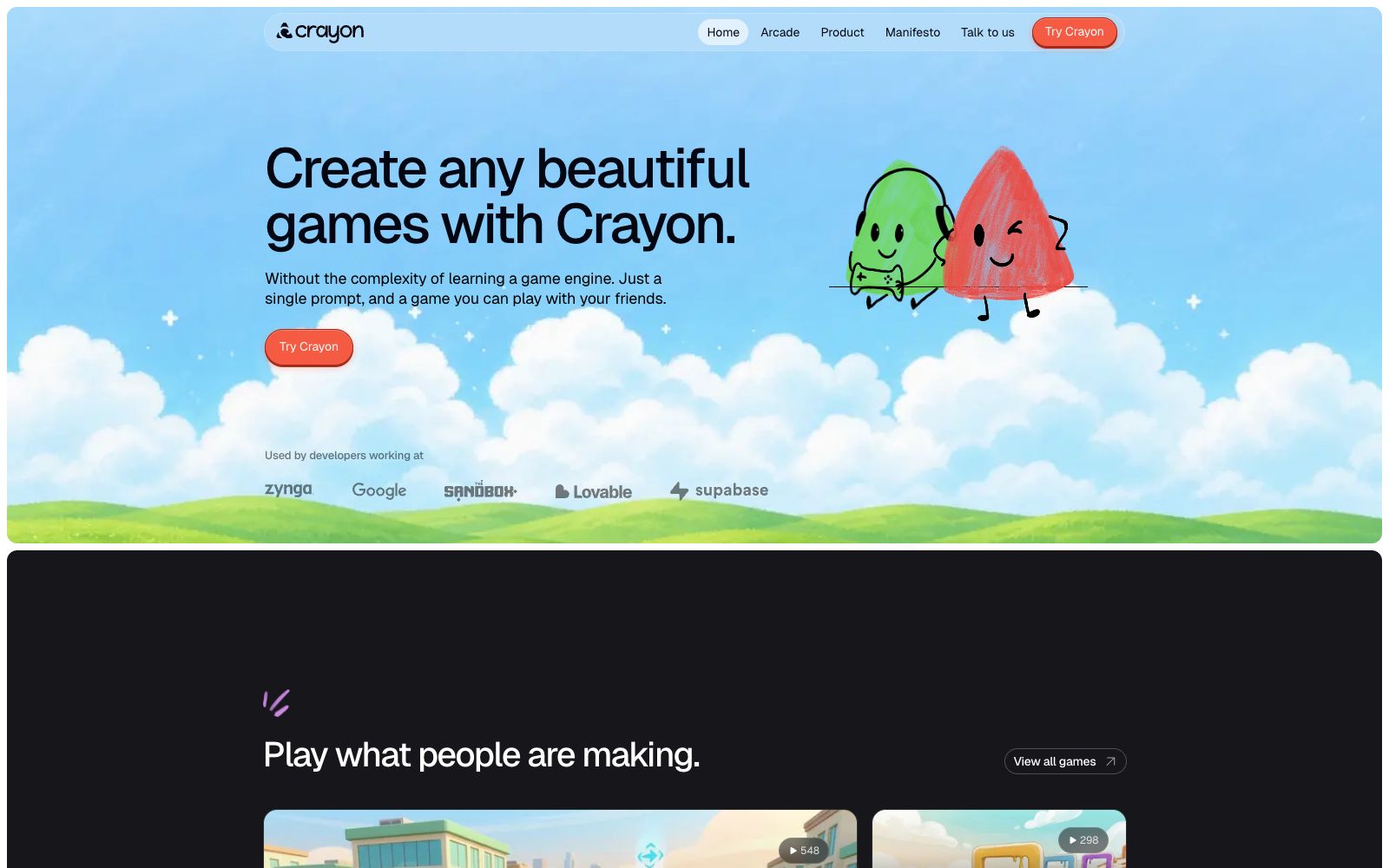
Crayon (usecrayon.ai) is a platform for making games with prompts. As stated on its official website: "Create any beautiful games with Crayon. Without the complexity of learning a game engine. Just a single prompt, and a game you can play with your friends." Unlike the route that requires learning engines and code first, it requires first describing your ideas in plain language, and then having Crayon's agent complete the rules into a playable version.
Who is it for?
- Beginners who have gameplay ideas but don't want to first learn game engines and coding.
- People who want to quickly make a small game for friends to play together.
- Designers or independent developers doing prototype validation: flesh out the gameplay first before deciding how much to invest.
- Publishers who need to place mini-games on Poki, Crazy Games, or their own websites.
- For teaching and workshop scenarios, use a single sentence to demonstrate the entire process from an idea to a playable final product.
Key features
6Start with a single prompt
You can begin by describing the game type, world, characters or an idea in everyday language. An official example is creating a surfing game set in beaches and oceans, where you collect pearls and avoid sharks.
Agent Completes Rules
During the generation process, the Agent will ask follow-up questions in return. For example, in the official demo, it will ask what type of surfing game this should be and how long the game should last, and provide options such as a single level, 5 short levels, and 10 levels with increasing difficulty.
Game Aspect Ratio Switching
You can choose Default, 3D, or 2D models during generation to decide whether the final product is 2D or 3D.
Modify art with natural language
The official website states that you can describe it like "Make a surfer character with cute chibi aesthetics" to adjust characters and materials, making the visuals closer to your vision.
Publishing & Exporting
The finished game can be published on Crayon's own Arcade, or exported to Poki, Crazy Games, or self-hosted. The official website states that you can play with friends with just one link.
Arcade Community
The homepage directly displays community works and their view counts. For example, *Last Train to the Sea* is marked with 4.6K views, with a gameplay description attached: Drive the cloud cable car through five towns, balance the wings, carry passengers, and earn tips.
Things to know
Usage Tips
- Don't write a long prompt in the first round: Share your idea in one sentence, and let the agent's follow-up questions help you define the rules and level length in turn.
- First use the Default model to get a general feel, then switch to 3D and 2D for comparison. The differences in visual styles will directly affect the gameplay feel.
- Be specific when modifying the art with natural language: add style words, subjects, and details. Vague descriptions usually require multiple rounds of adjustments.
- If you want to release, first clarify the difference between the two options: Publishing to Arcade gives you community exposure, while exporting to your own website means you are responsible for hosting and subsequent updates yourself.
- Confirm the license terms for assets and models before commercial use; the official website does not list pricing and commercial details on the homepage. If needed, directly contact the email provided on the official website for verification.
Traffic & popularity
Data month Sep 2026
Crayon AI receives about 114.0K visits per month and ranks #240,879 worldwide.
Monthly visits
7 monthsTraffic sources
- Direct33.9%
- Search24.5%
- Social21.4%
- Referrals10.4%
- Mail3.3%
- Other6.6%
Top countries
- India44.6%
- United States38.8%
- South Korea11.8%
- France4.3%
- New Zealand0.4%
Estimated from third-party traffic data.
Similar tools
 ChatforceChatforce is a chat-based AI game creation platform. According to its official website, a single description can drive four agents—director, programmer, artist, and sound designer—to collaborate, and a playable 2D or 3D game can be produced in 10 to 15 minutes. It supports mechanisms such as physics, enemy AI, and level progression, as well as multiplayer for up to 8 players. The finished product can be shared via a link.
 CadrantCadrant is an AI application generation platform for non-technical users. Its official website states that users can generate interfaces, logic and databases just by describing projects in natural language and publish them without a technical team. It covers websites, web applications and native iOS/Android applications at the same time, and allows binding of custom domain names.
 GameerGameer is an AI game platform in the browser. You can play AI-generated interactive narrative games directly without registration. After subscribing, you can turn an idea into a shareable browser mini-game, and the official website states that no coding is required.
 HiliteHilite is an AI podcast creation platform for creators. Its official website states that it supports remote multi-track recording, audio clipping based on scripts, automatic noise reduction, volume balancing, and generation of program descriptions. It also enables one-click publishing to platforms such as Spotify and Apple, making it suitable for interviews, courses, and brand programs.
 Rosebud AIYou can create a playable game with just one sentence of description or by picking a template, without writing any code at all. The official provides built-in game hosting and sharing, along with asset tools for character, portrait, and 3D model generation, and also offers story creation and digital human product lines.