


Cleanlab
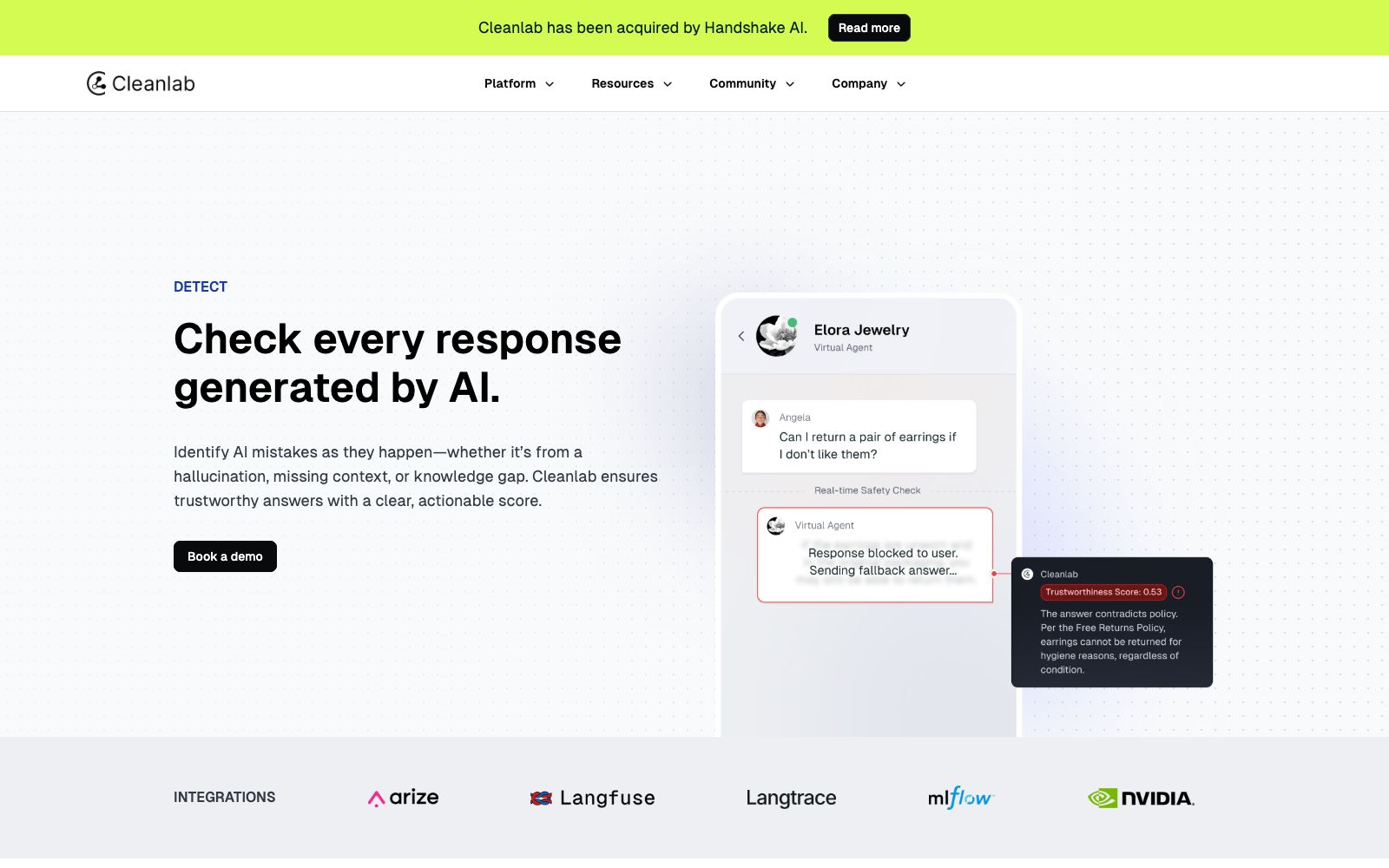
Cleanlab real-time assigns credibility scores to AI responses, identifies hallucinations, incorrect context usage and knowledge gaps, uses a single metric to decide when to intercept responses or route them to human agents, and safeguards the output quality of question-answering and customer service systems.
Updated: 2026-10-26
What is Cleanlab?
Cleanlab's Detect product is specifically designed to solve the production pain point of "unreliable AI responses": it scores each model output in real time to determine its credibility. The company categorizes the problem into three types—hallucinations, incorrect context usage, and knowledge gaps—all of which are difficult to completely avoid even with well-engineered LLMs, retrieval systems, or knowledge bases. What it aims to solve is not "making the model smarter," but "intercepting unreliable outputs at the right time," adding a reliable quality control checkpoint to already deployed AI systems. It works by scoring outputs in real time rather than conducting post-hoc spot checks, enabling integration into the online pipeline to perform risk assessment before responses reach users.
Who is it for?
- Teams that have already launched AI Q&A, customer service, or Retrieval-Augmented Generation (RAG) systems, especially those in industries where the cost of incorrect answers is high and a reliable human intervention mechanism is essential. Sectors with strict accuracy requirements such as finance, healthcare, and legal services, as well as consumer-facing products where wrong answers can damage reputation, will see the most obvious benefits. If your product has already experienced incidents like "wrong answers being screenshot and spread", it is a guardrail worth prioritizing.
Key features
6Hallucination Detection
Identifies instances where the model fabricates answers out of thin air. The official claims its detection capabilities have been proven and deliver the best performance among comparable solutions.
Incorrect Context Identification
Determine whether the answer references irrelevant or erroneous materials, preventing outputs that are "off-topic yet presented as authoritative" from reaching users.
Knowledge Blind Spot Marking
Identify scenarios where questions exceed the system's knowledge scope and prompt a switch to human support or supplementary materials instead of persisting with an answer.
Single Credibility Score
Output a metric verified by real-world operations, condensing complex judgments into a single score to help you set interception thresholds accordingly.
Tiered Escalation
Decide when to route responses to human agents, trigger fallback processes, or directly block them based on scores, creating a diversion mechanism of "low-risk approval and high-risk escalation".
Easy Integration
It enables side-by-side integration with existing AI systems, and the official offers various Integrations, allowing it to be launched without modifying the core pipeline.
How to use Cleanlab
- Treat it as a "quality inspection station" for the AI system rather than a final arbiter.
- First, roll it out with a small traffic volume, use a batch of labeled bad samples to verify the consistency between the scores and human judgments, then gradually unlock the interception and upgrade strategies.
- after going online, continuously feed back real misjudgment samples to calibrate the thresholds.
- In addition, you can connect it with the manual quality inspection process to let low-score responses automatically enter the review queue, and gradually consolidate the team's judgment experience into executable rules.
- Be careful not to let an excessively high interception rate degrade the user experience, and balance the two ends of "error prevention" and "availability".
Things to know
Traffic & popularity
Data month Sep 2026
Cleanlab receives about 4.7K visits per month and ranks #5,822,769 worldwide.
Monthly visits
12 monthsTraffic sources
- Direct38.7%
- Search35.3%
- Referrals11.8%
- Social5.7%
- Display ads2.7%
- Other5.7%
Top countries
- United States45.0%
- India17.4%
- Indonesia6.6%
- South Korea5.9%
- Turkey5.0%
Estimated from third-party traffic data.
Similar tools
 CopyleaksA text authenticity platform for enterprises and educational institutions, offering AI detection, plagiarism check, code plagiarism, and AI video detection. Officially, it supports more than 30 languages with a false positive rate of 0.03%, and can be integrated with various LMS via API.
 ExaA search API for AI agents that provides real-time web data, deep research, and structured content through a single endpoint, with highlighted, token-efficient results for Q&A, research, and coding agents.
 Baidu Intelligent Cloud Image RecognitionBaidu Intelligent Cloud's image recognition API service supports recognition of 100,000 types of objects and scenarios, and offers specialized capabilities such as animal, plant, flower, dish, Logo, and vehicle damage assessment.🤖ForefrontAn open-source model fine-tuning and deployment platform for developers, supporting dataset management, effect evaluation and serverless inference, emphasizing data sovereignty and model weight ownership; please note that its official website has been inaccessible recently, and the service status should be confirmed first.
 OpenAI CodexOpenAI's Capabilities for Code Scenarios and Entry to Development Documentation. Developers can create API Keys, install SDKs to make their first successful calls, and learn about agent construction and multimodal model selection from here.