


Bocha Wanxiang
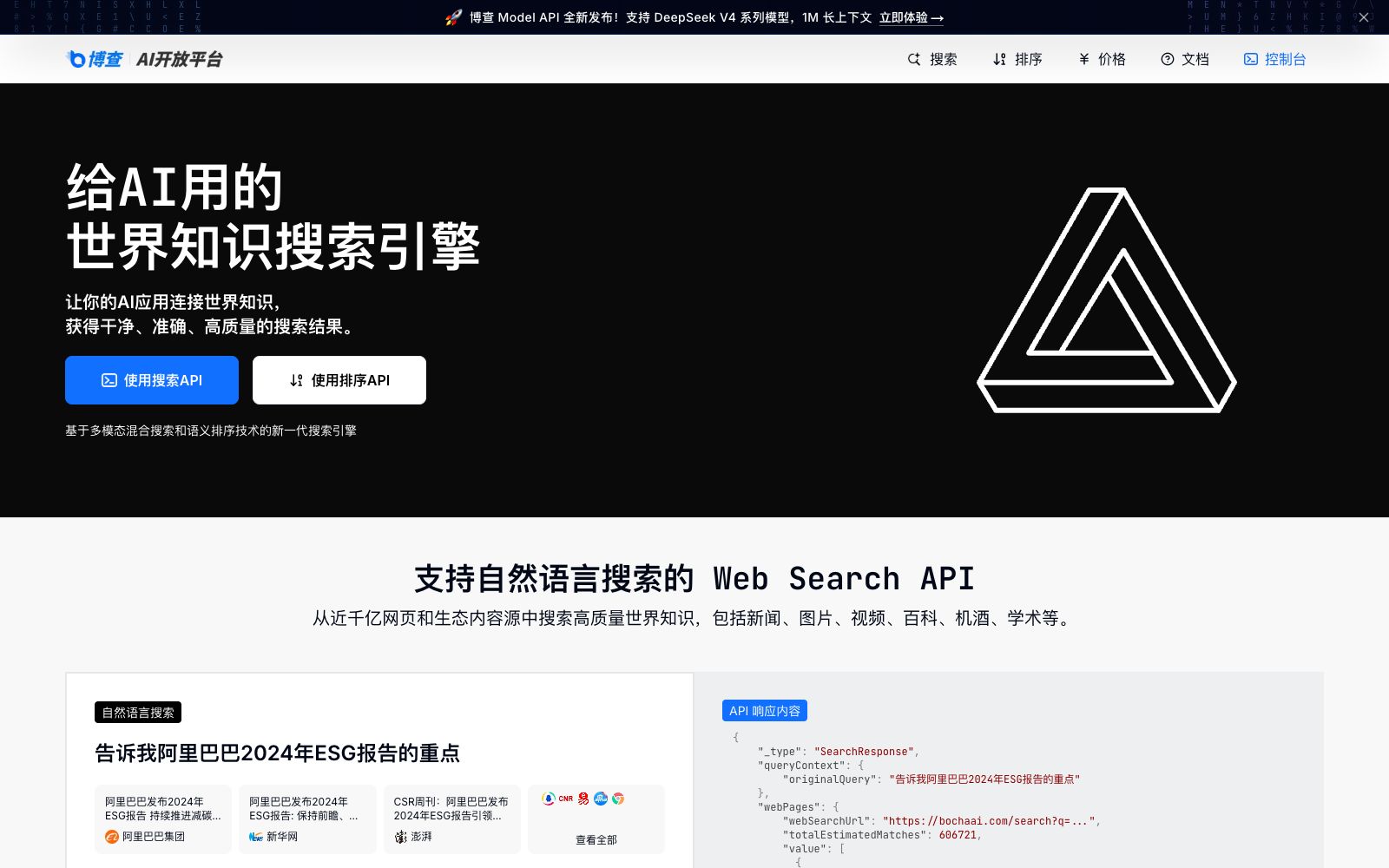
A search and ranking API platform for developers, officially positioned as a world knowledge search engine for AI, providing Web Search API and Semantic Reranker API.
Updated: 2026-10-26
What is Bocha Wanxiang?
The official website corresponding to Bocha Wanxiang is Bocha AI Open Platform (open.bochaai.com), with the title "Bocha AI Open Platform | Search API, Reranker API". First, it is necessary to clarify its positioning: it is a search and ranking API platform for developers, not an AI application for ordinary users to chat with directly. The official describes itself as "the world's knowledge search engine for AI", with the goal of "letting your AI applications connect with world knowledge and obtain clean, accurate and high-quality search results". It lists applicable scenarios as AI Agents, AI Chatbots, AI Search and various RAG applications.
Who is it for?
- Backend and algorithm engineers who want to equip self-developed AI applications or Agents with internet search capabilities: Just pass in query terms and parameters according to the documentation.
- Teams building RAG question-answering or AI search products: Use the search API for retrieval and then the ranking API to improve relevance.
- Projects requiring data cold start: The official has included "data cold start" in its applicable scenarios.
- Developers building workflows on agent development platforms: Integrate via plugins to minimize glue code.
Key features
4Web Search API
Officially, it supports natural language search. It can retrieve high-quality global knowledge from "nearly 100 billion web pages and ecological content sources", covering news, images, videos, encyclopedias, hotels and flights, academic resources and other types. It also supports custom filtering conditions and streaming/non-streaming output.
Semantic Reranker API
The official description states that the bocha-semantic-reranker model, based on the Transformer architecture, "achieves ranking effects close to those of similar models with 280M and 560M parameters with only 80M parameters, offering faster inference speed and lower costs."
Multimodal Hybrid Search
The official states that it supports hybrid search combining keywords and vectors, followed by secondary ranking using the bocha-semantic-reranker to improve the relevance of search results to the query.
Diverse Integration Forms
The official has listed three paths: calling via the official Bocha API, calling through large model tools, and using the Bocha search plugin on the agent development platform. It is stated that the result format is specially optimized for large models and can be called via the Function Call method, with an additional Agent Search API available.
How to use Bocha Wanxiang
- First, run the official example request: The method provided in the documentation is to send a POST request to https://api.bochaai.com/v1/web-search, with a Bearer API Key in the request header, and fields such as query, freshness, and summary can be set in the request body.
- Search and ranking consists of two steps: first use the Web Search API to retrieve candidates, then use the Semantic Reranker for secondary sorting.
- The official states that hybrid search combined with secondary sorting can significantly improve relevance, and the order should not be reversed.
- It is recommended to construct test sets based on real user expressions to evaluate effectiveness.
- parameters such as freshness and count affect the result scope and response size.
- Before connecting to production, it is advisable to fix a set of benchmark queries for regression testing.
- The API Key is a sensitive credential.
- it is recommended to call it on the server side rather than connecting directly from the front end.
- The footer of the official website also contains a Privacy Policy and Terms of Service.
- The official website's homepage does not display pricing and free quotas.
- specific quotas and billing are subject to the open platform console and official documentation.
Traffic & popularity
Data month Sep 2026
Bocha Wanxiang receives about 11.2K visits per month.
Monthly visits
12 monthsTraffic sources
- Direct52.1%
- Search31.4%
- Referrals15.8%
- AI assistants0.7%
- Mail0.1%
Top countries
- China83.8%
- Hong Kong, China8.8%
- United States7.1%
- Japan0.3%
Estimated from third-party traffic data.
Similar tools
 Bochat AI SearchBochat AI Search is a multimodal AI search engine that offers agents for restaurants, hotels, attractions, flight tickets and academic research. It supports natural language queries and provides a search API to help AI applications connect with global knowledge.
 TavilyReal-time search API for AI agents, providing interfaces such as search, extraction, crawling, maps and research, returning structured chunked content; the official claims that it has a built-in security verification layer that intercepts personal privacy information and prompt injection.
 AgentsetAgentset is an open-source RAG and agent building platform that lets you build production-grade question-answering applications in minutes: it supports multimodal parsing of images, charts and tables, automatic source citation, metadata filtering and self-hosting, and it delivers leading performance in benchmark tests.
 Tencent Cloud ADPTencent Cloud's enterprise-level intelligent agent development platform provides LLM+RAG, Workflow and Multi-agent development engines, supporting integration of construction, distribution, management and operation.
 HaystackAn open-source AI orchestration framework maintained by deepset, which builds production-ready agents, retrieval-augmented and semantic search systems with modular components, where every step can be inspected, debugged and replaced.
 LlamaIndexAn AI data framework centered on document intelligence, its flagship capability LlamaParse uses agent-style OCR to parse documents with complex tables and charts into structured context usable by AI.