


AudioPod AI
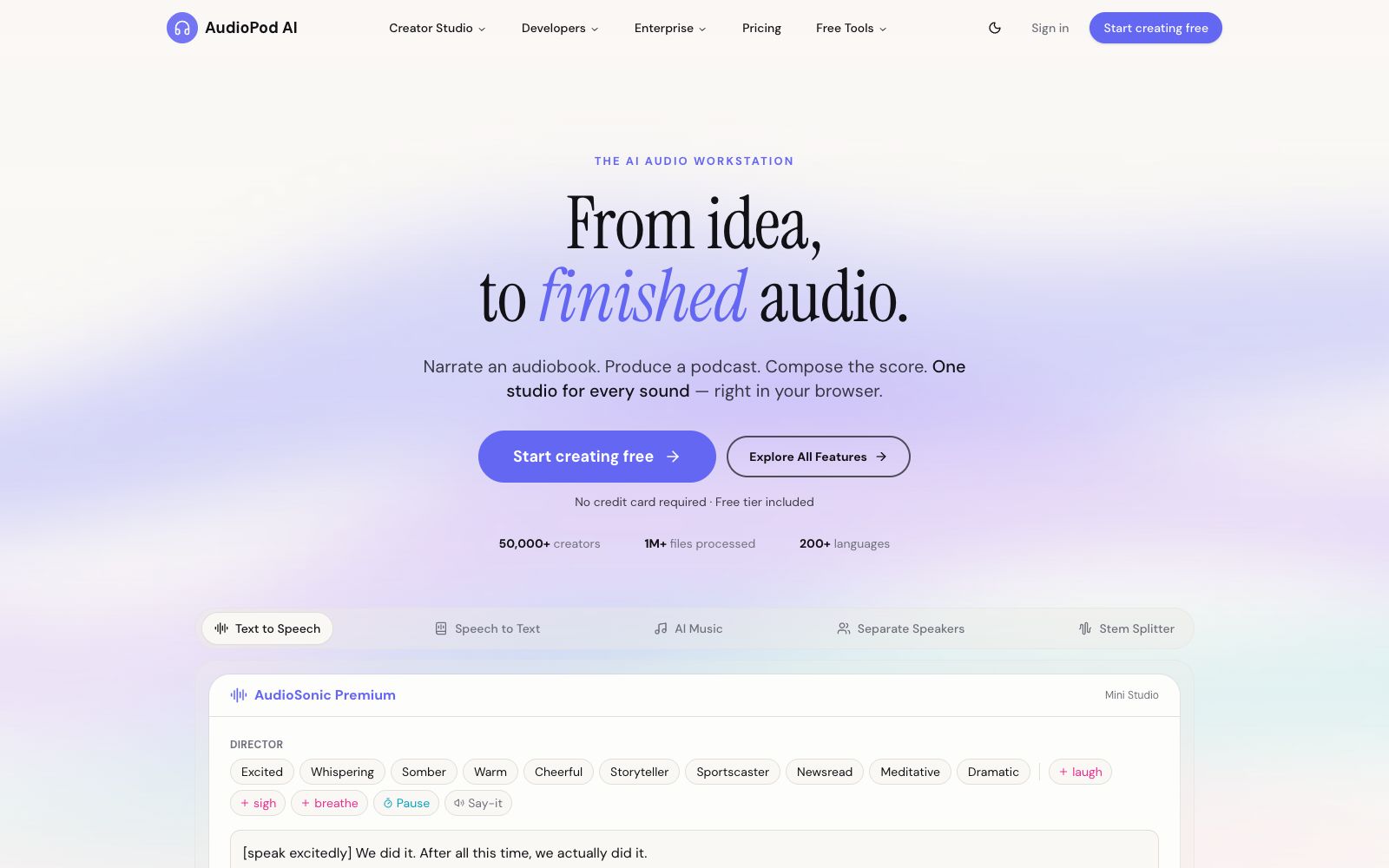
An AI audio workstation for podcasts and audiobooks, officially capable of importing PDFs or EPUBs to automatically split chapters and dub, outputting masters that meet ACX standards, and supporting over 200 languages as well as reading controls for intonation, pauses, etc.
Updated: 2026-10-27
What is AudioPod AI?
AudioPod AI defines itself as an AI audio workstation, serving podcasters and audiobooks. It is more than just dubbing: there is a complete production line from manuscript to finished product. Importing a PDF or EPUB allows automatic chapter splitting, voice selection, and mastering. The official claims it can output audiobook files that meet ACX standards. In addition, it offers background music and multi-track editing, eliminating the need to switch between three tools for a single program.
Who is it for?
- Independent podcasters: One person handles recording, soundtrack production and editing.
- Audiobook producers: Need to batch convert manuscript books into publishable audio content.
- Course and knowledge payment teams: Turn teaching materials into audio courses.
- Overseas content teams: Produce multilingual dub versions of the same script.
- Developers: Integrate dubbing and multi-track capabilities into your own products.
- Publishing houses and audio platforms: Batch convert book lists into publishable audio content.
Key features
7Audiobook Production Line
The official process covers manuscript, chapter segmentation, dubbing, mastering, and export. It supports importing PDF and EPUB files for automatic chapter cutting, and can be read out with studio voices or your own cloned voices.
Document-to-Podcast Conversion
The official claims it can transform documents into studio-quality podcasts, making articles and reports accessible as audio content.
Multilingual & Voice Design
The official claims to offer realistic voices covering over 200 languages, support custom voice design, and allow the creation of multilingual versions for the same program.
Director-level control
The official focus is on delivering a director's touch rather than just sound, allowing control over emotion, voice labels, pauses, and pronunciation.
Background Music & Stem Splitting
A single prompt can generate original music, and it can also split any song into clean stems, making it convenient to create opening and ending themes as well as background music.
API and Team Solutions
The official website offers three tiers for creator studios, developers, and enterprises. Developers can access audio APIs; the official states that the free tier provides 5,000 credits without requiring card binding.
Multi-role Assignment
In the official example, one chapter of a novel is automatically assigned a narrator voice and two character voices, eliminating the need to manually change voices for each line in multi-party dialogues.
How to use AudioPod AI
- 1Do a one-chapter trial first before bulk production: Tone, speaking speed and pauses only reveal issues in long-form content; verify first before scaling up.
- 2Cloned voices must be obtained with the written consent of the person concerned; the scope of commercial use is subject to the official terms, and the cost of disputes over voice ownership is very high.
- 3Correct polyphonic characters and proper nouns in Chinese one by one using pronunciation control, which is cheaper than re-recording afterwards.
- 4Audiobook mastering has strict indicators for noise floor and loudness, and it is recommended to recheck the exported files with detection tools.
- 5The free tier is suitable for running through the workflow; confirm the paid plan and commercial authorization before official production, as the official rules may be adjusted.
- 6First, clarify the character list before importing; confusion in voice assignment is mostly due to the lack of clear speakers in the text.
- 7Export long books chapter by chapter; if a single chapter fails, only re-run that chapter instead of reworking the entire book.
Traffic & popularity
Data month Sep 2026
AudioPod AI receives about 62.1K visits per month and ranks #612,016 worldwide.
Monthly visits
12 monthsTraffic sources
- Search70.3%
- Direct19.8%
- Social5.0%
- Referrals3.1%
- AI assistants1.2%
- Other0.7%
Top countries
- United States13.9%
- India6.0%
- Australia3.5%
- Mexico3.1%
- United Kingdom2.8%
Estimated from third-party traffic data.
Similar tools
 NotevibesNotevibes is an AI dubbing tool launched in 2018. You can input a manuscript or a single sentence to generate voiceovers, podcasts, audiobooks and dubbing slides. It supports more than 2,000 types of voices, over 130 languages and voice cloning.
 Lovevoice AI Voice GeneratorLovevoice is an online text-to-speech tool that provides nearly 300 AI voices and over 70 languages. It allows adjustment of speaking speed, volume and pitch, supports file-to-speech conversion and long text synthesis, and is suitable for video dubbing, podcast production and audiobook creation.
 ElevenReader by ElevenLabsConvert PDFs, e-books and web pages into natural speech for reading aloud, offer thousands of voices and multilingual narrators, and have 200,000 built-in audiobooks, suitable for people who listen to long texts during commutes and housework.
 VoiceboxAn open-source local voice studio that clones timbre from a few recordings, generates speech across multiple TTS engines, and enables global dictation in any application. The official description states that it is a free local alternative to ElevenLabs and WisprFlow.
 FineShare FineVoiceOnline AI voice workstation, supporting text-to-speech, voice cloning in about 30 seconds, voice changing and sound effect generation, covering 154 languages, allowing export of watermark-free dubbing, suitable for short video voiceovers, online course recording and multilingual localization.
 Sonic-3Cartesia's real-time speech synthesis model, officially claimed as the first with an audio package below 90 milliseconds, a single model covering 44 languages, supporting voice cloning and custom pronunciation dictionaries, is mainly targeted at the voice Agent scenario.