


Albus AI
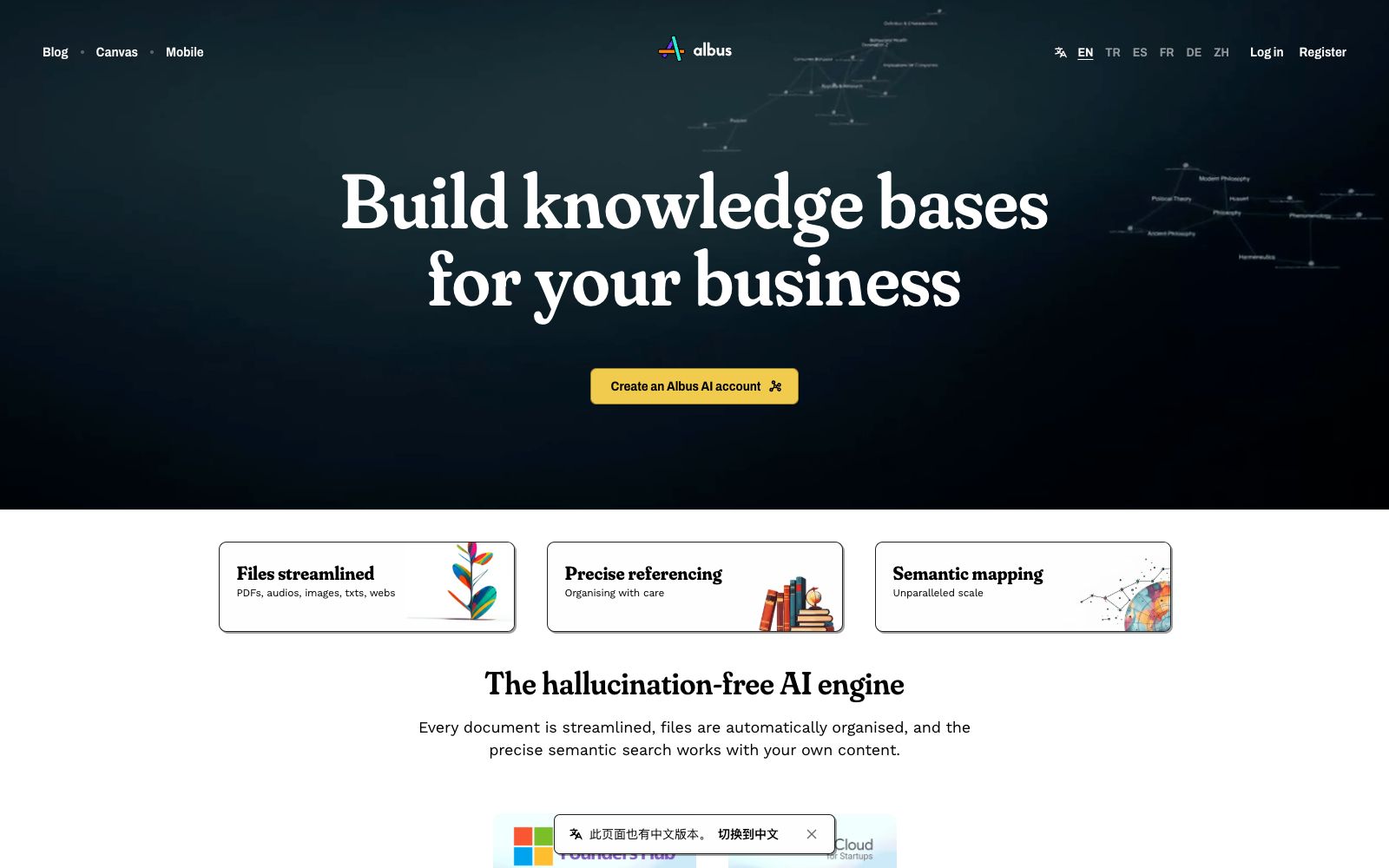
Albus AI is a cloud workspace that turns files into knowledge bases. Officially, it can automatically categorize PDFs, audios, images and webpages, perform semantic retrieval, provide citations with page numbers and chapters, and support multi-device access.
Updated: 2026-10-26
What is Albus AI?
The official website of Albus AI describes itself as the next-generation cloud workspace, with a core proposition of no need to create folders: when you upload files, the semantic indexing engine will automatically categorize them based on content, and when retrieving, it directly provides citations with page numbers and chapters. The official calls this engine a hallucination-free retrieval method, emphasizing that answers only come from your own content rather than external knowledge.
Who is it for?
- Design and research roles where data is scattered across multiple hard drives and cloud storage platforms, and retrieval relies entirely on memory.
- Small and medium-sized companies that need to build a shared knowledge base for their teams but have no one willing to maintain the directory long-term.
- Teams that have a large collection of podcasts, meeting recordings, and images and want all of this content to be searchable together.
- People who are often away and need to access the same database on mobile phones and tablets.
Key features
6File Streaming Processing
The official states that it supports various content formats such as PDF, audio, images, text, and web pages, and unifies different media into a single library.
Automatic File Organization
After uploading files, the system automatically categorizes them based on semantics. You can also adjust the directory structure of all documents with a single instruction, eliminating the need for manual drag-and-drop.
Accurate Citation
According to the official description, the answers are sourced from your own database and annotated with page numbers and chapters, making it easy to verify the original text later.
Semantic Mapping
The semantic mapping capability listed on the official website enables retrieval based on meaning rather than literal keyword matching.
Deeper Contextual Understanding
The official states that it can search across all PDFs, images, audio files, Word documents, Markdown files and web articles, connecting scattered information together.
Multi-device & Multi-language
The official website offers desktop and mobile applications, with the interface supporting English, Turkish, Spanish, French, German and Chinese.
How to use Albus AI
- 1Import on a small scale first to verify the classification effect, then migrate all at once to avoid large-scale rework caused by incorrect automatic classification.
- 2Citation annotations can locate chapters and sections, but for key conclusions, it is still recommended to open the original text for verification before external use.
- 3Audio and images depend on recognition quality; retrieval performance will drop significantly when the material is low in clarity. It is recommended to keep a text backup of important recordings.
- 4The official website lists two tiers: a Free version and a Pro version. The Pro version is priced at $20 per month, and quotas for real-time internet search and other features are subject to the official pricing page.
- 5Confirm the sharing scope before uploading customer data; all members in the team space can usually retrieve the same set of content.
- 6Cross-border teams should also pay attention to data storage locations and privacy policies. The official website lists a FAQ page and a terms of service page for reference.
- 7The official website mentions that you can change the directory structure of all documents with a single instruction; it is best to confirm the scope of impact before execution, and make backups if necessary.
Traffic & popularity
Data month Sep 2026
Albus AI receives about 3.7K visits per month and ranks #6,171,715 worldwide.
Monthly visits
12 monthsTraffic sources
- Direct39.6%
- Search34.4%
- Referrals10.8%
- Social6.2%
- Display ads3.0%
- Other6.0%
Top countries
- United States30.4%
- Argentina13.1%
- France8.8%
- Vietnam8.3%
- United Kingdom8.2%
Estimated from third-party traffic data.
Similar tools
 MeilisearchMeilisearch is an open-source ultra-fast search and AI retrieval platform. It provides full-text, semantic, hybrid and multimodal retrieval, supports vector storage, and can be deployed on the cloud or self-hosted. Officially, it is said to be used by more than 20,000 teams.
 WisFileAn AI file renaming and organizing tool that runs completely locally. It automatically renames files by extracting titles, authors, and years from their content, and sorts them into folders by theme. The official states that it is free and does not upload any data.
 imaThe AI Knowledge Steward launched by Tencent supports building personal and team knowledge bases, performing question answering and retrieval on imported materials, and generating PPTs, podcasts and research reports based on the materials, targeting scenarios of data organization and content creation.
 SparkleSparkle is an AI cleaning and file organizing tool for macOS. According to the official description, it can clean up junk and duplicate files, generate folders according to your working style and perform regular maintenance, and the deleted content is first moved to the Trash.
 FlowUsAll-in-one knowledge creation and publishing platform that supports online documents, multi-dimensional tables and mind maps. The official version provides multi-terminal synchronization, full-text search and WeChat clipping, and is built with AI writing, code table formula processing and translation capabilities.
 GitBookA team-oriented knowledge document platform that connects documents, products and users. It is officially claimed to proactively detect expired content, answer user questions with AI, identify knowledge gaps, and balance retrieval for humans and Agents.