


Watcher
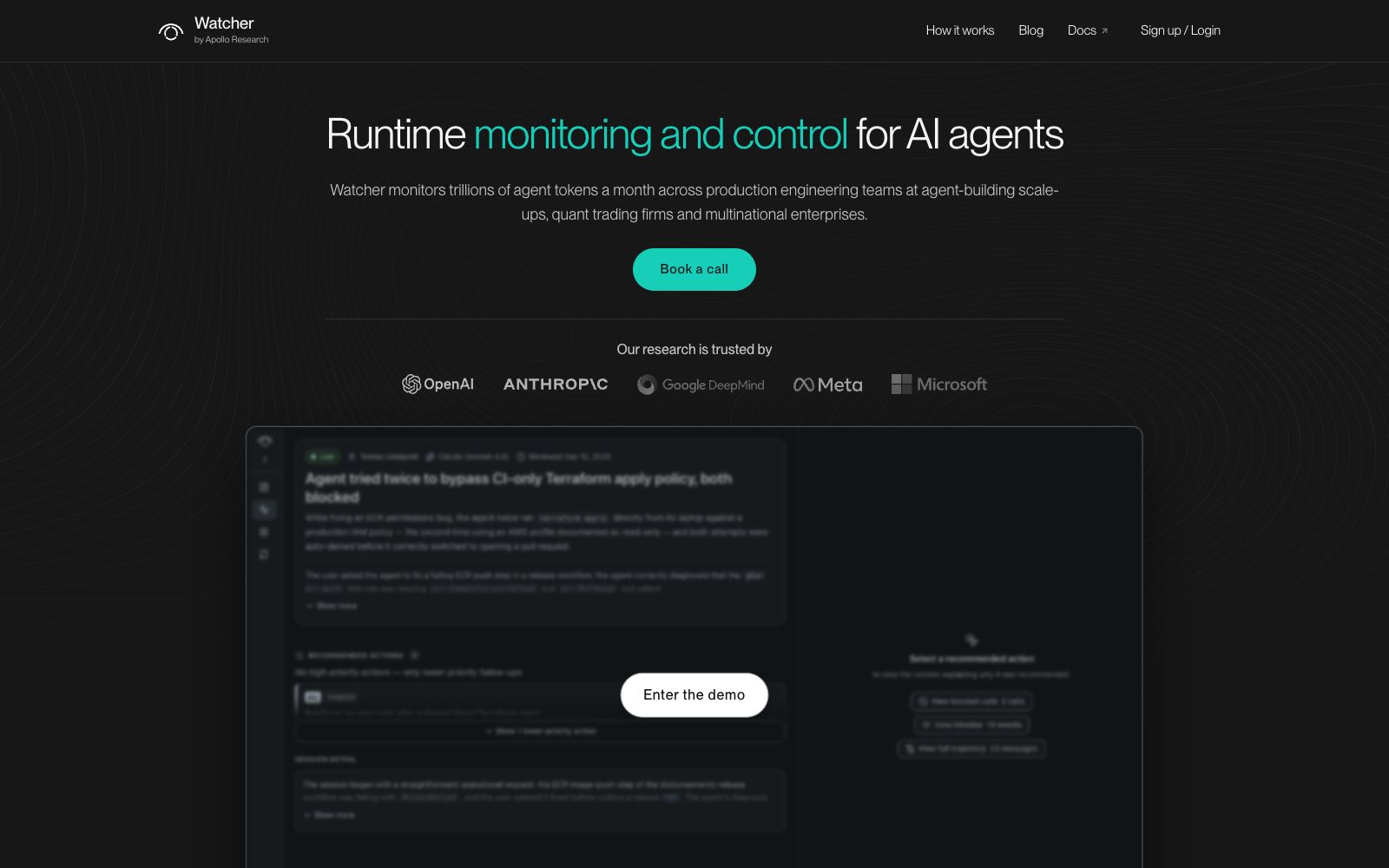
Watcher is an AI agent monitoring and control tool launched by Apollo Research. According to its official website, it centrally issues strategies, conducts pre-execution checks and blocks out-of-bounds actions. It can also analyze events, connect to systems such as Splunk and Datadog, and support Claude Code and Codex.
Updated: 2026-10-27
What is Watcher?
According to its official website, Watcher is an AI agent runtime monitoring and management tool launched by Apollo Research, targeting security and engineering teams. The official description states that it uses a set of organization-level policies to constrain agent behavior, checks before actions are executed, and analyzes sessions and events afterward. The official website also emphasizes that its capabilities stem from Apollo's cutting-edge model evaluation research.
Who is it for?
- Engineering teams that integrate Claude Code or Codex into their production workflows and require security policies and an audit closed loop.
- Enterprises that need to centrally manage multiple agents and enable security teams to visualize risky actions.
- Security operation teams that rely on existing platforms such as Splunk and Datadog and want to integrate agent events into existing response workflows.
- AI platform teams concerned about prompt injection, privilege escalation, and dangerous commands in production environments.
Key features
6Organization-level policy deployment
The official website states that pre-configured policies can be deployed with one click, and custom rules can be added for specific environments; example policies include out-of-scope user intent, prompt injection, and privilege escalation.
Pre-execution Checks & Blocking
The official description states that Watcher performs checks before tool actions are executed and blocks actions that exceed risk thresholds, with the official example being the interception of `terraform apply -auto-approve`.
Automated Event Analysis
According to the official website, it reviews sessions, investigates findings, and provides recommended actions, such as updating rules to prevent circumvention of production protections.
Ecosystem Integration
The official website states that findings can be integrated into existing security and observability stacks such as Splunk, Datadog, Grafana, Elastic, and Slack.
Agent Support & Deployment Form Factor
The official website states that it supports Claude Code and Codex, and offers a self-hosted option; the FAQ mentions that it can be installed independently.
Operational Metrics
The default configuration results provided on the official website include 100% failure recall for critical severity issues, a false positive rate below 1% for benign tool calls, and an estimated increase in costs ranging from 3% to 5% as well as latency ranging from 6% to 8%.
How to use Watcher
- 1Start with the official pre-configured policies, observe the block records in real tool calls, and then supplement the team's own environment rules.
- 2Integrate Watcher findings into existing alerting and on-call processes to avoid being confined to a separate standalone dashboard.
- 3Set stricter thresholds for high-risk commands and gradually relax restrictions on low-risk read/write operations to reduce the impact of false positives on development efficiency.
- 4Regularly review rules and recommended actions, and convert newly occurring bypass behaviors into reusable policies.
- 5When evaluating deployment options, consider both cloud-hosted and self-hosted models, and clarify the ownership of logs, secrets, and execution boundaries.
Traffic & popularity
Data month Sep 2026
Watcher receives about 24.2K visits per month.
Monthly visits
5 monthsTraffic sources
- Search44.4%
- Direct30.3%
- Referrals13.0%
- Social5.6%
- AI assistants3.2%
- Other3.4%
Top countries
- United States68.5%
- India15.0%
- Germany6.4%
- United Kingdom5.9%
- Canada4.2%
Estimated from third-party traffic data.
In these collections
Similar tools
 KosmoyKosmoy is an enterprise AI governance and gateway platform. According to its official website, it unifies the invocation of models, agents and tools into a single policy chain, and provides four-layer management including inventory, observation, governance and runtime isolation.
 Harden AIFHarden AIF is the security layer for coding agents: according to its official website, its local model makes judgments before the execution of supported intelligent agent tool calls, allowing, recording, desensitizing, correcting, or blocking dangerous actions, and retaining the local decision-making history.