

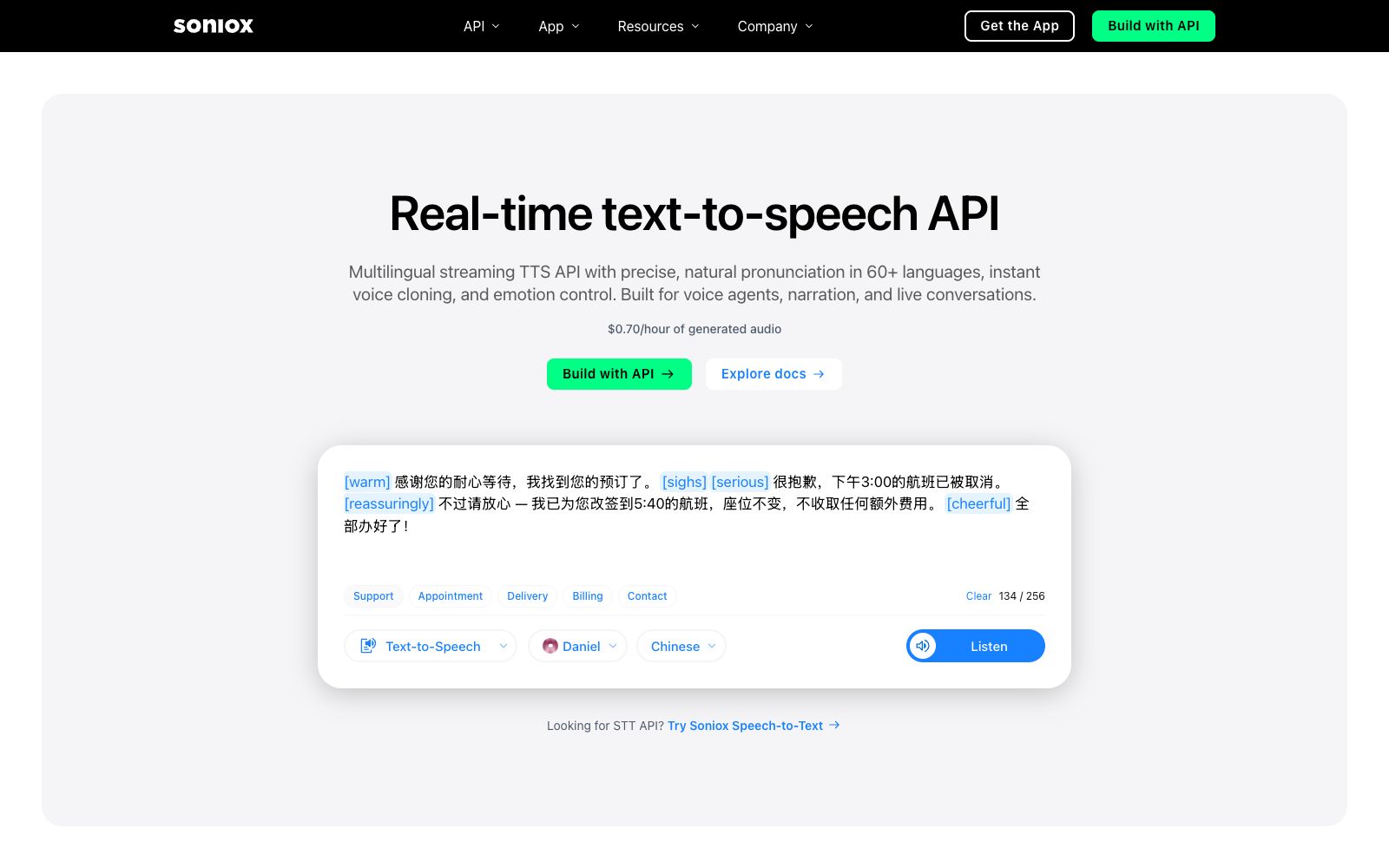

Soniox Text-to-Speech
Soniox Text-to-Speech is a real-time speech synthesis interface. Its official website states that it supports more than 60 languages and over 200 timbres. Labels can be used to control emotions and tones, and timbres can be cloned with just a few seconds of samples. It is charged based on the generation duration.
Updated: 2026-10-26
What is Soniox Text-to-Speech?
Soniox Text-to-Speech is a real-time speech synthesis interface provided by Soniox. According to its official website, it supports over 60 languages and more than 200 voices, and can return results in a streaming manner via WebSocket or REST. Its pricing page states that it starts at $0.70 per hour of audio generated. Different from speech synthesis that only performs "reading aloud", the official website focuses on using audio tags to control emotions and expression styles, and emphasizes the pronunciation accuracy of numeric strings and proper nouns. It is targeted at scenarios such as voice agents, audiobook dubbing, and real-time dialogue.
Who is it for?
- Product teams building voice agents and phone customer service solutions, as well as those requiring low-latency audio output and natural interruption capabilities.
- Content teams that need multilingual dubbing while retaining the same voice style.
- Industry scenarios with strict requirements for the pronunciation of order numbers, serial numbers, and personal names (the official website highlights this accuracy as a separate feature).
- Game teams that want to express emotion through sound rather than just telling audio content in a straightforward way.
Key features
7Multilingual and Multi-voice
The official website states that it covers more than 60 languages and over 200 voices, and supports the natural mixing of languages in the same paragraph.
Emotion and Expression Control
The official website demonstrates that square bracket tags can be used to specify tones such as whispering, sighing, soothing, and cheerful, enabling control over emotions, expressions, and vocal responses.
Voice Cloning
The official website states that a voiceprint can be created with just a few seconds of recording, and it emphasizes that it is not just imitation.
Accurate Pronunciation
The official website highlights the correct pronunciation of alphanumeric strings and the natural pronunciation of personal names as a separate feature, targeting scenarios with high pronunciation accuracy requirements.
Real-time Streaming
The official website states that the audio starts playing before the sentence is completed, and provides precise timing information for each character.
Two Access Methods
The official website provides WebSocket and REST call methods, along with a demo that can be directly listened to on the page.
Online Trial Available
The official website provides directly playable demonstrations for languages and voices, allowing you to compare the differences between voices on the same text before accessing the service.
How to use Soniox Text-to-Speech
- 1First use the playable demos on the official website to confirm the voice and language combination, then decide which access method to use; prioritize WebSocket for real-time conversations.
- 2Emotion tags should be specific; a vague description like "gently" is less stable than official tags.
- 3When dealing with proper nouns and numbers, first verify the pronunciation using a small number of samples. If necessary, adjust the text writing instead of just changing the voice.
- 4You must obtain authorization before cloning another person's voice, and the scope of commercial use shall be subject to the license statement on the official website.
- 5Pricing is based on the duration of generated audio; for long content, it is recommended to conduct batch synthesis tests first before launching to avoid repeated generation that drives up costs.
Traffic & popularity
Data month Sep 2026
Soniox Text-to-Speech receives about 139.9K visits per month and ranks #288,889 worldwide.
Monthly visits
12 monthsTraffic sources
- Direct50.2%
- Search37.2%
- Referrals6.1%
- Social3.5%
- Mail1.9%
- Other1.1%
Top countries
- United States12.2%
- South Korea9.8%
- India8.7%
- Austria6.3%
- Slovenia5.3%
Estimated from third-party traffic data.
In these collections
Similar tools
 MiniMax VoiceMiniMax's Speech and Music Generation Platform, officially powered by Speech 2.6 and Music 2.0, offers speech synthesis, timbre design, voice cloning and music creation, and supports vocal extraction and API access.
 AnyVoiceOnline AI voice cloning tool. The official claims that it can replicate the tone with just 3 seconds of audio. It supports text-to-speech and sound design, with a built-in voice model library covering Chinese, English, Japanese and Korean languages.
 Fish AudioAI voice platform that provides studio-grade text-to-speech and voice cloning. According to its official website, it has over 2 million voices and covers 8 languages, focusing on real-time voice models with emotional control.
 Wusheng AIA hyper-realistic AI voice synthesis and instant cloning platform (formerly Reecho), the official claims that the self-developed text-to-speech model supports over 30 languages and dialects, can clone voices with a minimum 3-second sample, and offers a voice marketplace and low-latency APIs.
 Doubao VoiceVolcano Engine's large-scale speech model product line covers capabilities such as speech synthesis, voice cloning, speech recognition, real-time speech and audio generation. The official statement mentions that it provides over 400 timbres and more than 30 languages, and supports API and SDK access for enterprises.
 Voiser AIVoiser AI is a multilingual platform integrating text-to-speech, speech-to-text, AI video generation and voice cloning. Officially, it claims to support over 140 languages and offers emotional voices and pronunciation customization.