


NodeLand
NodeLand is a learning tool that combines visual mind maps, flashcards and Feynman-style explanations. Officially, it is designed around three types of exercises: connection, recall and review, and shares the same account.
Updated: 2026-10-26
What is NodeLand?
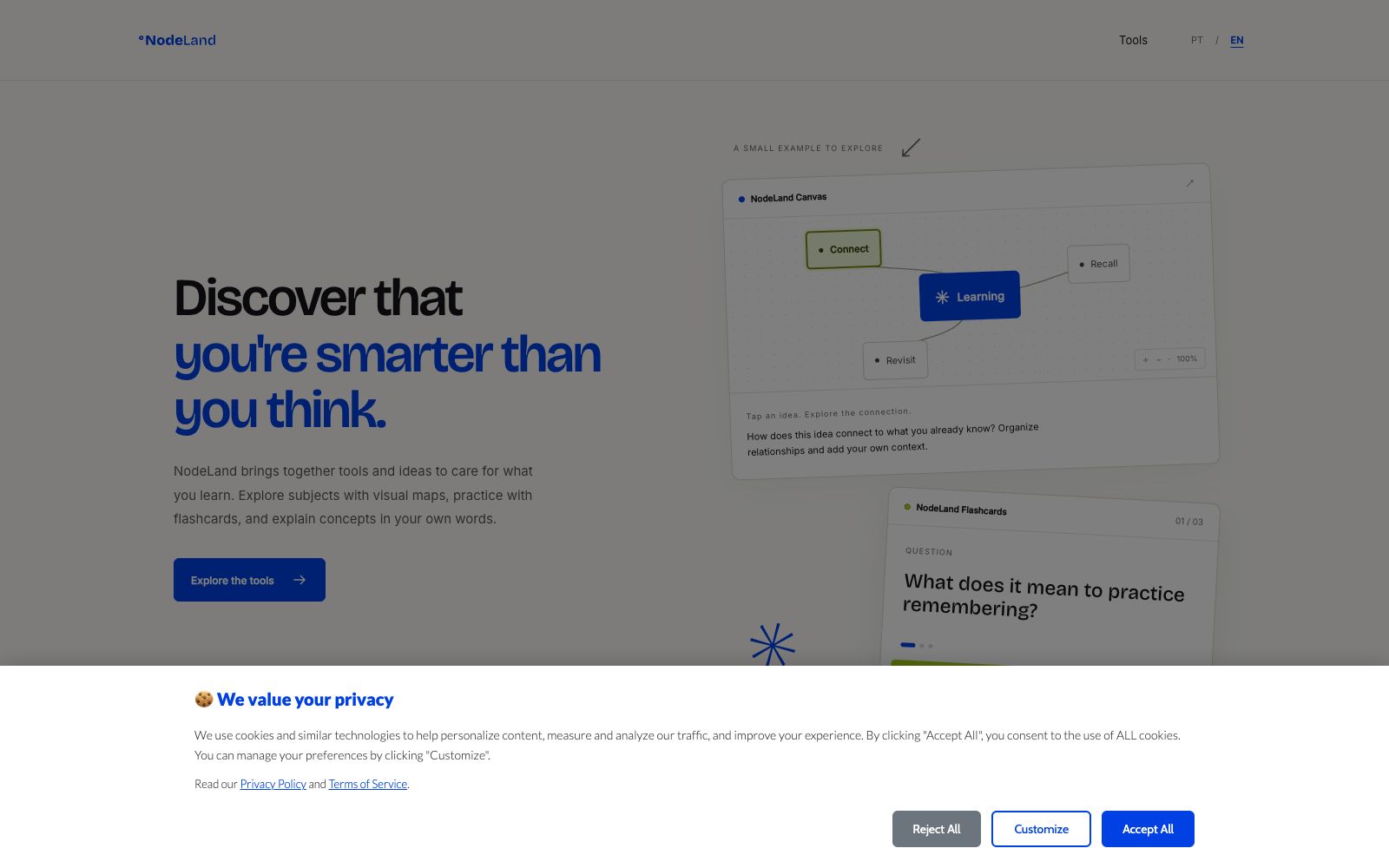
The official website of NodeLand describes itself as "Tools to learn, connect and remember", consisting of three small tools: NodeLand Canvas for drawing visual maps, organizing notes and relationships; NodeLand Flashcards for retrieval practice and spaced repetition; and NodeLand Feynman for explaining concepts in your own words and then answering questions from a "curious student". The three tools share the same NodeLand account. In the Foundations section of the official website, three learning habits behind it are specified: Connect (meaningful learning), Try to recall (active recall), and Revisit (spaced repetition), with a note that "Learning research is our starting point, not a promise of individual effectiveness."
Who is it for?
- Self-learners who are studying a new discipline and need to first clarify the relationships between concepts.
- Students and exam candidates who rely on extensive memorization and self-testing for exam preparation.
- People who have finished a book or a course and want to check if they truly understand something by "explaining it to others".
- Learners who need to progress in stages at their own pace rather than being pushed by a fixed curriculum.
Key features
5NodeLand Canvas
Described on the official website as "Give your ideas a shape", it organizes notes, explores relationships and retains context. It is a visual space to see the whole theme, supporting visual mind maps and linked notes.
NodeLand Flashcards
Create questions, attempt to answer them, and then revisit the material through spaced repetition. The official website refers to this as retrieval practice and spaced review, allowing you to practice one set at your own pace.
NodeLand Feynman
Pick a concept and explain it in your own words, then answer the questions raised by the system. It is used to discover "what other parts are not clear", and the official website labels it as Explanation, Questions, Feedback.
Connect / Recall / Revisit
The official website frames these three practices as the foundational design of the product, corresponding to meaningful learning, active recall, and spaced repetition respectively.
Unified Account Access
All three tools share a single login system, and the official website emphasizes that users can choose which one to use based on their current learning stage.
How to use NodeLand
- First, use Canvas to outline the structure of a topic, then turn the nodes that are easy to forget into Flashcards, and finally use Feynman to explain and check.
- The order provided on the official website is itself a complete learning path.
- When making flashcards, make the questions specific and avoid vague ones like "What is it?" that can't be judged as right or wrong, so that you can assess yourself effectively during review.
- For spaced review, you really need to leave a period of time before reviewing, as repeatedly flipping the same set of cards in a row has limited effect.
- The official website has not disclosed details such as pricing and availability, so it is recommended to try the free features first to confirm if they suit your learning habits.
- The official website clearly states that it does not guarantee individual learning outcomes, and it should be regarded as a practice tool rather than a guarantee for score improvement.
Traffic & popularity
Data month Sep 2026
NodeLand receives about 691 visits per month and ranks #15,856,552 worldwide.
Monthly visits
12 monthsTraffic sources
- Direct39.1%
- Search32.4%
- Referrals10.5%
- Social6.2%
- Mail3.6%
- Other8.1%
Top countries
- United States90.9%
- Japan7.8%
- India1.3%
Estimated from third-party traffic data.
Similar tools
 Memo AIAn AI knowledge workspace that can upload documents, videos, websites and text, supports source-based citation Q&A, and generates flashcards, notes, practice tests, mind maps and guided explanations from the same materials.
 OmnisetsOmnisets is an AI flashcard learning tool, positioning itself as an alternative to Quizlet. It allows AI-generated flashcards and offers spaced repetition, practice tests, and gamified learning, with free basic usage.
 Algor EducationAn AI learning platform developed by Algor Lab in Italy, which can convert PDFs, handouts, web pages or videos into concept maps, mind maps, flashcards and quizzes, and edit and review in the same study set, suitable for exam preparation and lesson planning.