


Glide
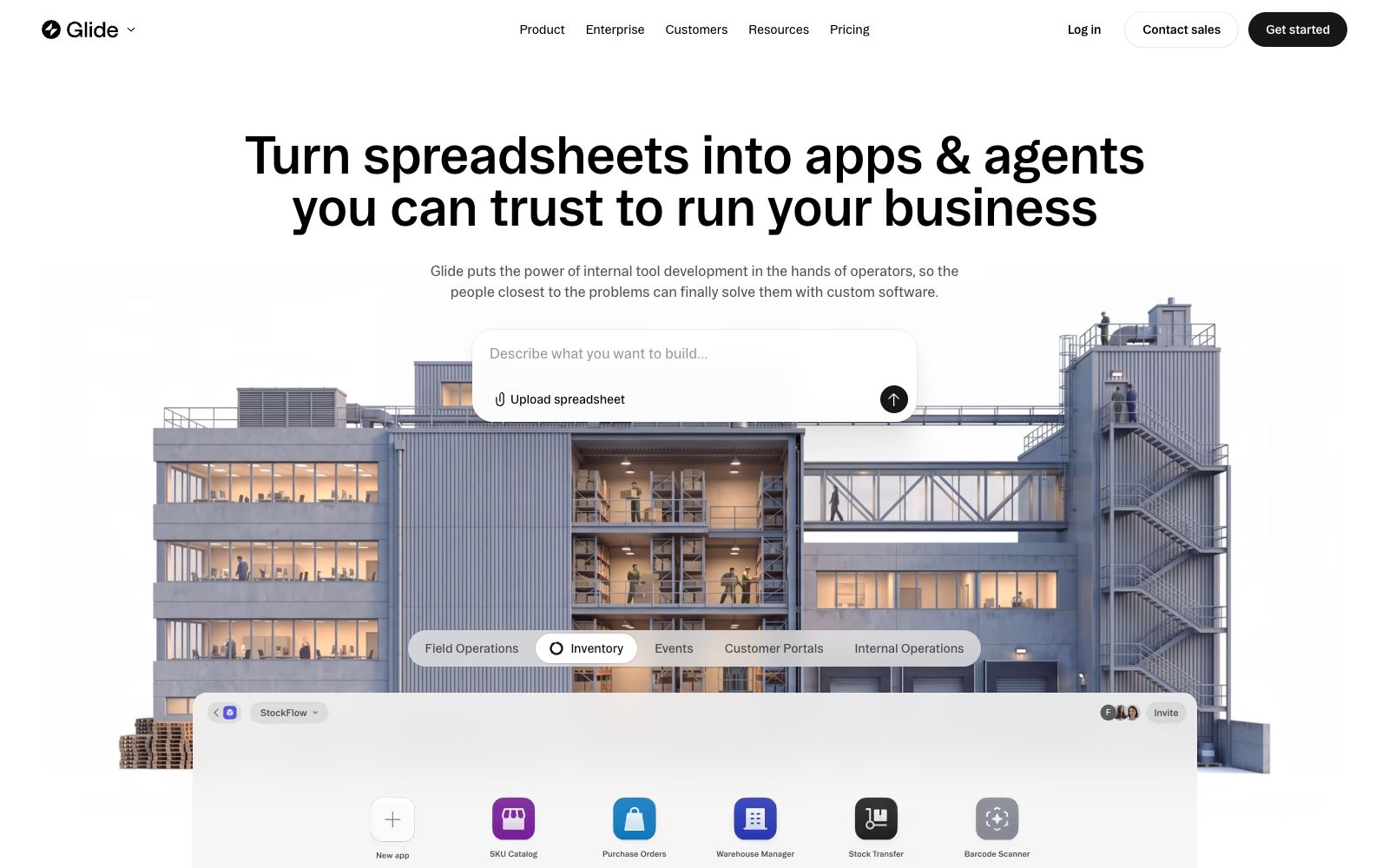
Glide is an AI building tool for enterprise internal applications. The official claims that it can turn spreadsheets into trustworthy business applications and agents, allowing users to get started without development, and it is suitable for frontline personnel to build software by themselves.
Updated: 2026-10-26
What is Glide?
Glide is an AI application building tool for enterprise internal applications, officially positioned as "turning spreadsheets into trusted business applications and agents". It emphasizes that frontline personnel who know the business best can directly use custom software to solve problems without waiting for IT scheduling. It directly turns tables, fields and processes into operable business applications, shortens the distance from idea to launch, and keeps data within the enterprise's own environment.
Who is it for?
- Operations and on-site teams that manage inventory, scheduling, and work orders using spreadsheets.
- Sales and service organizations that need to create exclusive portals for customers or partners.
- Small and medium-sized business owners who want to automate repetitive manual processes.
- Teams without development resources who are unwilling to purchase separate SaaS for every need.
- Field operation teams that need on-site data entry and real-time synchronization with the backend.
- Service providers who want to open query and self-service operation access to customers but are afraid of leaking full data.
Key features
10Table to App
Upload a spreadsheet or connect existing tools to generate an app without rebuilding the data structure.
Multi-device Views
Provide appropriate views and permission scopes for employees, managers, customers, and partners respectively.
Ask Glide
Ask business data in natural language and perform operations directly within the application, instead of just viewing reports.
Real-time Synchronization
A change made in one place triggers automatic updates for all associated applications, preventing inconsistencies across multiple spreadsheets.
Start with Templates
Modify ready-made templates to align with your own processes, shortening the distance from idea to launch.
Data Control
The company states that business data remains within the enterprise, making it easier to meet compliance and audit requirements.
Cross-device Collaboration
Field teams use mobile apps, management views dashboards, and customers access portals, all sharing the same data source.
Updates Take Effect Anywhere
The official statement says that changing a single record or status will trigger automatic updates across all associated applications.
GlideOS
After uploading or connecting data, the platform understands the structure, relationships and logic to generate applications.
Business-savvy Teams
The official positioning empowers those who know the business best to solve software problems on their own.
How to use Glide
- 1Start with a real business table to validate the data structure before expanding to more applications.
- 2Set the minimum visible fields for different roles to prevent sensitive data from leaking to external users.
- 3When handling paid or customer data, confirm the data storage region and commercial authorization scope.
- 4Platform permissions and integration capabilities are subject to change; review the official documentation again before connecting critical systems.
- 5When multiple applications share data, first define a single data source and field standards to avoid inconsistencies in statistics across different platforms.
Traffic & popularity
Data month Sep 2026
Glide receives about 1.4M visits per month and ranks #31,997 worldwide.
Monthly visits
12 monthsTraffic sources
- Direct56.4%
- Search26.8%
- Referrals7.1%
- Social3.9%
- Mail2.9%
- Other2.9%
Top countries
- United States19.2%
- Spain6.8%
- France5.9%
- India5.6%
- Ghana5.3%
Estimated from third-party traffic data.
Similar tools
 SoftrSoftr is a no-code AI business application platform. Officially, it enables the creation of secure portals and internal tools without development, featuring a built-in database, workflows, and fine-grained permissions, as well as integration with data sources such as Airtable.
 UI BakeryUI Bakery is a no-code internal tool building platform. Officially, it enables the rapid creation of secure and reliable internal applications, supports connection to more than 45 data sources, and offers MCP and code export capabilities, making it suitable for enterprises with compliance and sensitivity requirements.
 BudibaseAn open-source internal tool and AI agent platform that enables the building of applications, data tables and automated processes, handles employee requests, approval workflows and support ticket classification. The official claims to support self-hosting.
 ThunkableThis AI tool for building native mobile apps with Dialogflow Vscode, as officially stated, can create iOS and Android apps and publish them directly to the App Store and Google Play.
 BuildAIA conversational no-code AI application building platform with built-in databases, user management, and paid subscriptions. The official claims that it can turn ideas into applications that can be launched on your own domain within minutes, and it also provides digital employee capabilities.
 Jet AdminA business application development platform built on existing data sources: its official website states that it can integrate with over 200 data sources including Postgres, MySQL, MongoDB, Supabase, and Airtable. It automatically generates backends and APIs, and comes with built-in SSO, role-based access control, and audit logs.