


DeepTech
An AI for Science enterprise, officially stating that it takes DeepShine·Yuzhi Scientific Discovery Intelligent Engine as the foundation, builds tools such as Bohr Scientific Navigation and Lebesgue Intelligent Computing and scientific intelligent agents, targeting basic scientific research and drug and material R&D.
Updated: 2026-10-26
What is DeepTech?
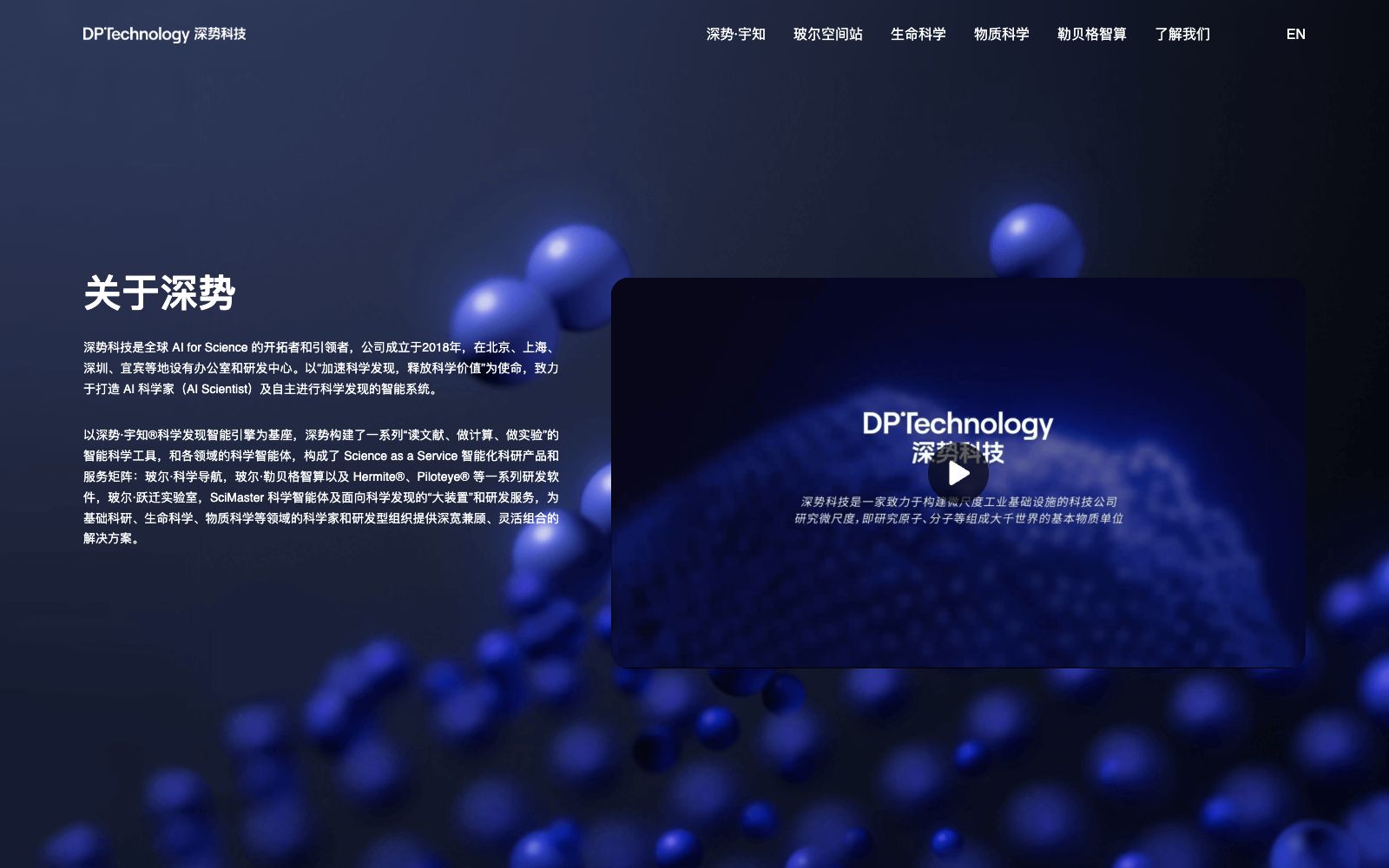
DeepTech was founded in 2018. Its official positioning is as a pioneer and leader in AI for Science, with the mission of "accelerating scientific discovery and unlocking the value of science". It is committed to building AI scientists and intelligent systems that can independently conduct scientific discovery. What it delivers to the outside world is not a single software, but a combination of a set of scientific intelligent tools and intelligent agents constructed around reading literature, performing calculations, and conducting experiments.
Who is it for?
- Researchers in computational chemistry and materials science at universities and research institutes: Replace scattered script workflows with integrated tools.
- Early R&D teams in pharmaceutical companies: Use computational simulations to reduce the number of trial-and-error rounds in experiments.
- R&D departments of battery and new material enterprises: Use micro-scale simulations to guide formula and material selection.
- R&D managers in enterprises: Evaluate the feasibility of introducing scientific computing capabilities in the form of services. Its official mission is to accelerate scientific discovery and unlock the value of science.
- Project teams requiring interdisciplinary collaboration: Enable experimental and computational personnel to share data within the same set of tools.
Key features
6DeepPose · Yuzhi Scientific Discovery Intelligent Engine
Officially described as the foundation of the entire product matrix, it supports three types of scientific tools: literature reading, computational research, and experimentation.
Bohr Science Navigator
Officially described as a tool for scientific literature and knowledge acquisition, helping researchers quickly enter a new field.
Bohr Lebesgue Intelligent Computing
Officially stated to provide scientific computing capabilities to support simulation calculations at the molecular and material levels.
Professional R&D Software
The official offering provides R&D software such as Hermite and Piloteye, tailored for various scientific computing and R&D scenarios.
Scientific Agents
Officially, it provides scientific agents such as SciMaster and the Bohr Transition Lab to independently advance research tasks. It is stated that the tool suite covers the three links of reading literature, performing calculations, and conducting experiments.
Science as a Service
It is officially stated that it forms an intelligent scientific research product and service matrix, providing flexible combination solutions for basic scientific research, life sciences, and physical sciences. The official goal is to build an intelligent system that can independently conduct scientific discovery.
How to use DeepTech
- 1For first access, it is recommended to choose a specific topic with clear boundaries, such as the property prediction of a certain type of molecules, and first complete the closed loop.
- 2The reliability of calculation results depends on the model's applicable domain, and experimental verification should be retained for scenarios beyond the applicable domain.
- 3The team needs to have basic scientific computing literacy; otherwise, the conclusions drawn by the tools cannot be correctly interpreted.
- 4Pay attention to the licensing and billing models for software and computing power, and estimate the costs of long-term computing tasks in advance.
- 5Clearly agree on the ownership of research results and data before cooperation to avoid disputes in subsequent publication and commercialization.
Traffic & popularity
Data month Sep 2026
DeepTech receives about 101.4K visits per month and ranks #301,267 worldwide.
Monthly visits
12 monthsTraffic sources
- Direct50.0%
- Search27.2%
- Referrals22.1%
- AI assistants0.6%
- Social0.1%
Top countries
- China74.7%
- United States12.9%
- Hong Kong, China3.1%
- India2.5%
- Vietnam2.0%
Estimated from third-party traffic data.
Similar tools
 XtalPiAn AI and robotics-driven pharmaceutical R&D platform enterprise, officially stated that it takes Agentic AI as the intelligent hub, uses more than 200 vertical-domain AI models for predictive design, and has laboratory robots complete wet experiments, forming a self-iterative R&D closed loop of dry and wet experiments.
 scienceOSscienceOS is an AI research tool for scientists, offering scientific chat that can converse with 230 million papers, multi-document Q&A with a maximum upload of 4,000 PDFs, and a project management workspace.
 Wolfram|AlphaA computational knowledge engine based on the Wolfram Language and over 35 years of R&D accumulation. Input natural language or mathematical expressions to get expert-level answers and step-by-step solutions, covering four major categories: mathematics, science and technology, society and culture, and daily life.
 Bohr AIBohr is an AI for Science space station for global scientists, offering literature search and structured Q&A, knowledge base dialogue, first draft generation of review articles, manuscript review and scientific figure drawing, along with supporting scientific computing power and experimental resources.
 BioMapA life science large model enterprise, officially stating that it has independently developed the xTrimo basic model and the BioMap OS dry-wet closed-loop discovery system, supports data insights and de novo design, and provides discovery services such as antibodies and proteins to pharmaceutical companies and scientific research institutions.