


Copyleaks
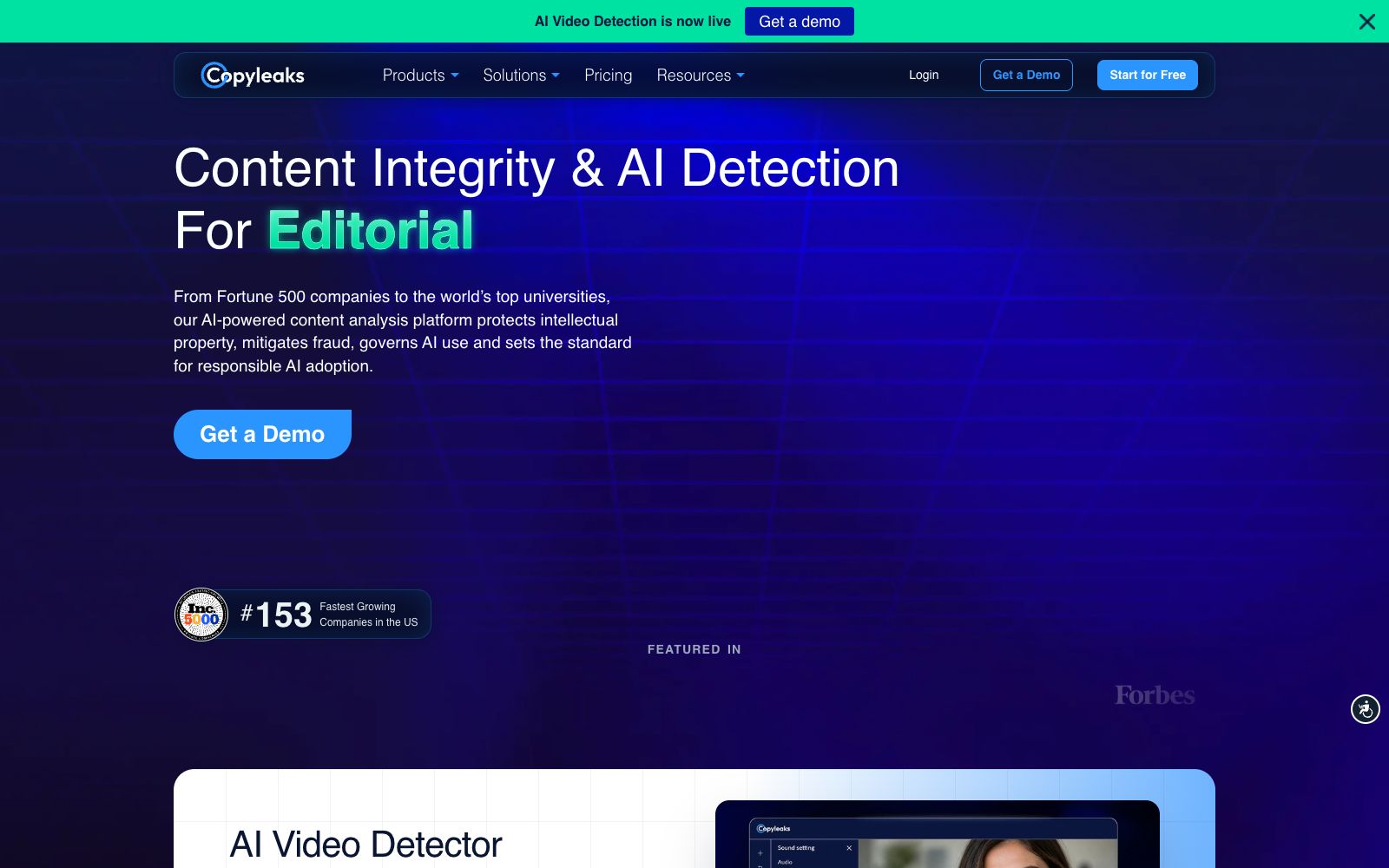
A text authenticity platform for enterprises and educational institutions, offering AI detection, plagiarism check, code plagiarism, and AI video detection. Officially, it supports more than 30 languages with a false positive rate of 0.03%, and can be integrated with various LMS via API.
Updated: 2026-10-26
What is Copyleaks?
Copyleaks is a text authenticity detection platform for enterprises and educational institutions. Its official website positions it as a content integrity suite covering AI detection, plagiarism check, code plagiarism, and AI video detection. Compared with tools that only perform text detection, it has a broader coverage: in addition to text, it provides source code traceability, AI model training data cleaning, and solutions to monitor whether LLMs reference your content. The official claims it supports more than 30 languages, with a false positive rate as low as 0.03%, and it publicly shares language-specific accuracy data on its detection page. It also clearly states that it does not provide "detection evasion"—the official wording is to help users understand AI detection rather than bypass it.
Who is it for?
- Publishers, media outlets and content platforms that need to batch-check originality before publication
- Universities and K-12 school administrators: Integrate LMS to embed AI detection into existing workflows
- R&D and security teams that need to verify whether supplier code contains AI-generated snippets
- Legal and content teams responsible for IP and copyright compliance who need to monitor whether their content is cited by LLMs
- Product teams that need white-label APIs and integrate detection capabilities into their own systems
Key features
6AI Text Detection
The official claims an accuracy rate of over 99% and a false positive rate of 0.03%. It can identify content generated by models such as GPT-5, GPT-4, ChatGPT, Claude, Gemini, DeepSeek, Llama, Bloom, Rytr, and Jasper, and is also capable of processing text that is a mix of AI and human-generated content.
Explainable AI Logic
After subscribing, you can view sentence-level results and the basis for being identified as AI-generated content, and trace back to verifiable sources.
Multilingual and Language-Specific Accuracy
The official website lists data such as 99.97% (human)/99.20% (AI) for English, 99.85%/98.02% for Spanish, 99.94%/95.63% for German, and 99.88%/96.18% for French, and states that it supports Simplified and Traditional Chinese.
Plagiarism and Code Plagiarism Detection
The plagiarism check covers rewritten and paraphrased text; for code, the official states that it can identify modified AI-generated code.
AI Video and Image Detection
The official website states that it provides multimodal detection capabilities covering video, audio, images, and text, with the launched AI Video Detector being prominently promoted on the homepage.
API and LMS Integration
Officially supports APIs, Canvas, D2L, Moodle, Blackboard, Schoology, Edsby, Sakai, as well as Chrome/Edge extensions and Google Docs add-ons.
How to use Copyleaks
- New users have a small amount of free credit.
- It is recommended to first use it to figure out the baseline score of their own content, and then decide whether to adopt a paid plan.
- When viewing the results, prioritize the sentence-level highlights and the basis given by AI Logic, which makes it easier to determine which sentences to revise than just looking at a single total score.
- For multilingual scenarios, pay attention to the language-specific differences officially announced: the AI-based recognition rate for non-English languages is significantly lower than that for human text, and a low score does not mean there are no problems.
- When detecting tools like Grammarly, the official explanation states that basic spelling and grammar modifications will generally not be marked, but generative rewriting functions may trigger alerts.
- When using the results for personnel, academic or contractual determinations, be sure to retain the manual review link.
- pricing, language coverage and compliance certifications (the official website states that it complies with GDPR and has passed SOC 2 and SOC 3) are subject to the current instructions on the official website.
Traffic & popularity
Data month Sep 2026
Copyleaks receives about 1.6M visits per month and ranks #35,408 worldwide.
Monthly visits
12 monthsTraffic sources
- Search62.3%
- Direct25.9%
- Referrals8.5%
- Social1.4%
- AI assistants1.3%
- Other0.6%
Top countries
- United States50.0%
- India6.8%
- Philippines3.5%
- Pakistan2.3%
- Australia2.1%
Estimated from third-party traffic data.
Similar tools
 Winston AIAn AI content detection tool for education, publishing and SEO teams, with an official accuracy rate of 99.98%; it supports OCR recognition of scanned documents, sentence-by-sentence prediction graphs, plagiarism check and AI image detection, and can generate shareable authenticity reports.
 PhraslyAn online tool that provides free AI detection and plagiarism check, the official website claims that its accuracy in detecting text generated by mainstream models reaches 99.8%, with no word limit, results generated in seconds, and specific sentences triggering detection will be highlighted.
 IsGen.aiA multilingual AI content detection tool, the official claims it supports more than 80 languages and covers Chinese scenarios. It provides sentence-level and phrase-level analysis, plagiarism detection and grammar checking, along with batch scanning and report generation.
 NoPlagioNoPlagio is a plagiarism and AI detection tool for Italian-speaking users. Its official website states that it supports plagiarism check for 129 languages and their translations, and marks rewrites, citations and similar fragments with different colors.
 uPass AIuPass AI is an AI detection and text rewriting tool for students. Officially, it claims to make rewritten text harder to detect while reducing repetition rates, and it aggregates results from multiple detectors for self-checks.
 Smodin AI DetectorThe AI content detection tool under Smodin, according to its official website, can identify text generated by mainstream models, covers more than 100 languages, and supports pasting text or uploading documents for quick scanning and providing probability scores.