


Augment Code
Focusing on an organization-scale intelligent agent software development platform, the official core product is a continuous delivery system that links the entire process from requirements to launch, and is equipped with automated links such as code review, vulnerability repair, and incident response.
Updated: 2026-10-26
What is Augment Code?
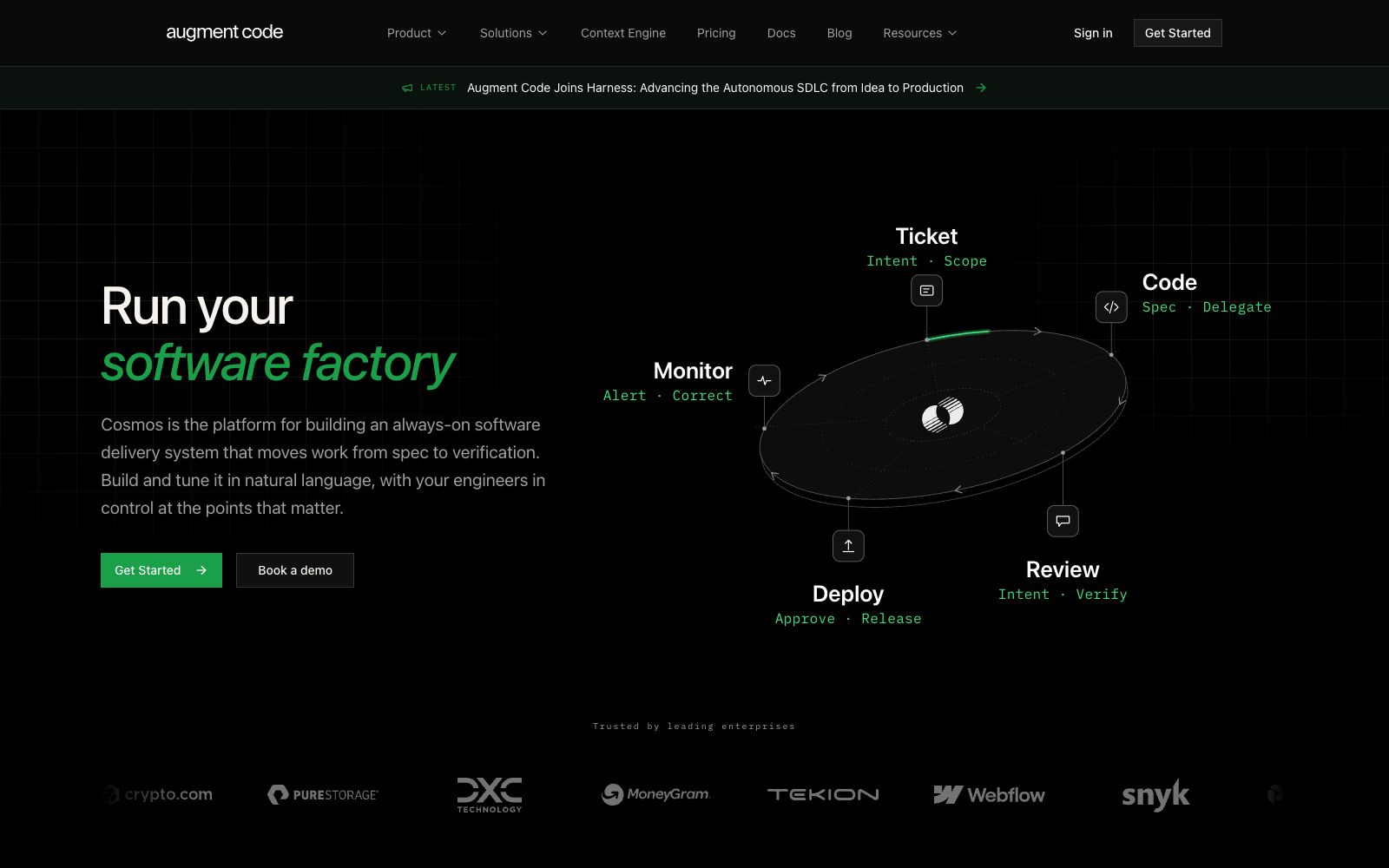
Augment Code is oriented towards "organizational-level" intelligence rather than that of individual engineers. The official website states it directly: Your engineers already have intelligent agents, but your organization does not, and Cosmos is the platform that fills this gap. It breaks down a single delivery into a complete loop from requirements to validation, aiming to build an always-online software delivery system.
Who is it for?
- Engineering leaders who have equipped individuals with coding assistants but have not yet established organization-level delivery pipelines.
- Technical teams with years of technical debt who need to regularize large-scale transformations such as framework upgrades.
- Platform teams under significant security and stability pressure who want to block errors and omissions at the review stage.
- Team managers who want to codify the work methods of top performers into the default workflow for the entire team.
Key features
7Run your software factory
The official website states that you can build and debug the delivery system using natural language, while retaining engineers' control over key nodes.
Full Closed Loop
The official website outlines the process as five stages: scoping requirements, assigning coding per specifications, validating intent, approving release, and monitoring alerts for error correction.
Code Review and Test Coverage
Every merge request is automatically reviewed by an agent, and test coverage metrics are continuously maintained by machines.
Ticket to PR
Directly generate reviewed merge requests from tickets.
Vulnerability remediation and Incident Management
From security alerts to remediation plans, and troubleshoot alerts before human intervention.
Migrations and Large Projects
Large-scale transformations are advanced in the form of long-term projects rather than one-off sprints.
Start from anything, Run anywhere, Expertise as an asset
A design principle mentioned on the official website, emphasizing that it can accept any input and run in any environment.
How to use Augment Code
- 1Start with the most painful link, such as automated review or security remediation, and get it fully operational before expanding to the entire process.
- 2The intelligent agent's automatic review must have a clear source of rules, otherwise the standards will not be aligned with those of manual review.
- 3The official news section mentions that the company has been acquired by another platform. Confirm whether the existing product roadmap and support policies are affected before making a purchase.
- 4Embed the "control points for humans" into the process in advance, and do not let changes made by the agent directly fall into the production branch.
- 5Large-scale migration tasks are costly; first verify the output quality in small batches before deciding to roll out on a large scale.
- 6The package, available capabilities and support methods may be adjusted; recheck the official website before formal deployment.
Traffic & popularity
Data month Sep 2026
Augment Code receives about 134.9K visits per month and ranks #313,825 worldwide.
Monthly visits
12 monthsTraffic sources
- Direct46.8%
- Search39.3%
- Referrals6.8%
- Social3.7%
- AI assistants2.2%
- Other1.2%
Top countries
- United States20.0%
- India14.8%
- United Kingdom8.7%
- Canada6.7%
- Czech Republic4.5%
Estimated from third-party traffic data.
Similar tools
 KodusOpen-source self-hostable AI code review tool, officially claiming that you can use your own model keys with no markup, unlimited PRs, the ability to identify issues across files and enforce team-specific custom rules.
 AgenticReviewAgenticReview evaluates how effectively teams guide AI agents, extending assessment beyond code quality, security, and testing. According to the company, its benchmark spans more than 30 million commits and approximately 100,000 repositories, reflecting real-world development at scale.
 Forge CodeA team-oriented software factory, officially stated that once configured, it can trigger tasks by defects, Slack discussions or alerts, automatically complete building, testing, deployment and continuous monitoring, and recover from checkpoints after a crash.
 LispaLispa is the cloud control plane for coding agents. It integrates Claude Code, Codex, Grok and Gemini into a single workspace. After the agent tasks are built and tested in the cloud, the results are viewed and merged through a browser.
 ZoahZoah is a full-stack software development platform, and its official website states that design, building and deployment can be completed in one place. The canvas is based on the real DOM, and what you draw is the production code; the Interfacer and Operators agents continuously improve the product, and the Operand framework is built into every application, covering scenarios from prototyping to large-scale operation.
 GitLab DuoGitLab Duo is an AI agent platform covering the entire software lifecycle. It integrates agents for planning, coding, security and deployment, and comes with enterprise-grade governance and self-hosted models, making it suitable for teams already using GitLab.