


Native Soil
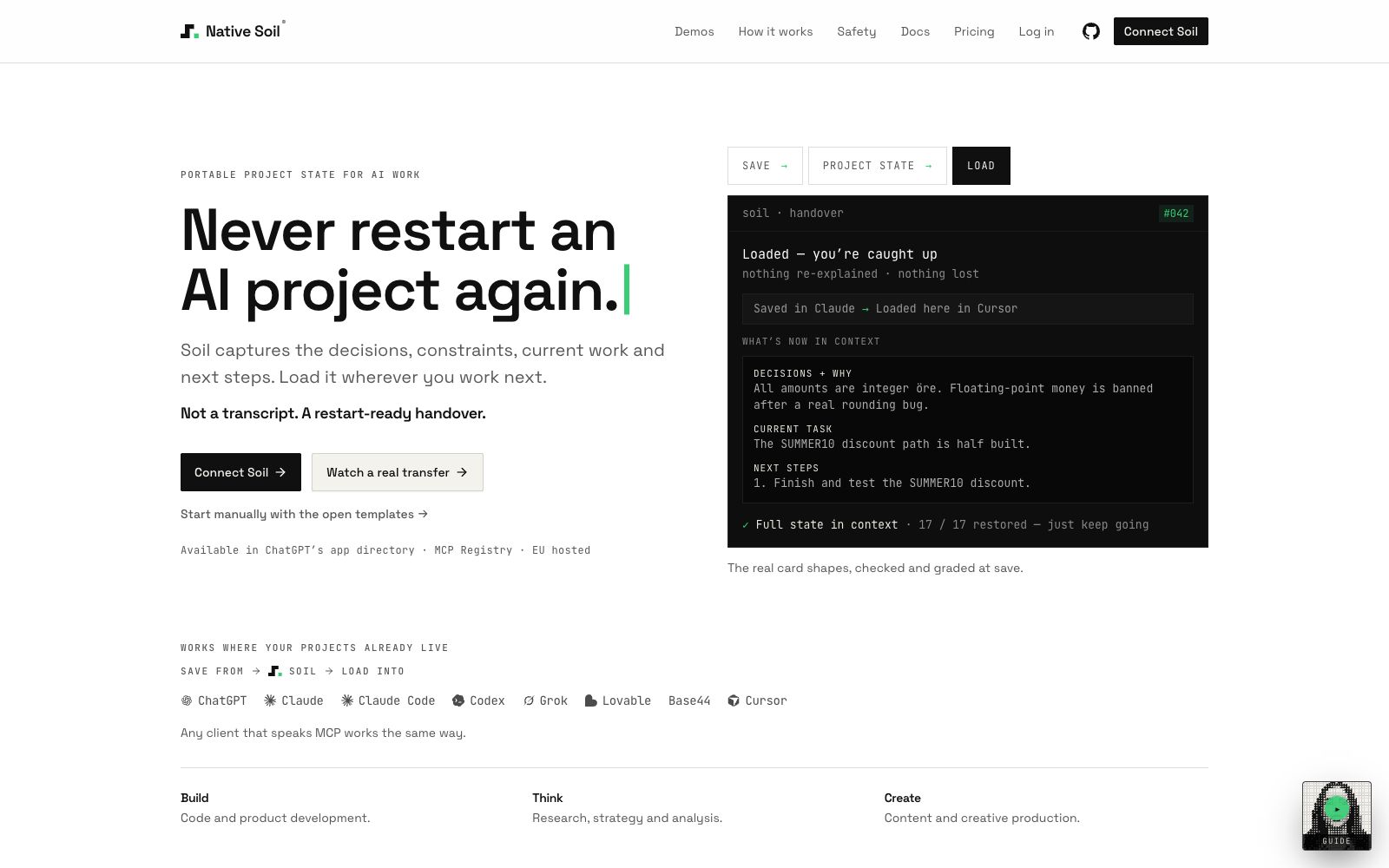
Native Soil is a workflow state handoff layer for AI projects: it saves decisions, constraints, current tasks, and next steps. After inspection, scoring, and desensitization, it generates a 17-section Markdown handoff that can be reloaded in other models and clients.
Updated: 2026-10-27
What is Native Soil?
The official website of Native Soil summarizes its products as "Save here. Load anywhere": what it saves is not the complete chat history, but the project state that allows the next model to continue working. The official website states that these states include 17 parts in total, such as decisions and their justifications, constraints, rejected paths, current tasks, blocking items, next steps, and source annotations. It is targeted at AI projects that switch between multiple models, clients, and service providers, with the goal of reducing the cost of reinterpreting backgrounds and reconstructing contexts.
Who is it for?
- Developers who use multiple AI clients simultaneously and often migrate coding, research, or content projects between models.
- Engineering teams that need to hand over project decisions, rejected solutions, and next steps to colleagues.
- Users who want handover files to be readable, diffable, and storable long-term, rather than relying on the built-in memory of a specific platform.
- Teams that are sensitive to credentials, paths and private context and prefer to run locally first before evaluating the cloud version.
Key features
6Structured Restart State
The official website states that each save extracts 17 sections to form a readable Markdown handover, instead of simply copying a large number of messages to the next model.
Pre-save Check
The official website states that before saving, it checks structure, completeness, security, and source, and assigns a score; the score is described as a prediction and does not guarantee zero loss.
Secret Stripping
The official website explicitly states "secrets stripped" in both the title and product description, and also mentions in the self-hosted version description that credentials are directly rejected.
Cross-client Loading
The official website states that saving and loading are available from ChatGPT, Claude, Claude Code, Codex, Cursor, etc., and claims that any client supporting MCP works in the same way.
Open-source Local Execution
The official website states that it is open-sourced under the Apache 2.0 license, providing a CLI, MCP, and SDK. When run locally, there are no accounts, no network requirements, and no telemetry, with data remaining on your own machine.
Cloud Extension
The official website states that the Cloud version adds login functionality available on web and mobile, project knowledge accumulation, loading result metrics, a dashboard, and invitable team projects.
How to use Native Soil
- 1First, run a complete save and cold load with the open-source template or local MCP to confirm whether the 17-section structure covers your project type.
- 2Clarify major decisions and rejected paths; what is often most valuable during recovery is why a particular path was not taken.
- 3Check the security summary before saving to ensure there are no credentials, internal paths, or other content that should not be transferred across tools.
- 4The official website for the free version states that a maximum of 500 personal handovers can be saved simultaneously, with the quota released upon deletion; team collaboration and project knowledge are Pro features.
- 5Do not treat the score as a guarantee of results; after loading, perform a recall check using your own decision checklist first.
Traffic & popularity
Data month Sep 2026
Native Soil receives about 1.2K visits per month and ranks #13,159,626 worldwide.
Monthly visits
8 monthsTraffic sources
- Direct78.7%
- Search10.2%
- Referrals5.8%
- Social2.1%
- Mail1.3%
- Other1.9%
Top countries
- Brazil100.0%
Estimated from third-party traffic data.
In these collections
Similar tools
 DyadA free and open-source desktop AI application builder. You can generate a fully functional full-stack project that can be run directly by describing your ideas. The code is entirely stored on your local machine and can be exported freely. It supports connecting to multiple model providers on your own and also supports local models.
 remioA local-first personal AI assistant and knowledge base for knowledge workers, which automatically aggregates web pages, meetings, emails and documents for unified retrieval and answering, can generate editable presentations, and supports self-contained models and mainstream international models.